
Featured Posts

Some Of My Favorite Lawrence Gowing Quotes
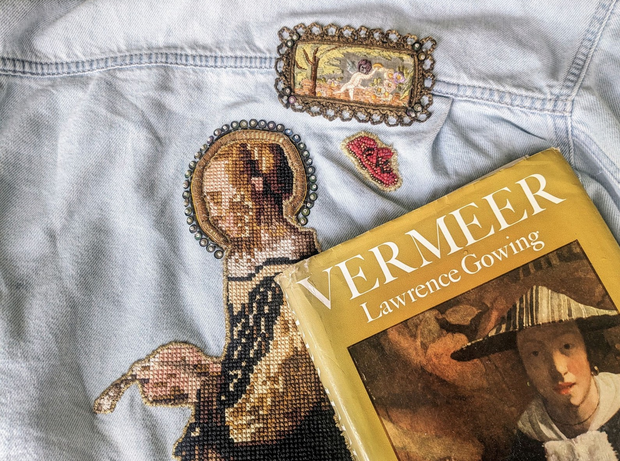
Lawrence Gowing’s 1952 book Vermeer has been such a powerful inspiration on my work. Influencing both the materials I used and the paintings I chose to replicate; the Pixelated Pearl Vermeer series would literally not exist without his writings. But it’s a bit of a black hole online. While there are references to, and scans of, the book, there aren’t a lot of quote excerpts, especially around the pearl picture concept. So here is a collection of my favorite Lawrence Gowing quotes about Vermeer and his pearl pictures.
“Thus it comes about that we see Vermeer building the ideal shape of domestic and feminine life. The representation, the construing ever more closely of the aspect of the beloved as it moulds her mask of light, is also an independent, intact construction of the essential forms of female being, in their permanence.” — Lawrence Gowing, 1952, Vermeer
This is the particular theme of the pearl pictures, a gentile stillness of stature. The shape is vertical. The figure appears, tender and immaculate, out of the cleft shadow of the cumbrous furniture; it is rooted in it, rooted, as we see at last, utterly unmoving, to the floor. And beside this upright shape, this pillar, we come to know another, its antithesis that nevertheless easily and equally combines with it. It is the shape of a bell. It is noticed as the shape of the raised skirt in The Music Lesson. More essentially we remember it as the shape of rounded shoulders which is often the stooping shape of preoccupation, of a woman bent attentively over a table. It is a feminine self possession…” — Lawrence Gowing, 1952, Vermeer
“It seems as if he was of a god-like detachment, more balanced, more civilized, more accomplished, and more immune from the infection of his time than any painter before or since. Or else he was of a naivety beyond belief, all eye and nothing else, a deaf-mute painter perhaps, almost an idiot in the lack of any of the mental furniture that normally clutters the passage between eye and hand, a walking retina drilled like a machine.” — Lawrence Gowing, 1952, Vermeer
“… incident and material have evaporated and light is the sole active principle that remains within the confines of the picture. The window itself has a new significance. The inhabitants of the room turn to it as to the source of their being: its light recreates them.” — Lawrence Gowing, 1952, Vermeer
“Yet her distance remains; with gentle firmness the impartial tones convey it. Tangled defences are woven about her: she is enclosed in the impenetrable envelope of space. We have come upon female life in its whole secluded richness: engrossed in itself it is seen entire and unimpaired.” — Lawrence Gowing, 1952, Vermeer
The Pearl and the Pixel
Despite being addicted to my smartphone, I am, at my core, an analogue creature. I have no allegiance to this digital dopamine dispenser. It’s just a means towards an end, towards a preferred neurotransmitter. Perhaps this lack of fealty to my various glowing screens is part of why I, personally, have never felt the pull of digital art. Oh, I get the appeal. I’m just too busy playing in the dirt for it to capture my attention for long.
Despite being addicted to my smartphone, I am, at my core, an analogue creature. I have no allegiance to this digital dopamine dispenser. It’s just a means towards an end, towards a preferred neurotransmitter. Perhaps this lack of fealty to my various glowing screens is part of why I, personally, have never felt the pull of digital art. Oh, I get the appeal. I’m just too busy playing in the dirt for it to capture my attention for long.
But the deeper I go into the works of Vermeer, the more I have been thinking about technologies and toolings. And of course, in my contrarian and luddite way, their opposites. Why? Because Vermeer is one of the earliest artists associated with assistive drawing technologies.
Did he or didn’t he
Their whispers bouncing
softly, inappropriately
off the Do Not Touch sign
on the museum walls.
Did he or didn’t he
they inked with keyboards and quills
into journals unread, collecting dust
in the academic halls.
Ever since Vermeer’s work was rediscovered in the 19th century, the question of whether he did or did not use a camera obscura has been a point of much academic contention. A clever little device – where light passes through an aperture in a darkened box or room, projecting an image (upside down) onto the inside – the camera obscura is considered a forerunner of the camera and the optical aesthetic we associate with photography today.
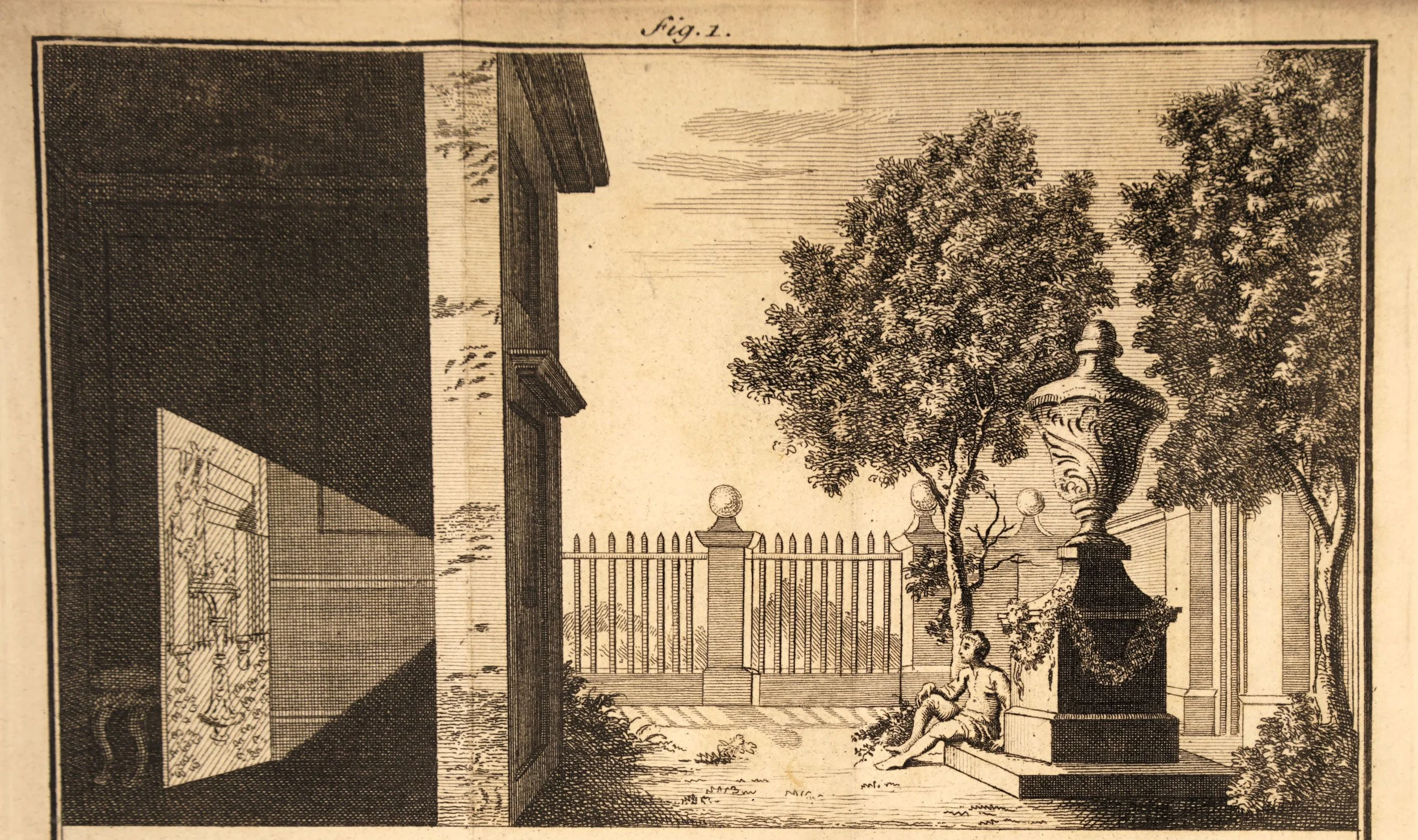
Some people see this optical aesthetic in Vermeer’s work – in the planes of focus, the pointillé highlights, the relative detail in how objects and figures are rendered, and the precise reflections and even more precise lines of his perspective. Painted over two hundred years before the invention of photography, it’s assumed this optical influence could only have come from the camera obscura.
But did he actually use one? And if so, did he use it for direct tracing or simply for aesthetic inspiration? They were certainly in circulation in the Netherlands in his time, albeit largely as a scientific curiosity. And while it’s been said that several of his contemporaries were introduced to it, there is scant proof that they were actually in use in the arts. Hell, Vermeer’s paintings are riddled with tiny pricks – evidence that he was using pins and strings to map his perspective. A crude method that would not have been necessary had he been using an optical device to outline his figures.
In the end, I do not really have an opinion on whether he did or did not use a camera obscura. I don’t find the question nearly as fascinating as what the techno-reverence behind it says about our larger relationship to art. This is the energy I have tried to bring to the Pixelated Pearl Vermeers.

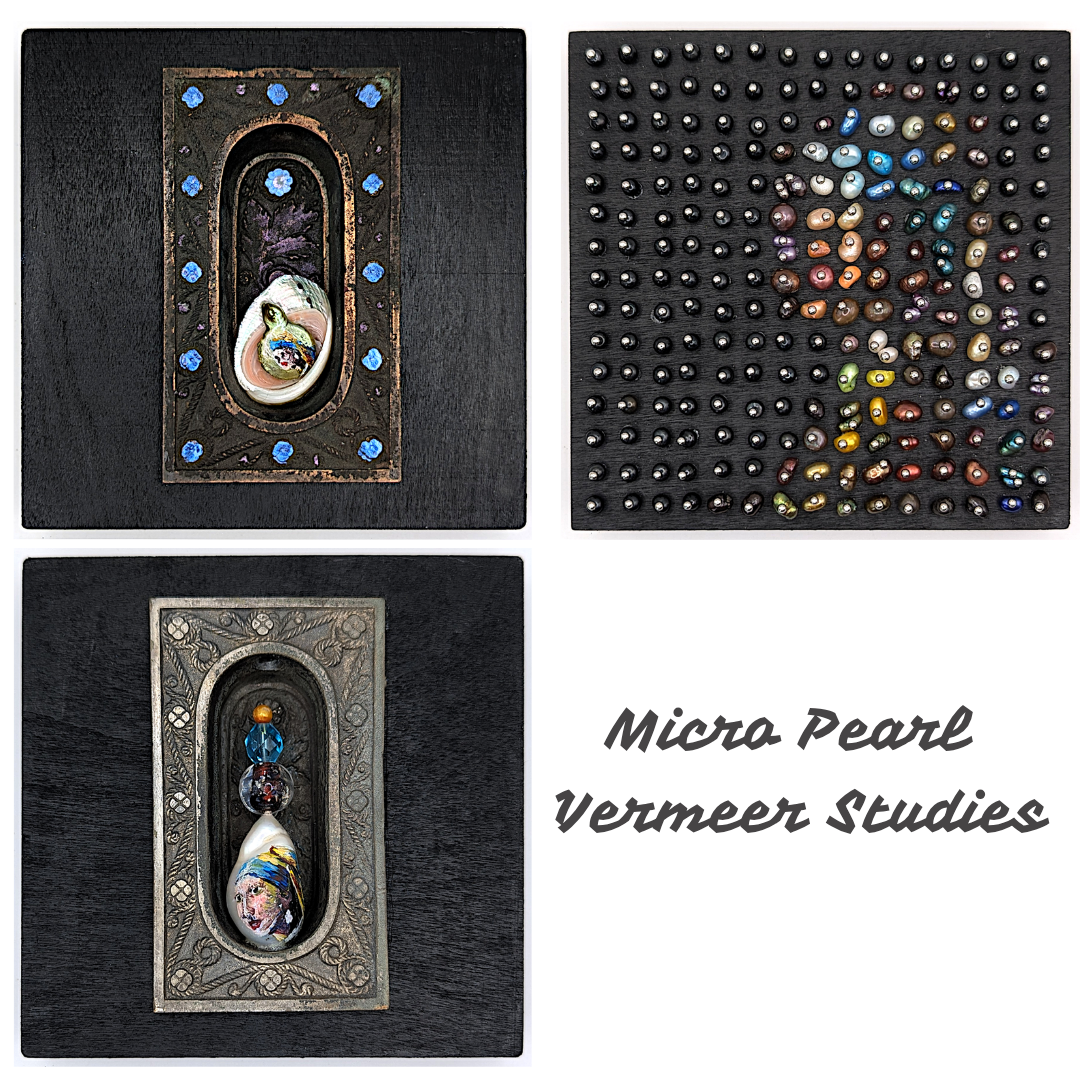
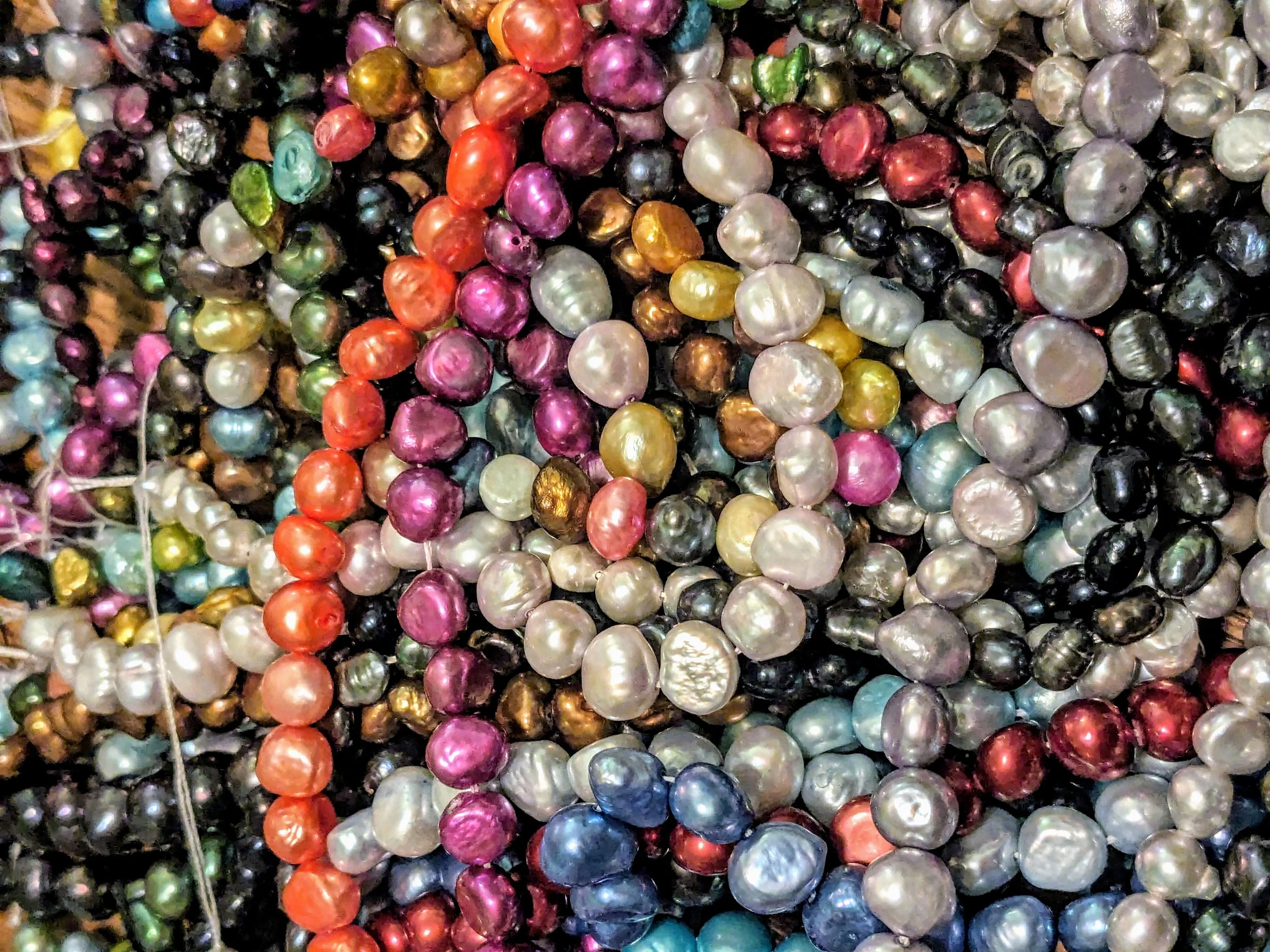
These are purposefully pixel art pieces. Not pointillism pieces – but pixel art pieces with all the digital connotations that word implies. To make them I find photos of the originals on the web and feed them into GIMP, using the software to pixelate them. These pixel art renditions are then printed out and used as the guide for choosing, placing, and pinning the pearls.
1 pixel = 1 pearl.
A laborious, expensive, and aggressively physical method of reinterpreting the computer’s output. Like Vermeer and the camera obscura, yes, I could do this whole process by hand. The computer is not necessary in this equation, but I like the creative parallels to Vermeer’s mythos and the way it brings a symmetry to the long and twisted digital paths his pieces have walked.
For the camera obscura introduced 17th century artists to a new aesthetic. To a new visual language of light and lines and focus that they then translated onto canvas. A three-dimensional subject rendered flat by the lens and then reinterpreted a second, equally flat time by brush and paint. My process continues that chain of dimensional custody, but inverts it at the last step. Tripping through a cascade of 2D renditions, only to thrust the subject back into the 3D world at the very end.
Subject – Camera Obscura – Painting — Photograph – Digital Image – Pixelated Image – Printed Image – Subject
Pearls annihilate the digital object by returning its volume, its substance. Bookending all those bytes and brushstrokes in the firm embrace of the real. Unabashedly corporeal, they thumb their nose at the digital world by using it to undermine itself.
Also, they’re just really fucking pretty.
Mona Lisa of the North
The source of Vermeer’s artistic mastery lies in the interplay of The Girl’s features with one another and with us the viewer. In the way our eyes travel across her face, looping her features deep into our brain like a particularly catchy radio jingle. Her penetrating gaze, her sly smile, her lack of eyebrows, her puzzling backstory, her talented but un-prolific creator, her modern day over-commercialization…
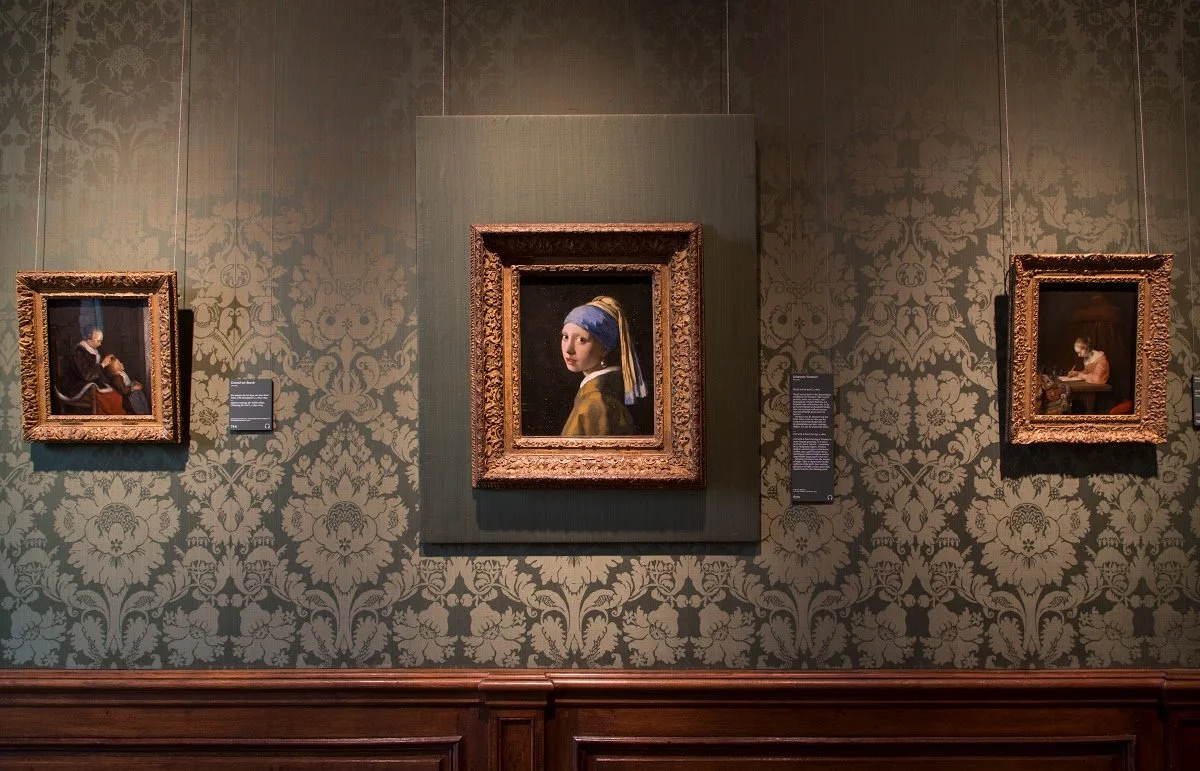
Girl with a Pearl Earring has many nicknames but none more telling than “the Mona Lisa of the North.” Part backhanded artistic compliment and part acknowledgement of the power of a mysterious smile, this nickname nonetheless positions Vermeer’s painting as one of the most important art pieces never louted for the Louvre.
Painted in Delft in 1665, Vermeer’s Girl with a Pearl Earring is a masterpiece of the Dutch Golden Age. While by no means my favorite Vermeer, she is definitely The Vermeer that his legacy hangs upon. A gorgeous portrait of a nameless girl wearing a turkish turban and an ostentatious pearl earring, it’s one of four surviving “tronies” painted by Vermeer.
Now tronies are a bit like obscenity - hard to define but you’ll know them when you see them. Neither portraits nor caricatures, they’re more akin to a character study. For tronies focus on physical qualities and expressions over the identity of specific, identifiable sitters. Coming after an era where most art was a political endeavour commissioned by churches and kings, this was quite the novel artistic development.
“The main goal of the artists who created tronies was to achieve a lifelike representation of the figures and to show off their illusionistic abilities through the free use of color, strong light contrasts, or a peculiar color scheme.Tronies embodied abstract notions such as transience, youth, and old age, but could also function as positive or negative examples of human qualities, such as wisdom, strength, piety, folly, or impulsiveness.” - Wikipedia
A distinctly “Low Country” tradition, by Rembrandt’s time in the early 1600’s a lucrative tronie market had developed and every Tom, Dick, and Jan was creating them. And while Rembrandt painted quite a few himself, his name is not pinned to the genre in quite the same way as Vermeer’s. Which is slightly ironic, for, as I mentioned, Vermeer painted only four of them.

But what a four they are! Hell, throw out the other three and Girl with a Pearl Earring is still a show-stopping, reputation-earning, tour de force amongst the genre. Painted in striking chiaroscuro with liberal use of ultra-expensive ultramarine pigments, Girl with a Pearl Earring absolutely captivates the viewer. I’ve heard you can watch people at the Mauritshuis lose their composure in front of her. Moved to cultural and aesthetic rapture as they make eye contact across the safety glass. Without the Louvre’s crowd control trappings (not to mention the crowds that have justified them), it’s still possible to sneak an intimate moment with her. Something untrue of the Mona Lisa for several decades now.
There’s a quote attributed to Girl With A Pearl Earring author Tracy Chevalier that I find apt when discussing the Mona Lisa comparisons.
“The image works because it is unresolved… You can’t ever answer the question of what she’s thinking or how she’s feeling. If it were resolved, then you’d move onto the next painting. But it isn’t, so you turn back to it again and again, trying to unlock that mystery. That’s what all masterpieces do: we long to understand them, but we never will.”
A mystery is continually in motion. In both the Mona Lisa and The Girl there’s a delicate triangulation between the eyes and the smile (and the earring) that moves our vision across the canvas. Back and forth, back and forth, our sight jumps between the features without resolution. Is the power of this art in her eyes? In her lips? In the slight dimpling of her checks? We fail to find a singular repository for the True Artistry Of The Work® because it resides in the gyrations of our eyesight, not in any surgically atomized facial feature.

The source of Vermeer’s artistic mastery lies in the interplay of The Girl’s features with one another and with us the viewer. In the way our eyes travel across her face, looping her features deep into our brain like a particularly catchy radio jingle. Her penetrating gaze, her sly smile, her lack of eyebrows, her puzzling backstory, her talented but un-prolific creator, her modern day over-commercialization…
Fine. The comparisons to the Mona Lisa might run more than skin deep. Or should I say, the comparisons to The Girl with a Pearl Earring of the South run more than skin deep. :P
The Pearl Pictures -- An Extended Cinematic Universe
One of the 20th century’s leading Vermeer experts was the English artist and writer Lawrence Gowing. Knowledgeable on both Vermeer’s historical and artistic context, one of Gowing’s most noteworthy contributions to The Discourse was defining the concept of the “pearl pictures” within Vermeer’s work.
“This is the particular theme of the pearl pictures, a gentle stillness of stature. The shape is vertical. The figure appears, tender and immaculate, out of the cleft shadow of the cumbrous furniture; it is rooted in it, rooted, as we see at last, utterly unmoving, to the floor. And besides this upright shape, this pillar, we come to know another, its antithesis that nevertheless easily and equally combines with it. It is the shape of a bell... More essentially we remember it as the shape of rounded shoulders which is often the stooping shape of preoccupation, of a woman bent attentively over a table. It has a feminine quality of self-possession..." - Lawrence Gowing Vermeer, Oakland CA: University of California Press
One of the 20th century’s leading Vermeer experts was the English artist and writer Lawrence Gowing. Knowledgeable on both Vermeer’s historical and artistic context, one of Gowing’s most noteworthy contributions to The Discourse was defining the concept of the “pearl pictures” within Vermeer’s work.
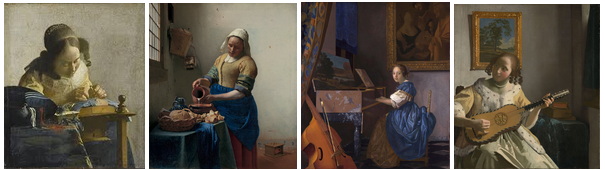
Named for their luminous approach to light, the “pearl pictures” are a group of Vermeer’s mid-career paintings noted for their similar subject matter and composition. They each feature a single woman at a table, facing a window in the left-hand corner of a room, engaging in a discreet activity, while either wearing or handling pearls.
Goring would initially identify four quintessential pearl pictures - Woman Reading a Letter, Woman with a Pearl Necklace, Woman Holding a Balance, and Woman with a Lute. Other scholars often group Woman Reading a Letter at an Open Window and Woman with a Water Pitcher into the pearl pictures, although their inclusion is not universally agreed upon.


Now, when I say that I’m a Vermeer fangirl, what I really mean is that I’m a pearl picture fangirl. Like Gowing, I am captivated by this series and its extended cinematic universe. All those bell-shaped women, like bowed tulips, gracing the canvas with their quiet introspection and soft self composure. Through repetition, you can watch as Vermeer hones his craft across the series. Whittling his visual language down to a precise, pointed simplicity.
“Even by Vermeer's standards, the scenes of these works are organized with exceptional economy utilizing a table with a single woman, a meager still life, a few carefully chosen props, a map or painting on the background wall and one or two chairs”
This is the apex of Vermeer’s art. The pearl pictures feel like individual celluloid frames clipped from a film reel. They are the pregnant pause preceding the action. A woman lost in her internal world, depicted in the half-second before the viewer’s entrance upon the scene. In them one can anticipate the interruption, the broken concentration to come. How the angles of her body and face, startled out of their self reflection, will snap back like a rubber band. Shifting their orientation under the requirements of a woman being perceived.
The way Vermeer captures this moment before the re/action feels intimate, familiar and also ripe for a feminist reading. And so the pearl pieces have become the centerpiece of my Vermeer studies.
In the art studio, bent over my work table by the window, I toil alone with my pearls and my pictures. A paper bell, a silk tulip, I pantomime the actions of Vermeer’s solitary female figures, perfecting them through my own repetitions. I feel a deep kinship with them. Yes, much of it is rooted in our shared gender. But there is an important divergence – I identify with the subjects of the pearl pictures because being an immigrant is a terribly lonely business and I see myself in their solitude and self containment.
In a way, my Vermeer studies are a pregnant pause of sorts. They represent the moment between being an American artist and an American-Dutch artist. The lonely, solipsistic work of figuring out who I am and what I want to create in this new place. I am the half-second before the re/action. Waiting for what comes next in this journey of making art in the Netherlands.

Tot ziens!
🎨🎨🎨
Of Sphinxes and Pearls - An Exploration of the Works of Johannes Vermeer
Johannes Vermeer, that famous painter of Dutch interiors and Dutch interior life, is one of the most elusive sphinxes of the art world. So much so that he is often known as “the Sphinx of Delft” due to the mysteries shrouding his life and practice. There are no notebooks, no journals, no sketches, no resumes or work histories, no early or in-progress works, and few contemporaneous accounts. His story is but conjectures wrapped in myths wrapped in legends, as all that’s survived are 36 paintings and the scantest of biographical details.
“A legend grows around a grain of truth, like a pearl.”– Peter S. Beagle
A painter without an origin story is but a sphinx without a riddle. In the realm of myth, the sphinx’s riddle is the source of her power, the vehicle she uses to send tongue tied travelers to their deaths. If she loses or lacks a riddle, her ferocity is reduced to the level of a declawed housecat mewling for more milk. Therefore, to call someone a riddle-less sphinx is to point at their hollowness without fear. To call out their toothlessness with a full throated and pearly white grin.
“You cannot kill me in any way that matters.”
“You cannot make art in any way that matters.”
Johannes Vermeer, that famous painter of Dutch interiors and Dutch interior life, is one of the most elusive sphinxes of the art world. So much so that he is often known as “the Sphinx of Delft” due to the mysteries shrouding his life and practice. There are no notebooks, no journals, no sketches, no resumes or work histories, no early or in-progress works, and few contemporaneous accounts. His story is but conjectures wrapped in myths wrapped in legends, as all that’s survived are 36 paintings and the scantest of biographical details.
The sphinx sits and paints
Tall as the crooked church leans
Against delft blue skies
Which makes it difficult to infer concrete biographical meaning in his work. Who and why and how Vermeer painted; all this information has been lost to the sands of time. In fact, for two centuries his work also languished in obscurity– attributed to other, more famous artists – only to be plucked from anonymity by Théophile Thoré-Bürger’s scholarly excavations. So without a biographical lens onto Vermeer’s work, how can we answer their riddles and come to understand his origin stories? Through his historical context.
The cut and cloth of a dress, the architecture and decor of a room; we can still interpret Vermeer and his work through the trappings of his era – specifically that of the merchant class during the Dutch Golden Age. And for me, one historical/cultural detail especially catches my eye– the presence of pearls in Vermeer’s work. Of his 36 paintings,18 feature pearls. They adorn ears and necklines and updos. They pour out of boxes and lay scattered on tables. Preposterously large and threaded in great quantity, they speak to an opulence emblematic of Vermeer’s specific era.

Rare and exotic, pearls were brought from Asia via the same trading routes and colonial holdings as the infamous Dutch spice trade. This evolution in capitalism and economics – aided by Dutch independence in 1648 – helped propel the merchant class to prominence in Dutch society. The very same class that Vermeer (nominally) and his collectors belonged to. And capitalism, ever abhorring a vacuum, would require new and expensive class markers to match this new era. Hence pearls became somewhat synonymous with this moment in Dutch empire, going “viral” among an upper class hungry for luxury goods.
Vermeer, by using pearls so consistently in his work, is positioning his figures in this same time period and economic space. For adorning his figures in gold and gemstones would have been too aristocratic and old fashioned. Just a few years out from the 80 Years War, this would have stuck out like a Hapsburg chin in the new Dutch society. And on the flipside, leaving his figures unadorned would have rendered them indistinguishable from the maids who served them. Too earthy and humble to enjoy the class-based leisure that his figures often exude.

So Vermeer's pearls function quite effectively as symbols of a certain class of wealth during the Dutch Golden Age. Was this about capitalizing on the class vanitas of his audience to sell work? About making social commentary in a rapidly changing country? About telling his or his family's biographical stories? The sphinx's lips remain sealed.
Why I Can't Get Vermeer Out Of My Mind...
There is no painter more Dutch than Vermeer. The other greats? Most casual viewers think Rembrandt was Italian (I did for embarrassingly long). And Van Gogh is far too French-adjacent (despite all those early peasant paintings). And beyond that? There’s Mondrian and Bosch and a sea of long-dead Jan and Frans and Hans named painters. But the national imagination and artistic reputation rests in outsized part upon Vermeer and his slim thirty-six surviving works.
A painter of middle class domestic spaces and the women who inhabited them, he is of course most famous for his “tronie” style portrait Girl with a Pearl Earring. Her face stares out at you from a hundred Amsterdam souvenir shops. Right next to the windmill magnets and the clog keychains. Like the scent of weed, she drifts throughout the cityscape. Inescapable. Elusive.
One of the most famous faces in art, there’s a reason she’s referred to as the “Mona Lisa of the North.” But more on that particular story another day…

But The Girl is a bit of an anomaly in Vermeer’s oeuvre, despite her immense contribution to it. Vermeer infamously played with the gaze but was rarely so direct with it. While some of his figures do look at the viewer – interrupted in mid-act, mid-sentence, mid-thought, mid-flirtation – the direct, perceiving gaze of The Girl is a bit of a rarity in Vermeer’s work. More frequently, he positions us, the viewer, in the role of voyeur; watching women in their personal moments of self reflection and interaction. We see them drinking, conversing, reading, writing, playing music, but generally we are not included in these acts. As silent and passive witnesses to their quietude, our presence is bought with the art patron’s coin. A currency outside the usual economies of the private family space.

This familiar and familial painting style – colloquially known as genre painting – represented a huge departure from the suffering Christs, self-aggrandizing patron portraits, and quaint landscapes of other European masters. A staple of the Dutch Golden Era, genre paintings were created all over the Low Countries, but few examples are as captivating as the intimate simplicity of Vermeer’s women.
The art historian Lawrence Gowing would even go so far as to christen a subset of Vermeer’s genre paintings “the pearl pictures” for their similar compositions and enigmatic, individual beauty. He would hold these paintings - each depicting a single woman at a large table facing towards a left-hand window while engaging in some discreet activity – as the pinnacle of the artform.
“The lady of the pearl pictures inherits a rich accumulation of meaning. Sometimes it seems that half the imagery of the genre tradition hangs about her, invisible.” - Lawrence Gowring, Vermeer, Oakland CA: University of California Press, 1997
Within this strict compositional guideline we see a visual language distilled to its purest qualities, to the interplay of light and color and melancholy detachment. “Yet she is usually alone, waited on only by the light. Daylight, the window itself, is indeed a presence in the room.”

As an immigrant to the Netherlands, studying Vermeer is part of how I’m artistically acclimating to my new country. Learning the stories and brushstrokes that make up Dutch art history. But my love for Vermeer runs deeper than mere historical relevance. I am also drawn to the solitude and sense of quiet containment in his subject matter – and how this reflects my own experience of being female and restarting life in a new country.
There are days where I’ll be working in my studio or tending to my house and I’ll catch a glimpse of a familiar posture or gesture or expression – familiar because I’ve seen them depicted in the dozen Dutch art history books cluttering my coffee table. The resemblance is uncanny because the emotional component is uncanny. I love the Netherlands, but the nest I’ve carved out for myself here is lined with a deep solitariness. Which is different from solitude, mind you. There is none of the emptiness, the unhappiness. Just quiet. The quiet of an art studio and a garden. Of tea kettles and chicken coops and sun-drenched naps. Of owning too many cats and not having enough local friends.
Vermeer’s is an art of everyday intimacies, single film cells clipped from the reel of time, left scattered across the floor, as relatable now as they were in the 1650’s. I'm excited to share my artistic and intellectual journey through his work. To share what that work has meant to me on my immigration journey.