
Pixelated Pearl Vermeers
Using pearls to explore solitude, femininity, class, and ways of seeing in the works of Johannes Vermeer - a series by Kasey Smith
Pixelated Pearl Vermeer — Lady Seated At A Virginal
“Thanks to art, instead of seeing one world only, our own, we see that world multiply itself and we have at our disposal as many worlds as there are original artists, worlds more different one from the other than those which revolve in infinite space, worlds which, centuries after the extinction of the fire from which their light first emanated, whether it is called Rembrandt or Vermeer, send us still each one its special radiance.”
There is no painter more Dutch than Vermeer. The other greats? Most casual viewers think Rembrandt was Italian (I did for embarrassingly long). And Van Gogh is far too French-adjacent (despite all those early peasant paintings). And beyond that? There’s Mondrian and Bosch and a sea of long-dead Jan and Frans and Hans named painters. But the national imagination and artistic reputation rests in outsized part upon Vermeer and his slim thirty-six surviving works.
A painter of middle class domestic spaces and the women who inhabited them, he is of course most famous for his “tronie” style portrait Girl with a Pearl Earring. Her face stares out at you from a hundred Amsterdam souvenir shops. Right next to the windmill magnets and the clog keychains. Like the scent of weed, she drifts throughout the cityscape. Inescapable. Elusive. One of the most famous faces in art, there’s a reason she’s referred to as the “Mona Lisa of the North.” But more on that particular story another day…
But The Girl is a bit of an anomaly in his oeuvre, despite her immense contribution to it. Vermeer infamously played with the gaze but he was rarely so direct with it. While some of his figures do look at the viewer – interrupted in mid-act, mid-sentence, mid-thought, mid-flirtation – the direct, perceiving gaze of The Girl is somewhat of a rarity in Vermeer’s work. More frequently, he positions us, the viewer, in the role of voyeur; watching women in their personal moments of self reflection and interaction. We see them dressing, reading, writing, playing music; but rarely are we included in these acts. As silent and passive witnesses to their quietude, our presence is bought with the art patron’s coin. A currency outside the usual economies of the private family space.
These paintings, with their familiar and familial airs, represented a departure from the monumental historical paintings, sycophantic patron portraits, and quaint landscapes of earlier generations of European art. For Vermeer captures a golden moment in time where an ascendant Dutch merchant class was first spreading its wings and seeking to define itself. What did they care about, what did they believe, what did they wear, how did they live, and how did they express themselves? Vermeer lived in the perfect moment (and belonged to the perfect class) to not only ask these questions, but to set the answers to canvas.
“In Flanders they paint with a view to external exactness... done without reason or art, without symmetry or proportion, without skillful choice or boldness, and, finally, without substance or vigor...That is why we call good painting Italian.”
@kaseysmithdesigns I'm Vermeer's No. 1 fangirl and I spend way too much time thinking about how to recreate his paintings using freshwater pearls. #artistsoftiktok #vermeer #pixelart #pearlart ♬ original sound - Kasey Smith
Like Vermeer, I, too, am exploring what it means to be Dutch. A recent immigrant to the Netherlands, the Pixelated Pearl Vermeers are a deeply personal series about the ups and downs and solitary joys of my journey through this new country. For it I have recreated all fourteen of Vermeer’s solitary female figures using freshwater pearls. While I was “lightly inspired” by Girl with a Pearl Earring and the prevalence of pearls in Vermeer’s works, the main inspiration for this series was the work of English artist, writer, and Vermeer expert Lawrence Gowing, Knowledgeable on both Vermeer’s historical and artistic context, one of Gowing’s most noteworthy contributions to The Discourse was defining the concept of the “pearl pictures” within Vermeer’s work.
Named for their luminous approach to light, the “pearl pictures” are a group of four to six mid-career paintings noted for their similar subject matter and composition. They each feature a single woman at a table, facing a window in the left-hand corner of a room, engaging in a discreet activity, usually while either wearing or handling pearls. Now, when I say that I’m a Vermeer fangirl, what I really mean is that I’m a pearl picture fangirl. Like Gowing, I am captivated by this series and its extended cinematic universe of similarly solitary female figures. All those bell-shaped women, like bowed tulips, gracing the canvas with their quiet introspection and soft self composure. Through repetition, you can watch as Vermeer hones his craft across the series. Whittling his visual language down to a precise, pointed simplicity.
“Even by Vermeer's standards, the scenes of these works are organized with exceptional economy utilizing a table with a single woman, a meager still life, a few carefully chosen props, a map or painting on the background wall and one or two chairs”
This is the apex of Vermeer’s art. The pearl pictures feel like individual celluloid frames clipped from a film reel. They are the pregnant pause preceding the action. A woman lost in her internal world, depicted in the half-second before the viewer’s entrance upon the scene. In them one can anticipate the interruption, the broken concentration to come. How the angles of her body and face, startled out of their self reflection, will snap back like a rubber band. Shifting their orientation under the requirements of a woman being perceived.
The way Vermeer captures this moment before the re/action feels intimate, familiar and also ripe for a feminist reading. And so the pearl pieces have become the centerpiece of my Vermeer studies.
In the art studio, bent over my work table by the window, I toil alone with my pearls and my pictures. A paper bell, a silk tulip, I pantomime the actions of Vermeer’s solitary female figures, perfecting them through my own repetitions. I feel a deep kinship with them. Yes, much of it is rooted in our shared gender. But there is an important divergence – I identify with the subjects of the pearl pictures because being an immigrant is a terribly lonely business and I see myself in their solitude and self containment.
In a way, my Vermeer studies are a pregnant pause of sorts. They represent the moment between being an American artist and an American-Dutch artist. The lonely, solipsistic work of figuring out who I am and what I want to create in this new place. I am the half-second before the re/action. Waiting for what comes next in this journey of making art in the Netherlands.
“This is the particular theme of the pearl pictures, a gentle stillness of stature. The shape is vertical. The figure appears, tender and immaculate, out of the cleft shadow of the cumbrous furniture; it is rooted in it, rooted, as we see at last, utterly unmoving, to the floor. And besides this upright shape, this pillar, we come to know another, its antithesis that nevertheless easily and equally combines with it. It is the shape of a bell... More essentially we remember it as the shape of rounded shoulders which is often the stooping shape of preoccupation, of a woman bent attentively over a table. It has a feminine quality of self-possession..." - Lawrence Gowing Vermeer, Oakland CA: University of California Press


The Guitar Player, Woman with a Lute, Woman Reading a Letter, Lady Writing a Letter, and A Maid Asleep at Vol. 7 Fleeting Whispers 2025.

Lady Seated at the Virginal at Holy Art Amsterdam 2025

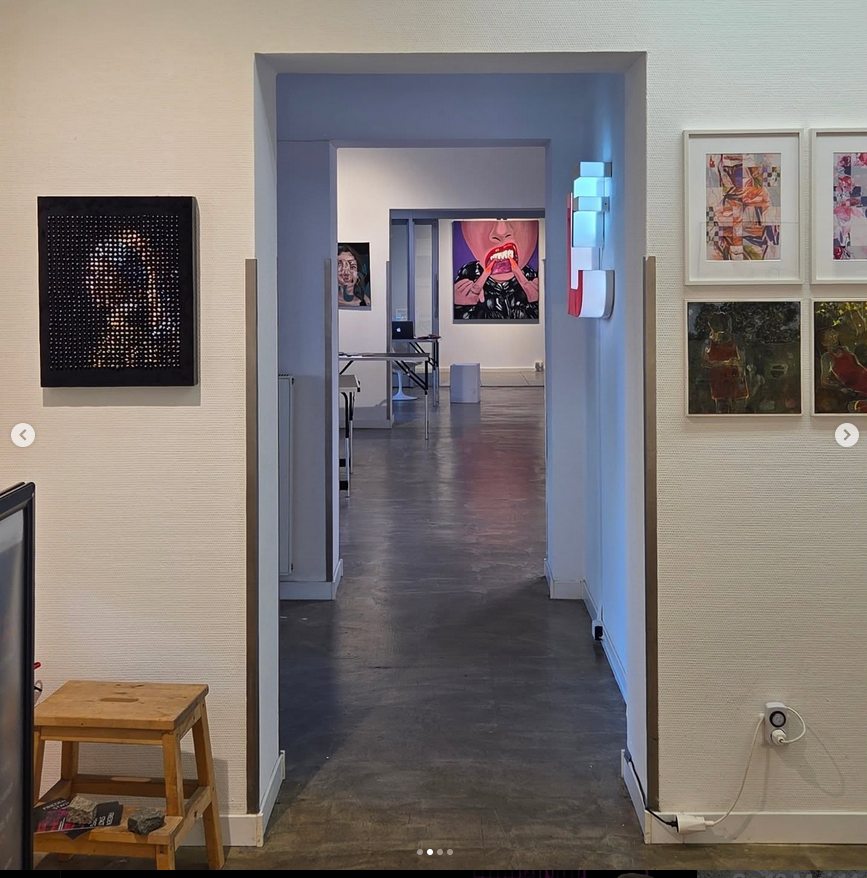
Girl with a Pearl Earring at Fresh Legs Berlin 2025
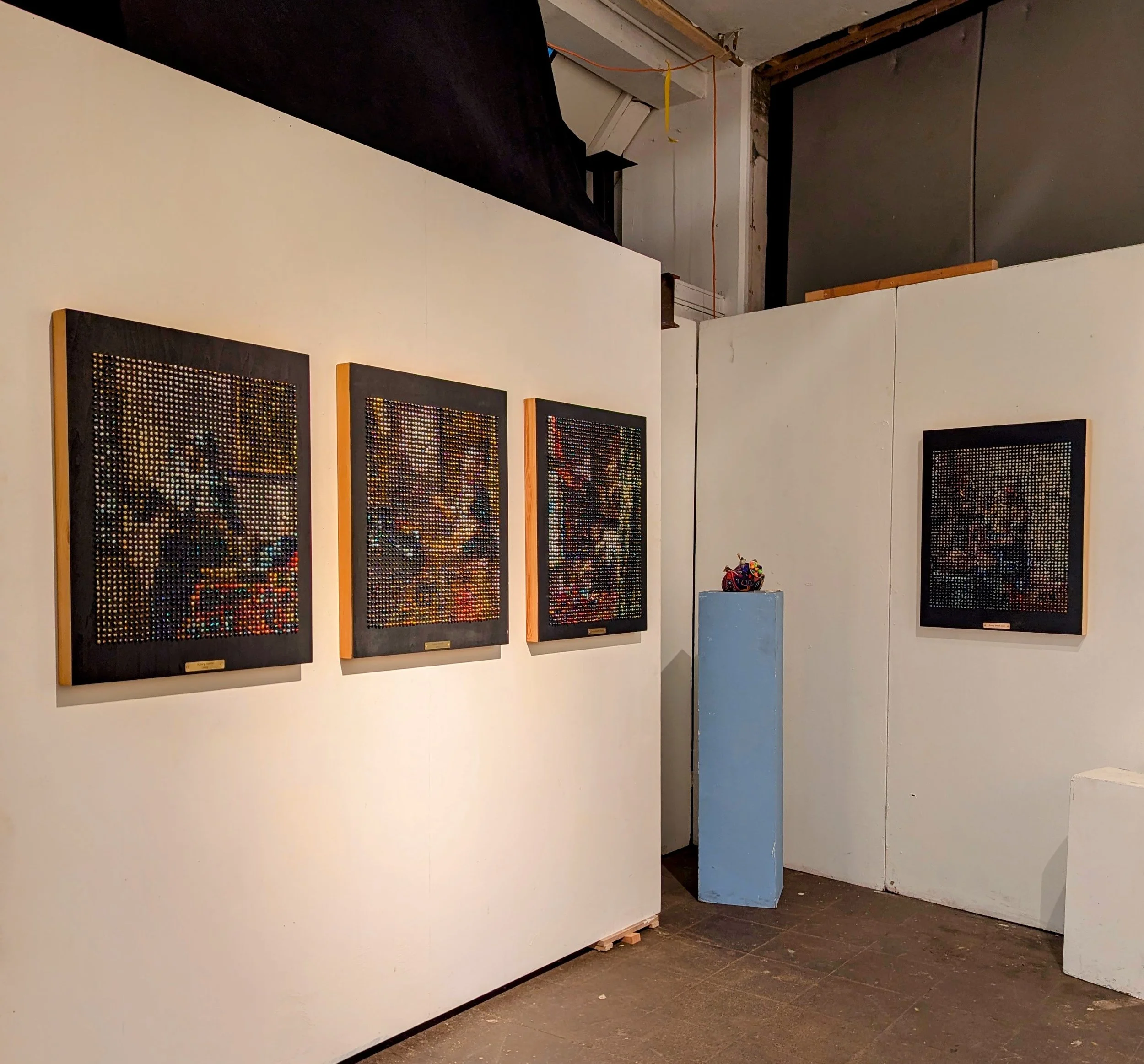
Woman with a Water Jug, Woman with a Balance, Woman Reading a Letter at an Open Window, and The Milkmaid at Vrij Palais Open September 2025
Select originals from the Pixelated Pearl Vermeer series are available for sale. Prices available on request.