
Why I Painted Myself Into Remrandt's The Storm On The Sea Of Galilee
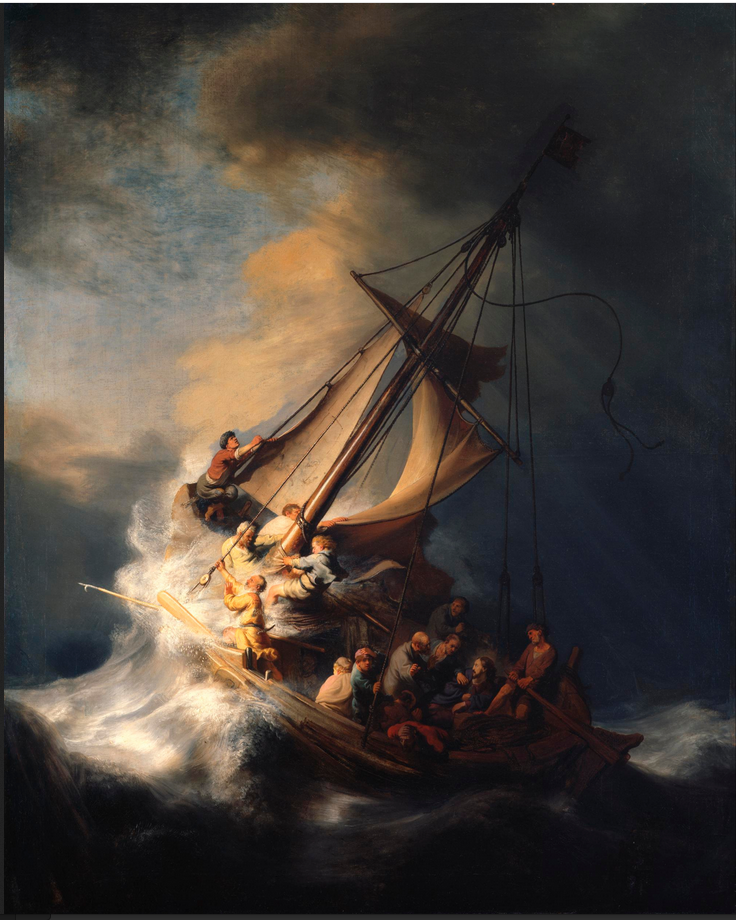
Rembrandt Painted Fourteen Figures…
Rembrandt’s painting The Storm On The Sea Of Galilee is considered a masterclass in using glances and lines of sight to convey meaning within a painting. Illustrating the biblical story of Jesus and his disciples encountering a storm at sea; it’s an allegory for salvation through Christ.
In it, some of the disciples turn their eyes to Jesus, who exudes calmness and light in the darkest part of the storm. They ask him to save them from disaster, to lead them out of the storm to the clear skies breaking on the horizon. Other disciples, their backs turned to Jesus and their eyes averted from his gaze, try to save themselves. They fight a fraught and losing battle with the boat’s sails as the storm rages on around them, unaware that salvation is right around the corner.
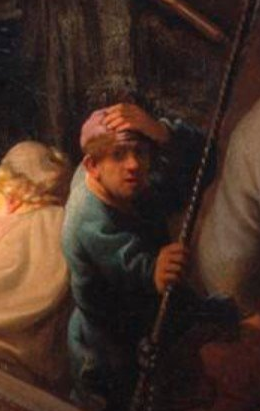
Only one figure stares at the viewer. Not a disciple, but a self-insert character of Rembrandt himself. He stands between the two groups – those motivated by fear and those motivated by faith. Rembrandt’s self portrait can be seen as a representation of the universal human struggle between those modes of thought. With his eyes he implores us, the viewer, to consider our fate on this boat of life, and how turning our life over to Jesus can help us weather the storm.
It’s a beautiful painting, but it’s not really a subtle painting.
As an atheist, Rembrandt’s religious works aren’t really my favorite Rembrandt’s. But I do love this painting, if only for the dramatic backstory of its theft from the Isabella Stewart Gardner Museum. As you know (I think?) I’ve been making a lot of art about the repercussions of that theft, specifically about the potential fate(s) of this painting and the theory that it’s been rolled up in a tube for thirty-five years.
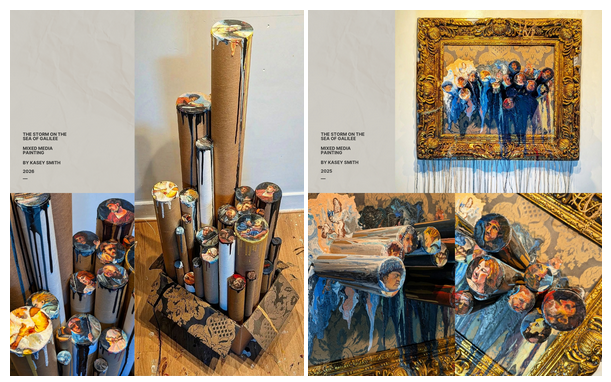
In exploration of this theory, I’ve created two mixed-media paintings where I’ve broken up the figures from The Storm On The Sea Of Galilee and painted them across a series of poster tubes. Between the two pieces and all the preliminary sketches, prototypes, and tests, I’ve probably painted each of the fourteen figures around four times. And while working on all those little portraits I was thinking a lot about that self-insert character of Rembrandt’s. About how he ropes the viewer into the painting, into the boat, and implies that we’re all stuck in this together – just us and Jesus – with just the power of his glance.
… And I Painted Fifteen Figures
Which brings me to the fact that there are FIFTEEN figures in each of my two pieces.
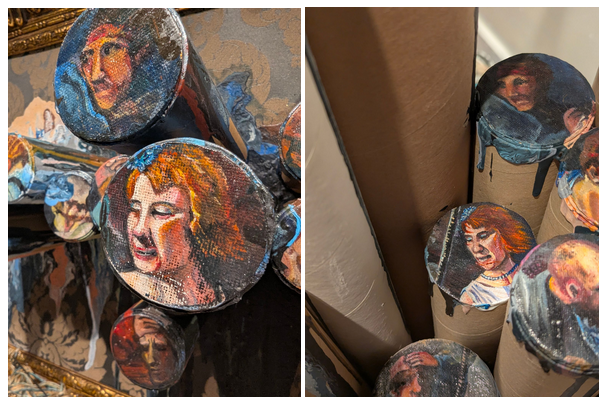
That’s because I decided to make my own self-insert character and add her into the pieces. And just like Rembrandt, I was very intentional with her gaze – where it lies and what it means. My self insert looks to Rembrandt. Looks at him, looking at the viewer. Looks at him as a stand-in for the legacy and corpus of art history.
Just as Rembrandt inserts himself into this biblical story, here I am inserting myself into the canon of art history and into the presence of one of the great Dutch masters. It’s an insertion marked by deference. I’m not THAT full of myself. I’m not claiming the viewer with my gaze – only the great master can do that. But I do look to him for creative guidance and inspiration as I continue my exploration of Dutch art history and what it means to live and create work in the Netherlands.

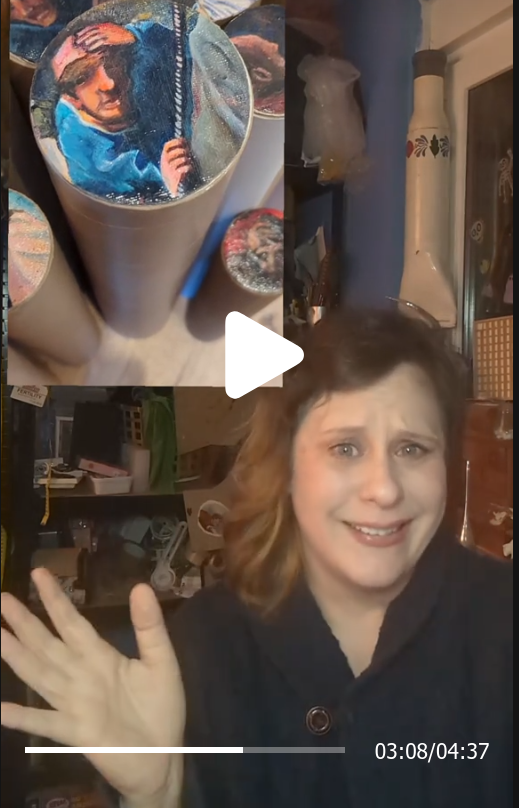
@kaseysmithdesigns Putting all those art history classes to work by doing a deep dive into why I added myself into Rembrandt's The Storm On The Sea Of Galilee. #artistsoftiktok #arthistorytiktok ♬ original sound - Kasey Smith
