
Am I accidentally making art about the Five Stages of Grief?
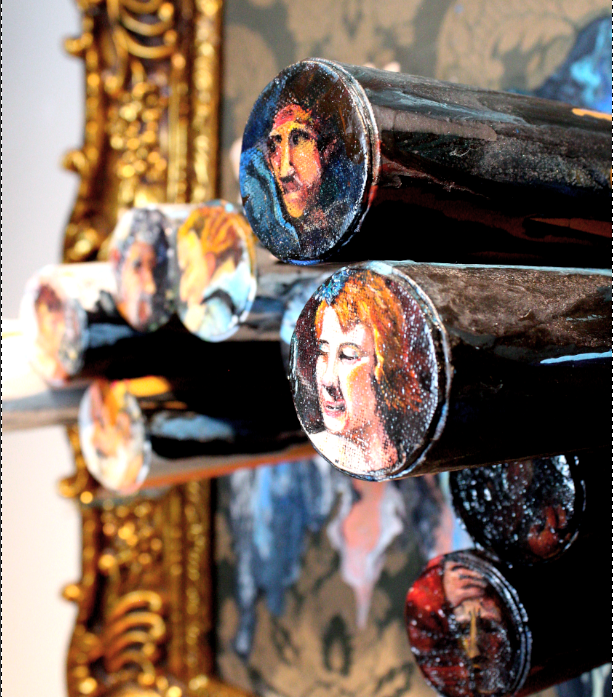
Psychological frameworks feel safe, stable. A roadmap to the unmappable, they arm us with an understanding of our experiences. Albeit sometimes in kooky, Kool-Aid flavored and patchouli scented ways.
I have often kept these kinds of pop psychological frameworks – and their close relative, the personality test – at arms length. Greeting them with the full might of my grumpy skepticism, I’d dismiss them as the domain of self help books, HR offices, and the spiritual girlies. “Me? Well, I don’t know about you, but my unique personal experiences can’t be understood through such a generic, reductionist format.” A sentiment exhibiting just a wee bit of egotism and unhealed trauma from that Four Temperaments quiz in seventh grade Health class. *shudder*
So to say I’m an unlikely candidate to make art about the Five Stages Of Grief would be somewhat accurate. It is simply not the way I have approached loss in either my personal life or in my work. However, the more I turn my Dutch Masters series over in my head – not the pearl Vermeers or the Rembrandt tube paintings, but the broad overarching story of studying Dutch art history as a cultural integration tool – the more I can see its structure guiding the work.
What are the Five Stages Of Grief
The Five Stages of Grief, or the Kübler-Ross model, is a framework developed by psychiatrist Elisabeth Kübler-Ross to understand the emotional journey we undergo following loss. The five original stages were denial, anger, bargaining, depression, and acceptance; although later versions would expand the roadmap to include shock and processing. However, the original five remain foundational to how we popularly understand the process of grief. Even if they are neither scientifically proven, linear, nor a universal process.
Immigration As Grief
So what am I grieving?
First, some context. A therapist once described my interior emotional life as academic. I process things slowly, which means I’m constantly looking in the rearview mirror to understand my emotions; the moment, and the feeling having long passed me by. When you can only understand yourself in hindsight, your relationship to yourself becomes a bit detached, impersonal. Still unprocessed thoughts and feelings exist outside of language for you. Unnamed, unknown, untamed.
Now, there are parts of my immigration journey to the Netherlands that still live in this feral, wordless place. That are still just smears of ash and ochre on a cave wall. It has been three years since I left the US and I’m still too in the moment to apply the full might of self-reflection to these experiences. Without the benefit of time and distance I cannot name, cannot know, and cannot tame them.
***
Let me state, flat out, that immigration to Europe is a fucking privilege. Not only is it expensive, but it is gatekept by so many requirements — both soft and hard — that can only be unlocked through massive class and body privilege. I will always be a realist about the pros and cons of leaving the US, this was very much written from the place of analyzing and feeling one of those cons.
***
The best I can do is say that immigration has felt like a little death. Not THAT one you perverts. But leaving the US is a transition that is huge and transformative and unknowable. It is a small taste, an amuse bouche, of that huge and transformative and unknowable transition that awaits us all. And it has changed me so much that very few of you truly know me anymore. I am a ghost in our old shared life but I cannot even haunt it properly; having been tossed up on distant shore, the spiritual and traumatic attachments severed but not cauterized.
How the Five Stages of Grief Map to My Art
So if I am carrying around all this grief for the person I was, for the country I was born in, for the life I had in the Bay Area, how does this map to the art I am making? And why am I specifically seeing the Five Stages Of Grief in it?
The Vermeer and Rembrandt pieces are part of a larger series – The Guild Of Saint Luke – that is about my immigration journey and my attempts at cultural integration. The idea being, that by studying and researching the Dutch Masters ala an apprenticeship in a painters guild, I could gain insight into my new home. So if this series is about immigration, and immigration carries some grief for me, then the groundwork for the Five Stages Of Grief have been set.
Looking at the Vermeer and Rembrandt pieces, how do those pieces map to the first two stages of grief?
Denial
The Vermeer pieces, to me, have an undeniable edge of sadness to them. But sadness is not a stage of grief, for it imbues all of grief. No, it is the way they are sad that feels like the first stage of grief – the stage of denial. While there is strength and joy in female solitude, that was not my relationship to it when I started depicting Vermeer’s singular female sitters. All those self-contained, solitary women remind me of how early in my move, I would hide in self-imposed isolation every time I started becoming overwhelmed. Which, due to brain wiring, was often. Of hiding behind garden fences and front window curtains because everything beyond their demarcation was fraught with anxiety and the Unknown.
This refusal to engage, this disassociation-as-lifestyle, is a form of denial. Both a denial of reality and a denial of the discomfort and experiences required to grow. When we hide from the world, the world leaves us behind. Which is where/how it is so easy to get mired in this stage of grief. (is this why it took me so long to finish this body of work?)
Anger
There is not a lot of subtlety to the anger in the Rembrandt pieces. The impotent rage flailing against a senseless, violating loss is fairly surface level. The Storm On The Sea Of Galilee was stolen and likely destroyed. And for what? Nothing. A giant gapping hole in the collective culture and the Isabella Stewart Gardner Museum’s collection. We are all poorer for its loss. That is not fair and I’m angry about that. Actually, nothing is fair and I’m angry about that too. Angry, angry, angry.
And The Night Watch? That pompous pantomime of security theater? I am angry about everything that it represents. I am angry that we are offered up no better options for safety than fake it until we make it. Angry that we are expected to follow along in the charade. Angry, angry, angry.
Will there be a Bargaining?
I still have a lot of work left to do on the Rembrandt pieces, but I do know that Van Eyck and the history of oil painting will be the next stage. Will this map to Bargaining or will this emergent pattern be broken less than halfway through the series? It is still too early to tell.
Hell, even when I’m elbow deep in the series it will probably be too early to tell. The proper time and space for contemplation having yet to be achieved. But I’m interested to see how it all works out and if the Five Stages Of Grief will leave a mark on the rest of this work.
