
Featured Posts
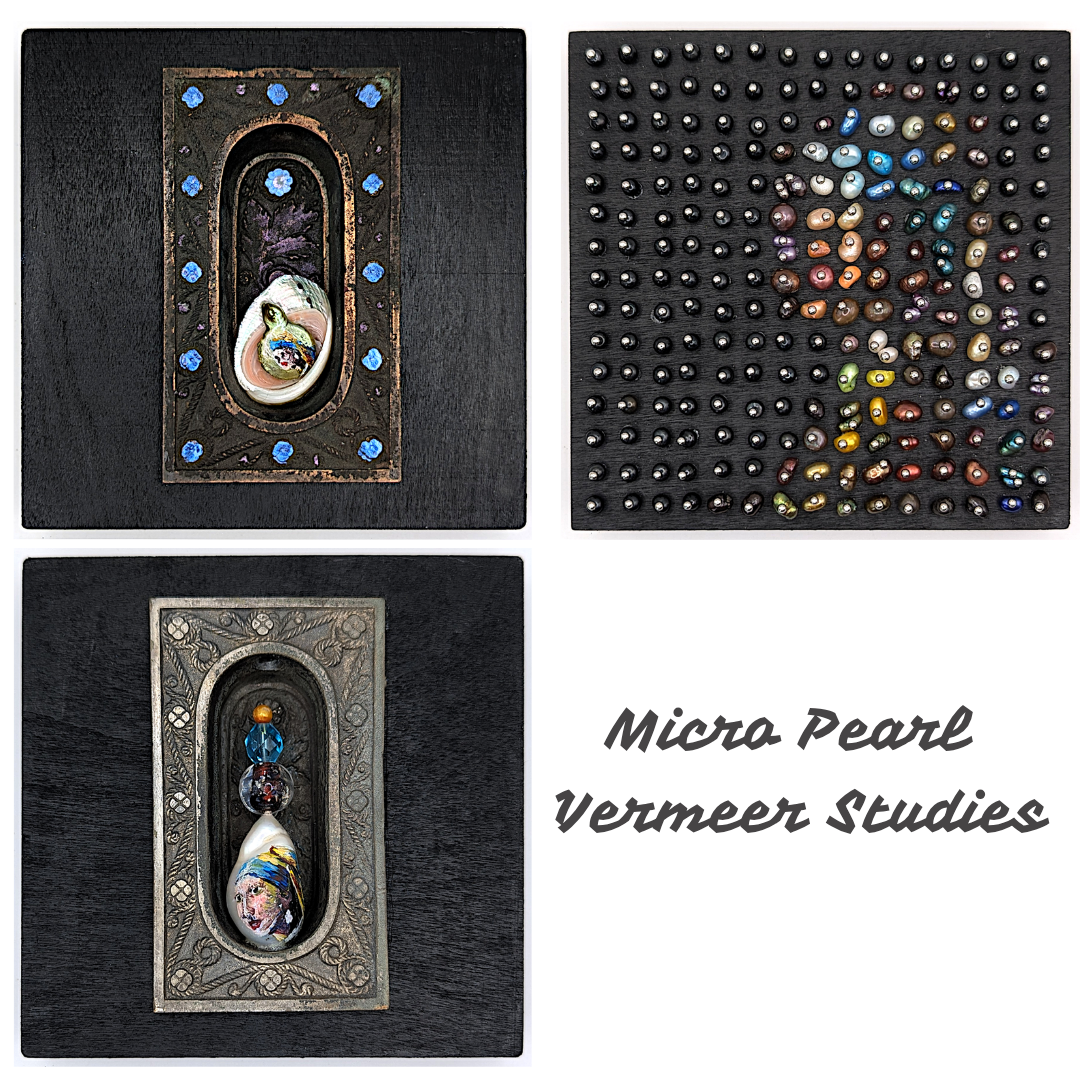

The Pearl Pictures -- An Extended Cinematic Universe
One of the 20th century’s leading Vermeer experts was the English artist and writer Lawrence Gowing. Knowledgeable on both Vermeer’s historical and artistic context, one of Gowing’s most noteworthy contributions to The Discourse was defining the concept of the “pearl pictures” within Vermeer’s work.
“This is the particular theme of the pearl pictures, a gentle stillness of stature. The shape is vertical. The figure appears, tender and immaculate, out of the cleft shadow of the cumbrous furniture; it is rooted in it, rooted, as we see at last, utterly unmoving, to the floor. And besides this upright shape, this pillar, we come to know another, its antithesis that nevertheless easily and equally combines with it. It is the shape of a bell... More essentially we remember it as the shape of rounded shoulders which is often the stooping shape of preoccupation, of a woman bent attentively over a table. It has a feminine quality of self-possession..." - Lawrence Gowing Vermeer, Oakland CA: University of California Press
One of the 20th century’s leading Vermeer experts was the English artist and writer Lawrence Gowing. Knowledgeable on both Vermeer’s historical and artistic context, one of Gowing’s most noteworthy contributions to The Discourse was defining the concept of the “pearl pictures” within Vermeer’s work.
Named for their luminous approach to light, the “pearl pictures” are a group of Vermeer’s mid-career paintings noted for their similar subject matter and composition. They each feature a single woman at a table, facing a window in the left-hand corner of a room, engaging in a discreet activity, while either wearing or handling pearls.
Goring would initially identify four quintessential pearl pictures - Woman Reading a Letter, Woman with a Pearl Necklace, Woman Holding a Balance, and Woman with a Lute. Other scholars often group Woman Reading a Letter at an Open Window and Woman with a Water Pitcher into the pearl pictures, although their inclusion is not universally agreed upon.


Now, when I say that I’m a Vermeer fangirl, what I really mean is that I’m a pearl picture fangirl. Like Gowing, I am captivated by this series and its extended cinematic universe. All those bell-shaped women, like bowed tulips, gracing the canvas with their quiet introspection and soft self composure. Through repetition, you can watch as Vermeer hones his craft across the series. Whittling his visual language down to a precise, pointed simplicity.
“Even by Vermeer's standards, the scenes of these works are organized with exceptional economy utilizing a table with a single woman, a meager still life, a few carefully chosen props, a map or painting on the background wall and one or two chairs”
This is the apex of Vermeer’s art. The pearl pictures feel like individual celluloid frames clipped from a film reel. They are the pregnant pause preceding the action. A woman lost in her internal world, depicted in the half-second before the viewer’s entrance upon the scene. In them one can anticipate the interruption, the broken concentration to come. How the angles of her body and face, startled out of their self reflection, will snap back like a rubber band. Shifting their orientation under the requirements of a woman being perceived.
The way Vermeer captures this moment before the re/action feels intimate, familiar and also ripe for a feminist reading. And so the pearl pieces have become the centerpiece of my Vermeer studies.
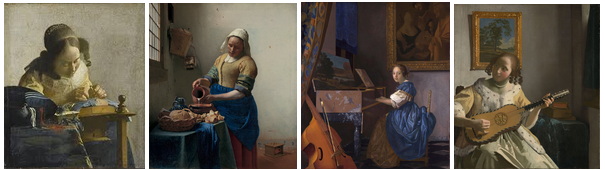
In the art studio, bent over my work table by the window, I toil alone with my pearls and my pictures. A paper bell, a silk tulip, I pantomime the actions of Vermeer’s solitary female figures, perfecting them through my own repetitions. I feel a deep kinship with them. Yes, much of it is rooted in our shared gender. But there is an important divergence – I identify with the subjects of the pearl pictures because being an immigrant is a terribly lonely business and I see myself in their solitude and self containment.
In a way, my Vermeer studies are a pregnant pause of sorts. They represent the moment between being an American artist and an American-Dutch artist. The lonely, solipsistic work of figuring out who I am and what I want to create in this new place. I am the half-second before the re/action. Waiting for what comes next in this journey of making art in the Netherlands.

Tot ziens!
🎨🎨🎨
Of Sphinxes and Pearls - An Exploration of the Works of Johannes Vermeer
Johannes Vermeer, that famous painter of Dutch interiors and Dutch interior life, is one of the most elusive sphinxes of the art world. So much so that he is often known as “the Sphinx of Delft” due to the mysteries shrouding his life and practice. There are no notebooks, no journals, no sketches, no resumes or work histories, no early or in-progress works, and few contemporaneous accounts. His story is but conjectures wrapped in myths wrapped in legends, as all that’s survived are 36 paintings and the scantest of biographical details.
“A legend grows around a grain of truth, like a pearl.”– Peter S. Beagle
A painter without an origin story is but a sphinx without a riddle. In the realm of myth, the sphinx’s riddle is the source of her power, the vehicle she uses to send tongue tied travelers to their deaths. If she loses or lacks a riddle, her ferocity is reduced to the level of a declawed housecat mewling for more milk. Therefore, to call someone a riddle-less sphinx is to point at their hollowness without fear. To call out their toothlessness with a full throated and pearly white grin.
“You cannot kill me in any way that matters.”
“You cannot make art in any way that matters.”
Johannes Vermeer, that famous painter of Dutch interiors and Dutch interior life, is one of the most elusive sphinxes of the art world. So much so that he is often known as “the Sphinx of Delft” due to the mysteries shrouding his life and practice. There are no notebooks, no journals, no sketches, no resumes or work histories, no early or in-progress works, and few contemporaneous accounts. His story is but conjectures wrapped in myths wrapped in legends, as all that’s survived are 36 paintings and the scantest of biographical details.
The sphinx sits and paints
Tall as the crooked church leans
Against delft blue skies
Which makes it difficult to infer concrete biographical meaning in his work. Who and why and how Vermeer painted; all this information has been lost to the sands of time. In fact, for two centuries his work also languished in obscurity– attributed to other, more famous artists – only to be plucked from anonymity by Théophile Thoré-Bürger’s scholarly excavations. So without a biographical lens onto Vermeer’s work, how can we answer their riddles and come to understand his origin stories? Through his historical context.
The cut and cloth of a dress, the architecture and decor of a room; we can still interpret Vermeer and his work through the trappings of his era – specifically that of the merchant class during the Dutch Golden Age. And for me, one historical/cultural detail especially catches my eye– the presence of pearls in Vermeer’s work. Of his 36 paintings,18 feature pearls. They adorn ears and necklines and updos. They pour out of boxes and lay scattered on tables. Preposterously large and threaded in great quantity, they speak to an opulence emblematic of Vermeer’s specific era.

Rare and exotic, pearls were brought from Asia via the same trading routes and colonial holdings as the infamous Dutch spice trade. This evolution in capitalism and economics – aided by Dutch independence in 1648 – helped propel the merchant class to prominence in Dutch society. The very same class that Vermeer (nominally) and his collectors belonged to. And capitalism, ever abhorring a vacuum, would require new and expensive class markers to match this new era. Hence pearls became somewhat synonymous with this moment in Dutch empire, going “viral” among an upper class hungry for luxury goods.
Vermeer, by using pearls so consistently in his work, is positioning his figures in this same time period and economic space. For adorning his figures in gold and gemstones would have been too aristocratic and old fashioned. Just a few years out from the 80 Years War, this would have stuck out like a Hapsburg chin in the new Dutch society. And on the flipside, leaving his figures unadorned would have rendered them indistinguishable from the maids who served them. Too earthy and humble to enjoy the class-based leisure that his figures often exude.

So Vermeer's pearls function quite effectively as symbols of a certain class of wealth during the Dutch Golden Age. Was this about capitalizing on the class vanitas of his audience to sell work? About making social commentary in a rapidly changing country? About telling his or his family's biographical stories? The sphinx's lips remain sealed.