
Keep Your Art Close
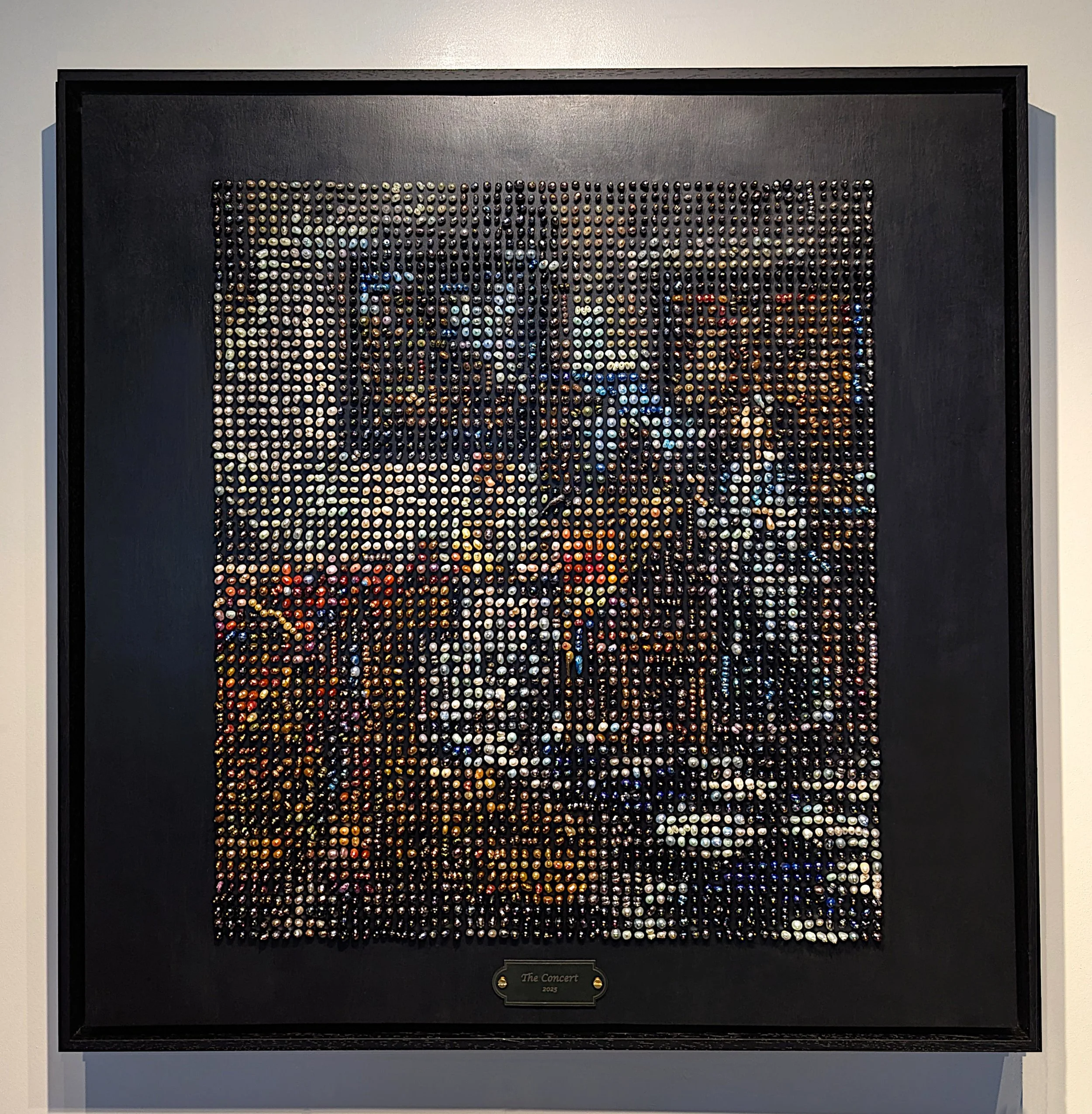
There’s an easter egg hidden in my rendition of The Concert. A secret homage to an artist who shaped me as a teenager. To a small moment in a big museum with profound knock-on effects to my art.
But first. A bit of a family backstory…
My great uncle was somewhat of a hoarder. He’d inherited the family home back in Illinois and nominated himself to be the keeper of family memories, family heirlooms, and family detritus. Everything was there – the photos and letters and birth announcements and knick knacks from 3+ generations of the family. But there was also a lot of junk that didn’t need to be cluttering up every corner of the home. Piles of cardboard boxes and catalogues and 50 year old coupons and So. Many. Stamps. (he’d worked for the post office).
When he and his wife needed to enter memory care, the women in the family took it upon themselves to sort, clean, and throw out this memory palace of debris. I went with them on their second trip, when the house had already been sold, and we were sorting through the last of its contents in a cavernous storage unit in the suburbs of Chicago. It was a grueling trip, and we had only one day for sightseeing, which we spent in the Art Institute of Chicago.

I have a lot of fond memories of that day at the museum, but the one that really stands out is standing in front of Chuck Close’s Big Self-Portrait, 1967–1968 with my mother and debating whether it was a painting or a photo. I think I was around 14 or 15 at the time. I’d been to the (old) De Young and the Legion of Honor, but SFMOMA had *just* reopened and we hadn’t gone yet. So this might have been my first experience of an art piece from the post-WWII era. Either way, I was fascinated.
To this day, I love Close’s hyperrealism portraits. The big, exacting canvases that exude that magical optical aesthetic which he staked his initial career/reputation on. But the ones that truly move me are the ones from the 90’s when he was recovering from his spinal artery collapse and relearning how to paint from his wheelchair. Specifically the ones where he was working with pixel grids, color theory, and layered organic shapes.

Are you seeing where I’m going with this… ;)
From Day One of this Vermeer series, I’ve been thinking about Chuck Close and his use of grids. Specifically the ones from this era. About the geometries and anti-geometries at work within them and the parallels with the freshwater pearls I use. But The Concert is the only one where I purposely tried playing with a “Closeian” approach to layering by pinning contrasting and complimentary pearls onto one another.
There’s A LOT going on in The Concert – the folds of the oriental rug, the viol on the floor, the paintings on the wall and on the harpsichord, the three figures, the pegboard of the lute – and I knew that capturing them was important to the “success” of the work. But how to achieve that within a medium-scaled piece? Especially within the formulaic limitations of pixel art AND the color limitations of the dyed freshwater pearl market?
By using layering and color theory I was able to highlight small areas of the piece that I wanted the eye to linger on, or draw sightlines that I wanted it to travel across. I was also able to give the impression of subtle patterning in areas that required depth, and shift the temperature and tone of color areas that needed a little extra umph.

Thus the layered pearl technique is densely clustered around the most colorful and most detailed areas of the painting. The highlights on the folds of the rug, the shoulder belt on the seated lutist, the pleats on the singer’s dress, the tree within the landscape painting, etc. Many of them are also placed on diagonals, working with Vermeer’s original composition to enforce how the eye moves around and into the painting. The effect is an economical approach to detail, working in a level of subtly that far exceeds the size of the pixel grid I was working within.
So I have to ask -- If I made a small version of Girl With A Pearl Earring using this layering technique would you buy one?
