
Introducing a New Series Inspired by The Night Watch
The Night Watch is incomplete. Or, more accurately, The Night Watch was rendered incomplete.
For the first seventy-three years of its existence it hung in the Groote Zaal of the Kloveniersdoelen in Amsterdam. Created with the space in mind, it existed as a proto-site specific installation; in perfect harmony with the architecture of the space. But in 1715 it was moved to Amsterdam City Hall, necessitating that all four sides be trimmed in order to better fit the new space. This little shave removed approximately 64.4cm from the left side, 7 cm from the right side, 23.3 cm from the top, and 11.3 cm from the bottom. Despite the value of Rembrandt’s work – both in our current moment and at the time of the initial trimming – these strips were seemingly treated without care and have now been lost to time.
Unlike many lost masterpieces from this era – for example, the 6 to 10 “undiscovered” Vermeers – we know exactly what was removed from The Night Watch due to a surviving reproduction by Gerrit Lundens. Created between 1642 and 1655, Lundens would have based his copy on the original, pre-trimmed Night Watch, helping us to better understand what was removed during the 1715 move. Based on comparisons with his painting, we can tell that much of what was lost was background. However, there were three minor figures – two militiamen and a child – who were entirely removed from the lefthand side.
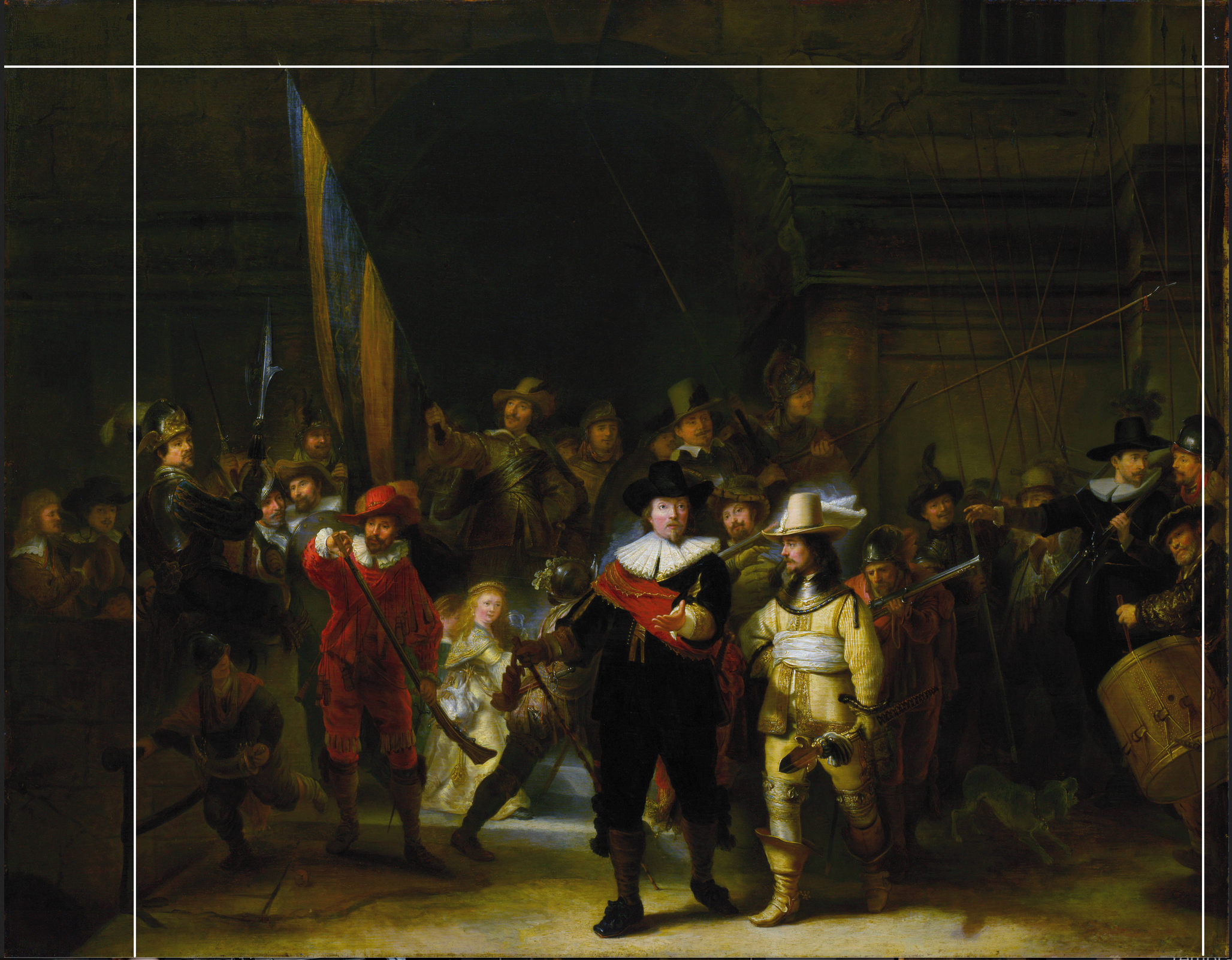
I think of those lost strips often. Especially about those three faces set adrift into the world without the rest of their compatriots to ground them. For who is a militiaman without his company? Do the brushstrokes still convey their valor and service when viewed in isolation or do they melt back into civilian status; stripped of their military standing just as they were stripped from the rest of the painting?
And while they were most likely lost due to error instead of theft, their fate brings up some of the same questions as Rembrandt’s missing Storm On The Sea Of Galilee. Were they sent to the dump? Were they incinerated? Were they recycled into canvases for other art pieces? Are they moldering in someone’s attic? Are they on display in someone’s home; and if so, do they even know what they have?
Still, one hopes that these three little margin doodles had what it takes to survive as an independent painting. That even without the rest of The Night Watch they would have had the power of subject, composition, and quality to make it these last three hundred years.
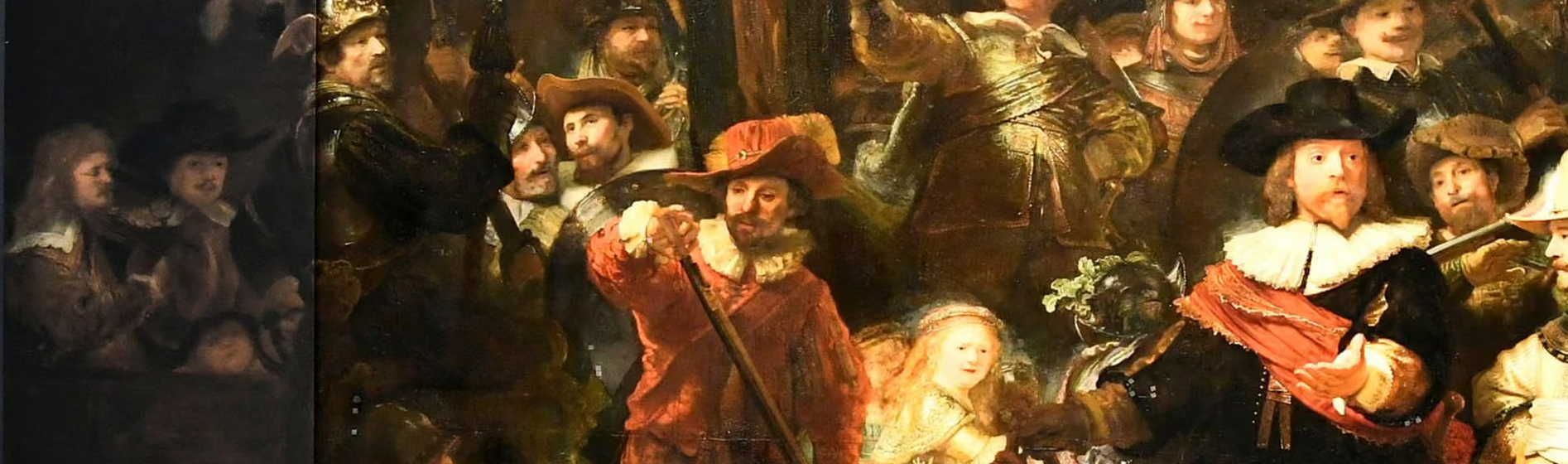
But we all know that this is a hope against hope.
The Night Watch is one of the most famous paintings in Dutch art history; second only perhaps to Girl With A Pearl Earring. With Lundens’ reproduction acting as a guide, we have never not-known what to look for. And yet, we have never found the missing pieces
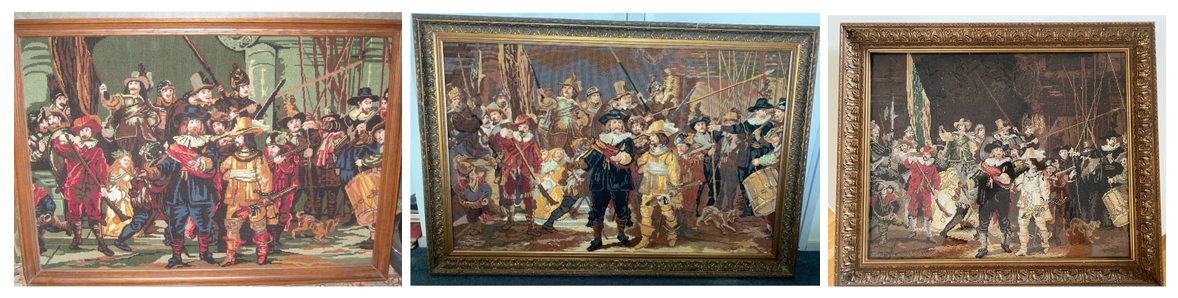
The Rijksmuseum has done admirable work to heal the painting and reproduce the missing strips, but this work is very recent. Many reproductions of the Night Watch, especially older ones, depict the incomplete, post-trimming painting. This includes all the vintage cross-stitches of The Night Watch I’ve used in my Night Watch Burglary Tools series.
And perhaps it shouldn’t, but it bothers me that those three little lost faces don’t appear on any of my Night Watch Burglary Tools; that no cross-stitch or embroidery pattern exists which contains them. Now, I am not a cross-stitcher. I am not the person to correct this art historical oversight within the disciple. But I am a painter who can address it in my own way. So I would like to introduce you to my second series around the Night Watch, tentatively titled Completion (this is likely to change).
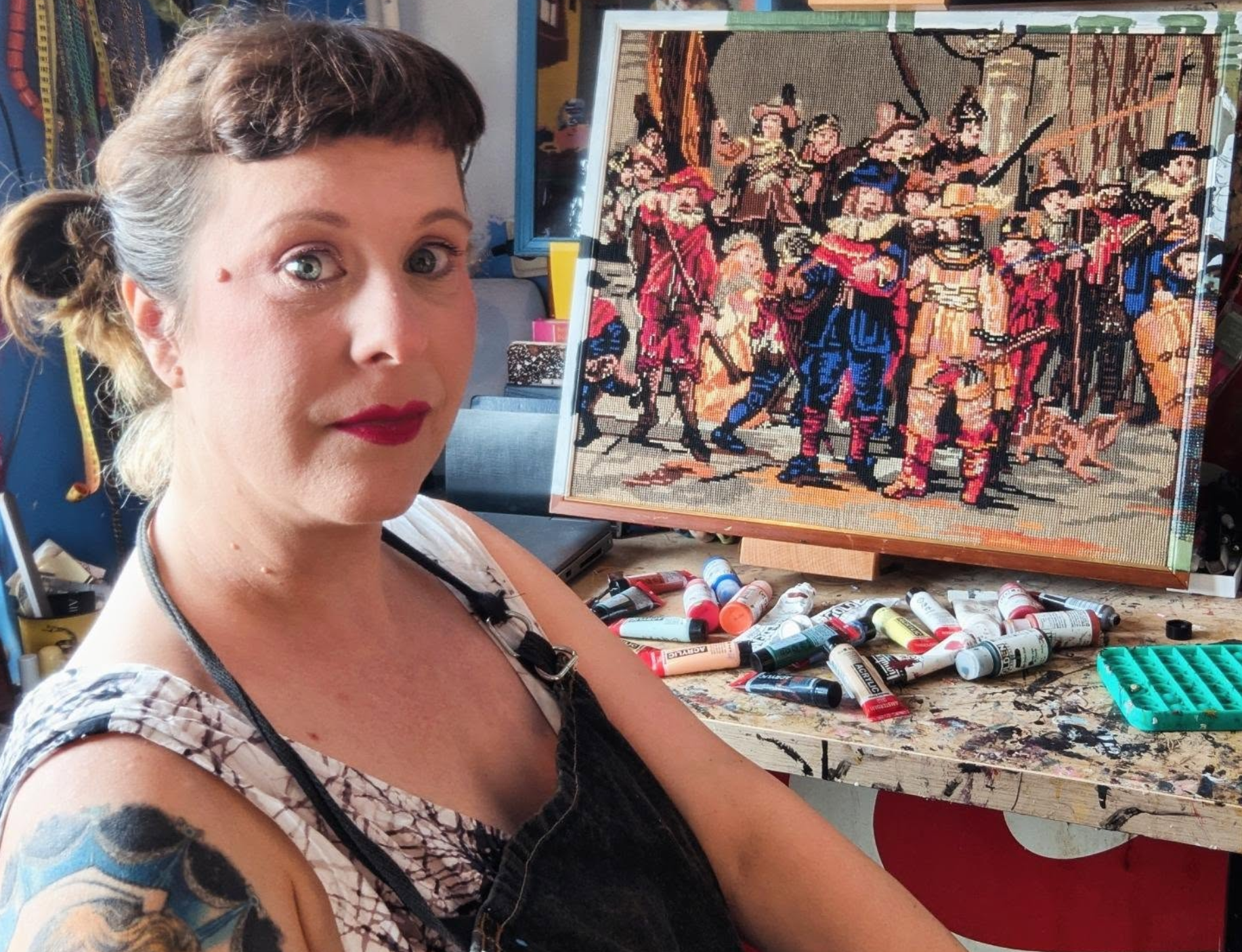
In this series I am taking framed examples of the three most common Night Watch cross-stitch patterns – measuring approximately 47x57cm, 70x60cm, and 140x95cm respectively – and painting back in the missing portions. These additions will stretch across the front and sides of their frames, continuing off onto the walls around them. They will in effect “complete” the cross-stitch Night Watches, but with paint instead of thread. Haloing The Night Watch as we know it with The Night Watch as it was originally intended.
Healing was a major focus of my mixed media embroidery piece The Storm On The Sea Of Galilee 1, wherein I referenced both the stolen Rembrandt piece and the site of the crime in an effort to process the painting’s loss. (currently on display at Unit4Art through February 2027).
“In the first piece, the dominant material is string. And what does string do? It binds, it connects, it fixes, it secures. Here, string represents an attempt to heal the loss, to recreate the painting in the language of repair, mirroring the museum’s use of the green damask towards similar ends.” – The Storm On The Sea Of Galilee Parts 2 and 3
I am referencing similar themes with this series; albeit with different materials and symbolism. In these new pieces the thread does not heal, it is what needs healing. Needs to be returned to the origin point of the painting’s completion. It is, in a way, an inversion of The Storm On The Sea Of Galilee 1. Where in that piece, thread was used to heal paint; here paint is used to heal thread in an attempt to reunite the cross-stitch with the painting it represents.
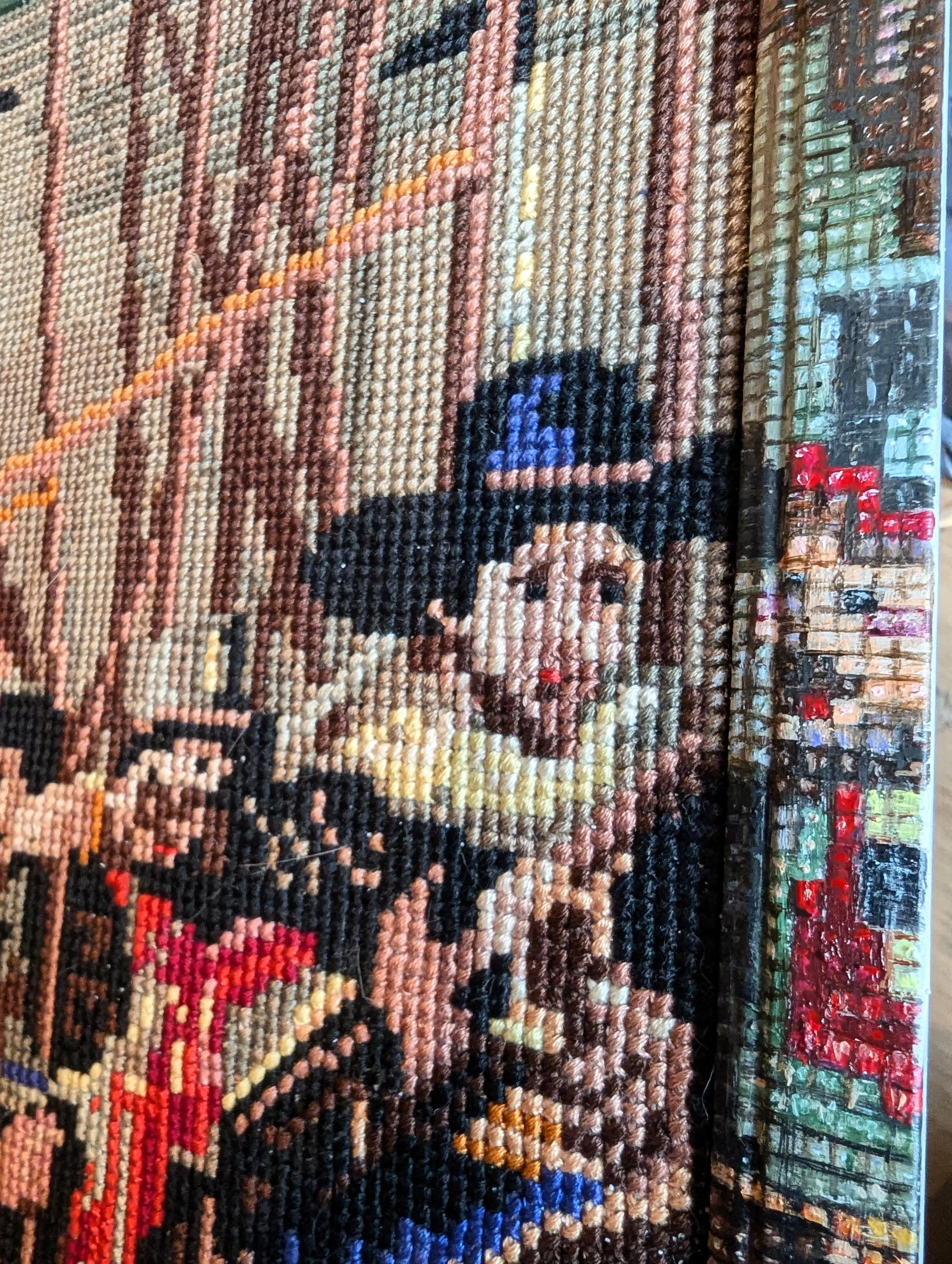
I am currently about a fifth of the way through painting/healing the 70x60cm cross-stitch, which both is and is not a lot of progress on this piece. I’m learning as I go — it’s essentially a pixel art piece and while I have made those before, I have never PAINTED one before — so hopefully I can apply those lessons to the 47x57cm and 140x95cm versions.
Stay tuned as I further develop these paintings, as well as the Night Watch Burglary Tools!
