
Featured Posts
Come See Two of the Pixelated Pearl Vermeers at De Engelse Kerk in Middelburg on October 4th
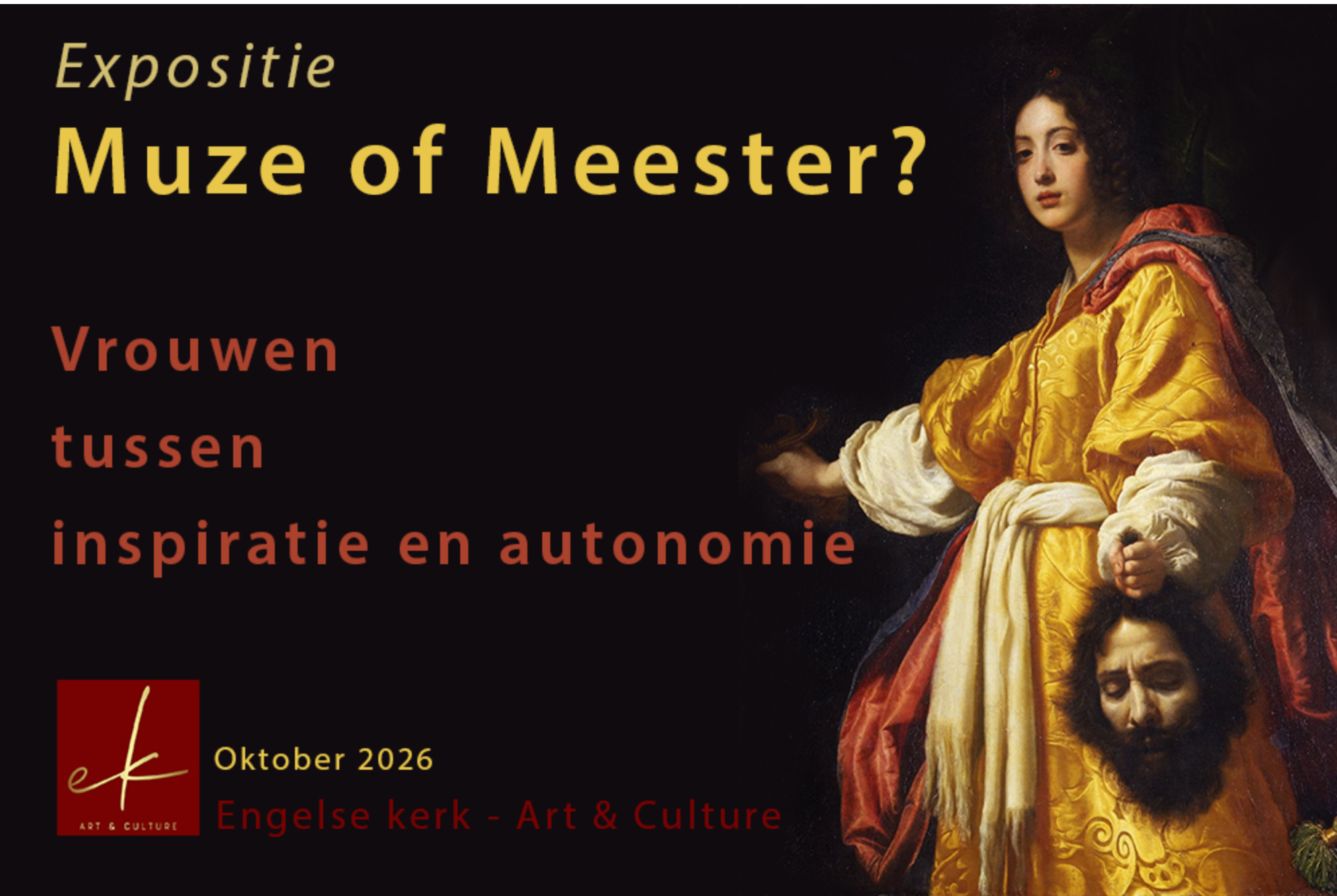
It's been about a year since I last exhibited any of the Pixelated Pearl Vermeers, so I am excited to be bringing two of them -- Woman Reading A Letter and Lady Writing A Letter -- to this show in the province of Zeeland. Even without speaking Dutch, you should be able to surmise that a show called "Muze or Meester" would be about the male gaze and the role of women in the arts. Which seemed like the perfect setting for my recreations of Vermeer's contemplative, solitary female sitters.
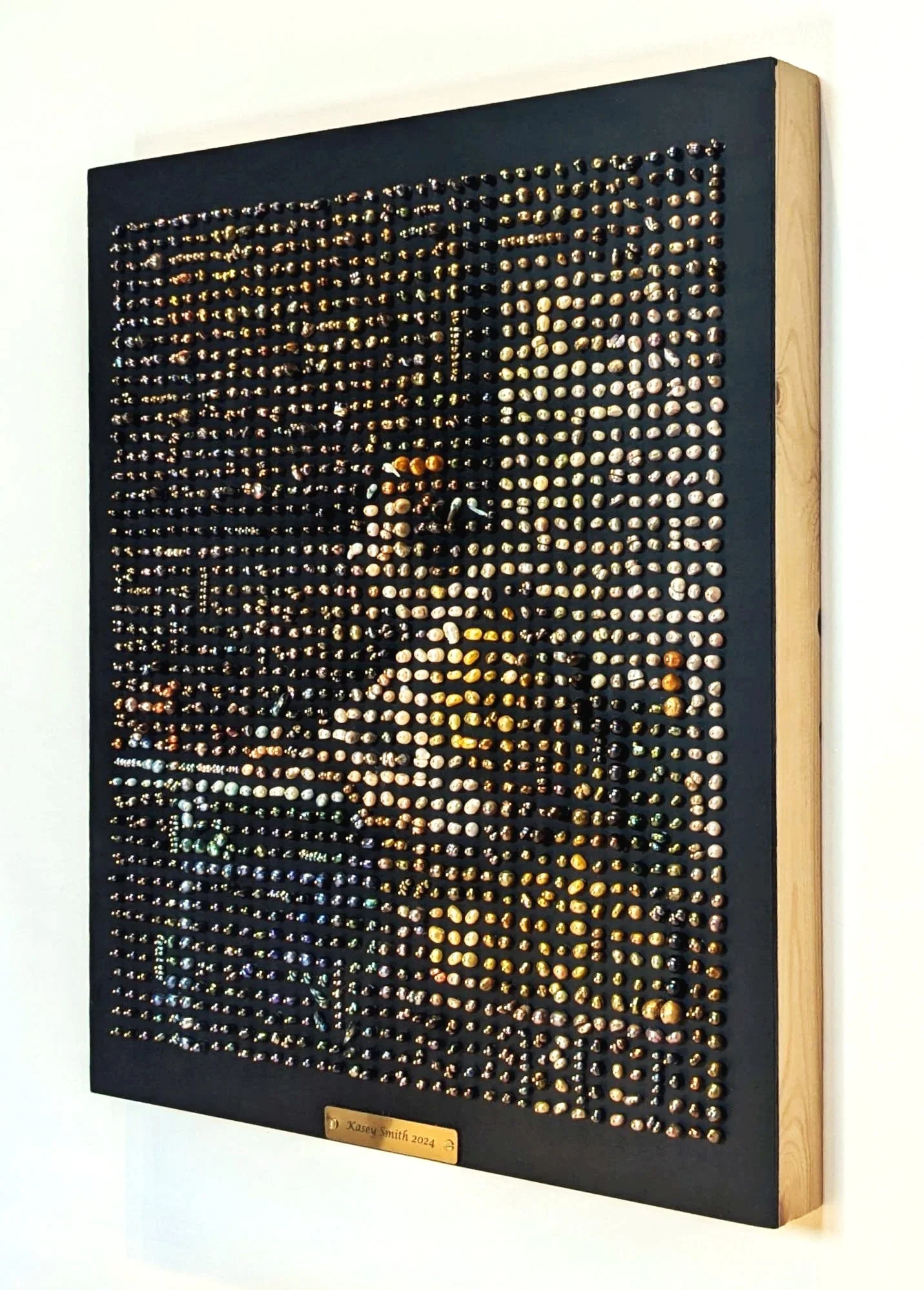
So if you're around and about Zeeland on October 4th you should stop by the opening at De Engelse Kerk in Middelburg. If you can't make the opening, the show will be on display through the end of that month.
Sunday October 4th
13:00 - 17:00
Engelse Kerk – Middelburg
Simpelhuisstraat 10
Middelburg, Zeeland 4331 PH
Introducing a New Series Inspired by The Night Watch
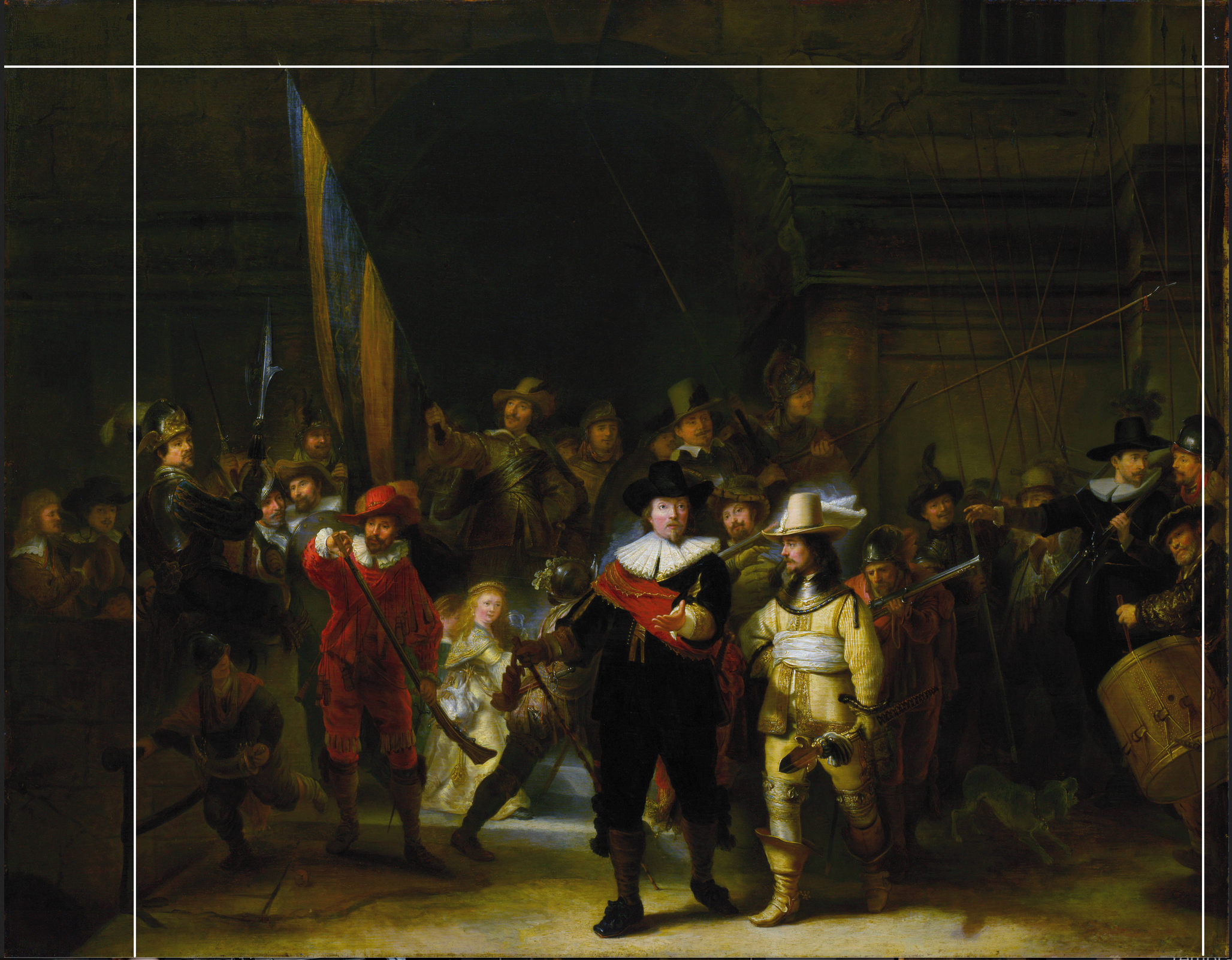
The Night Watch is incomplete. Or, more accurately, The Night Watch was rendered incomplete.
For the first seventy-three years of its existence it hung in the Groote Zaal of the Kloveniersdoelen in Amsterdam. Created with the space in mind, it existed as a proto-site specific installation; in perfect harmony with the architecture of the space. But in 1715 it was moved to Amsterdam City Hall, necessitating that all four sides be trimmed in order to better fit the new space. This little shave removed approximately 64.4cm from the left side, 7 cm from the right side, 23.3 cm from the top, and 11.3 cm from the bottom. Despite the value of Rembrandt’s work – both in our current moment and at the time of the initial trimming – these strips were seemingly treated without care and have now been lost to time.
Unlike many lost masterpieces from this era – for example, the 6 to 10 “undiscovered” Vermeers – we know exactly what was removed from The Night Watch due to a surviving reproduction by Gerrit Lundens. Created between 1642 and 1655, Lundens would have based his copy on the original, pre-trimmed Night Watch, helping us to better understand what was removed during the 1715 move. Based on comparisons with his painting, we can tell that much of what was lost was background. However, there were three minor figures – two militiamen and a child – who were entirely removed from the lefthand side.
I think of those lost strips often. Especially about those three faces set adrift into the world without the rest of their compatriots to ground them. For who is a militiaman without his company? Do the brushstrokes still convey their valor and service when viewed in isolation or do they melt back into civilian status; stripped of their military standing just as they were stripped from the rest of the painting?
And while they were most likely lost due to error instead of theft, their fate brings up some of the same questions as Rembrandt’s missing Storm On The Sea Of Galilee. Were they sent to the dump? Were they incinerated? Were they recycled into canvases for other art pieces? Are they moldering in someone’s attic? Are they on display in someone’s home; and if so, do they even know what they have?
Still, one hopes that these three little margin doodles had what it takes to survive as an independent painting. That even without the rest of The Night Watch they would have had the power of subject, composition, and quality to make it these last three hundred years.
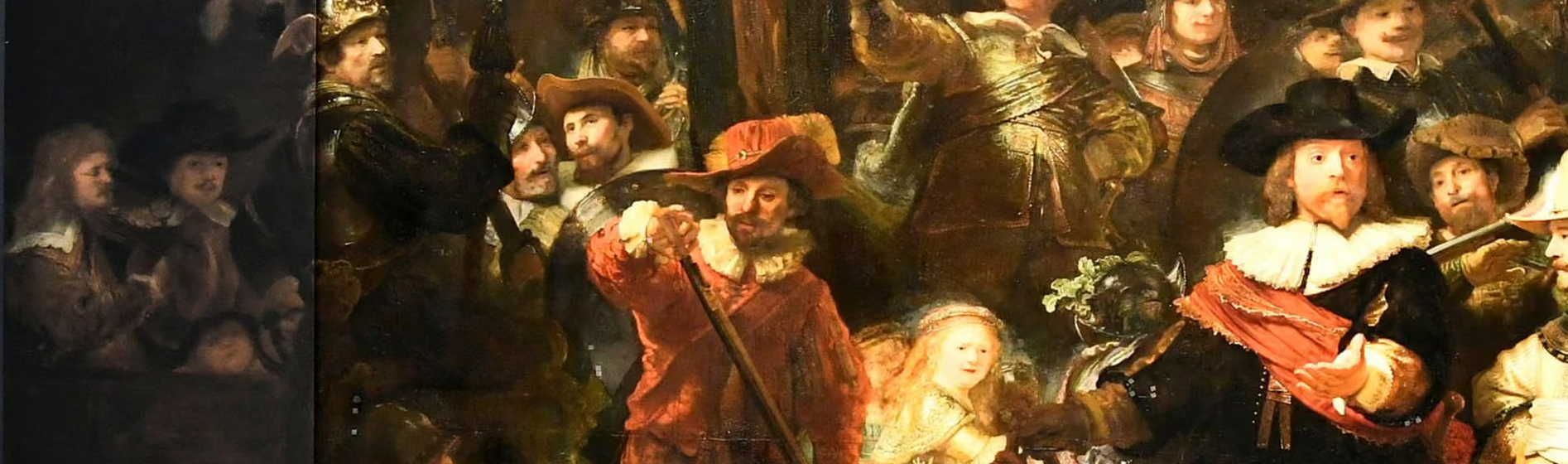
But we all know that this is a hope against hope.
The Night Watch is one of the most famous paintings in Dutch art history; second only perhaps to Girl With A Pearl Earring. With Lundens’ reproduction acting as a guide, we have never not-known what to look for. And yet, we have never found the missing pieces
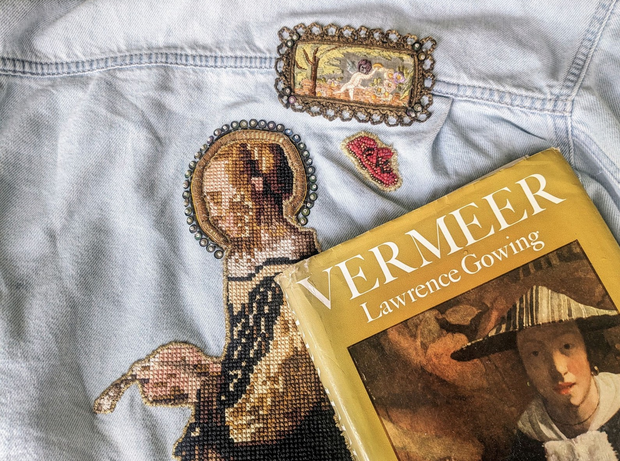
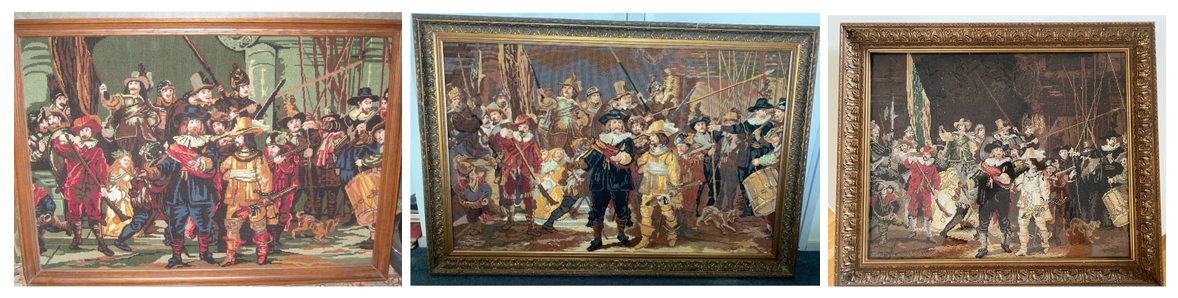
The Rijksmuseum has done admirable work to heal the painting and reproduce the missing strips, but this work is very recent. Many reproductions of the Night Watch, especially older ones, depict the incomplete, post-trimming painting. This includes all the vintage cross-stitches of The Night Watch I’ve used in my Night Watch Burglary Tools series.
And perhaps it shouldn’t, but it bothers me that those three little lost faces don’t appear on any of my Night Watch Burglary Tools; that no cross-stitch or embroidery pattern exists which contains them. Now, I am not a cross-stitcher. I am not the person to correct this art historical oversight within the disciple. But I am a painter who can address it in my own way. So I would like to introduce you to my second series around the Night Watch, tentatively titled Completion (this is likely to change).
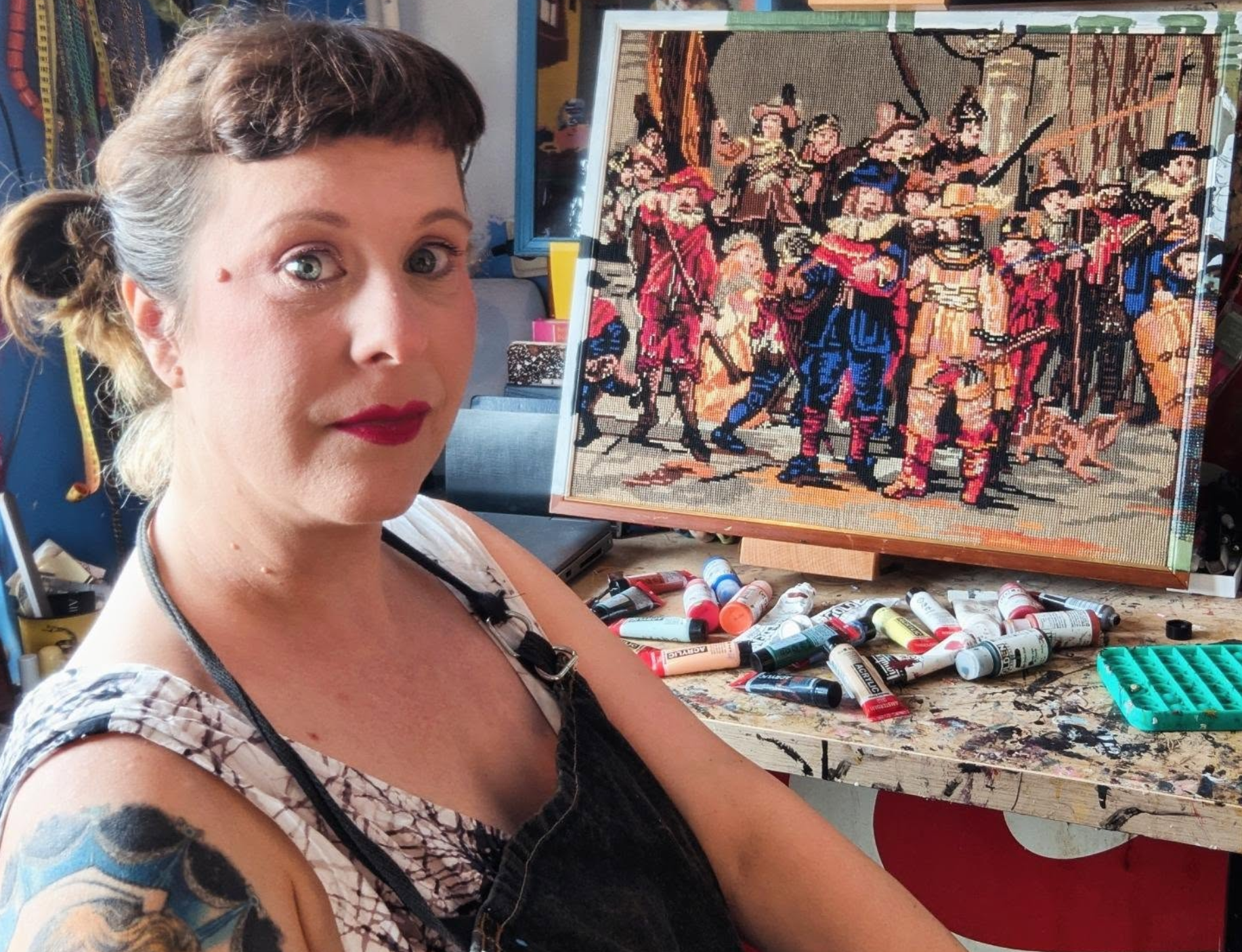
In this series I am taking framed examples of the three most common Night Watch cross-stitch patterns – measuring approximately 47x57cm, 70x60cm, and 140x95cm respectively – and painting back in the missing portions. These additions will stretch across the front and sides of their frames, continuing off onto the walls around them. They will in effect “complete” the cross-stitch Night Watches, but with paint instead of thread. Haloing The Night Watch as we know it with The Night Watch as it was originally intended.
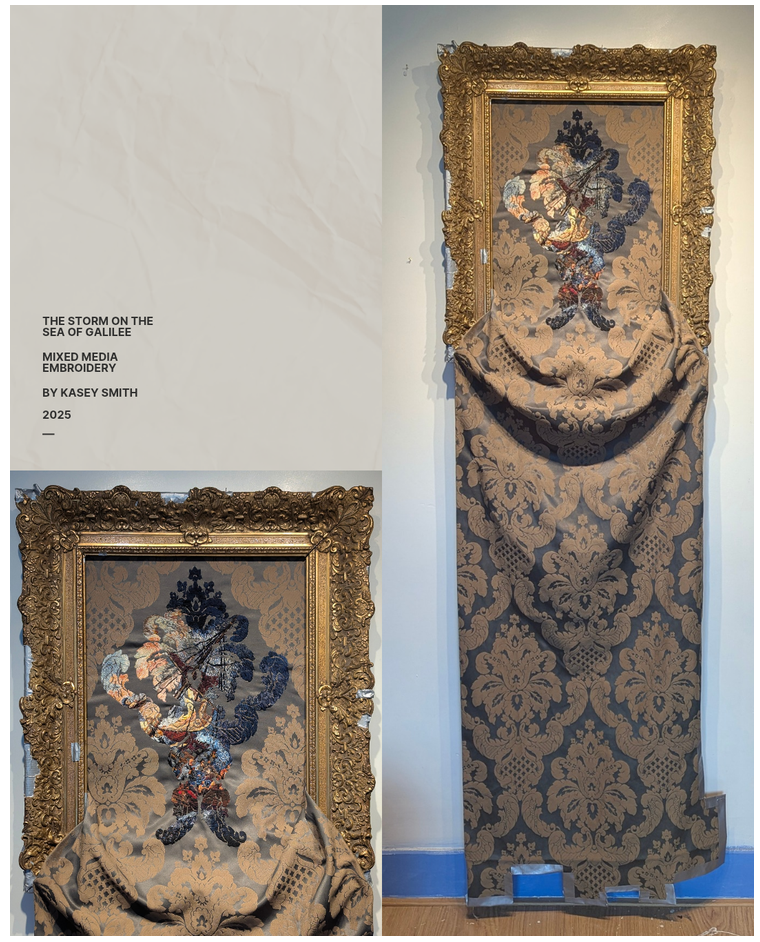
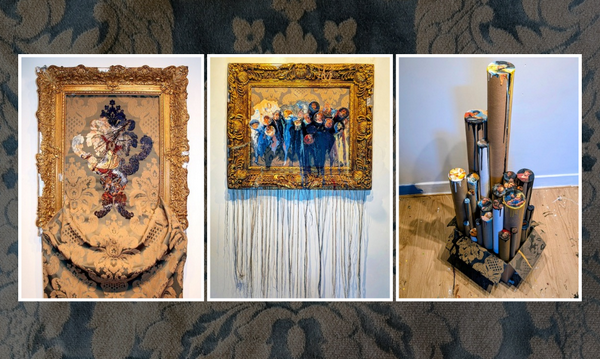
Healing was a major focus of my mixed media embroidery piece The Storm On The Sea Of Galilee 1, wherein I referenced both the stolen Rembrandt piece and the site of the crime in an effort to process the painting’s loss. (currently on display at Unit4Art through February 2027).
“In the first piece, the dominant material is string. And what does string do? It binds, it connects, it fixes, it secures. Here, string represents an attempt to heal the loss, to recreate the painting in the language of repair, mirroring the museum’s use of the green damask towards similar ends.” – The Storm On The Sea Of Galilee Parts 2 and 3
I am referencing similar themes with this series; albeit with different materials and symbolism. In these new pieces the thread does not heal, it is what needs healing. Needs to be returned to the origin point of the painting’s completion. It is, in a way, an inversion of The Storm On The Sea Of Galilee 1. Where in that piece, thread was used to heal paint; here paint is used to heal thread in an attempt to reunite the cross-stitch with the painting it represents.
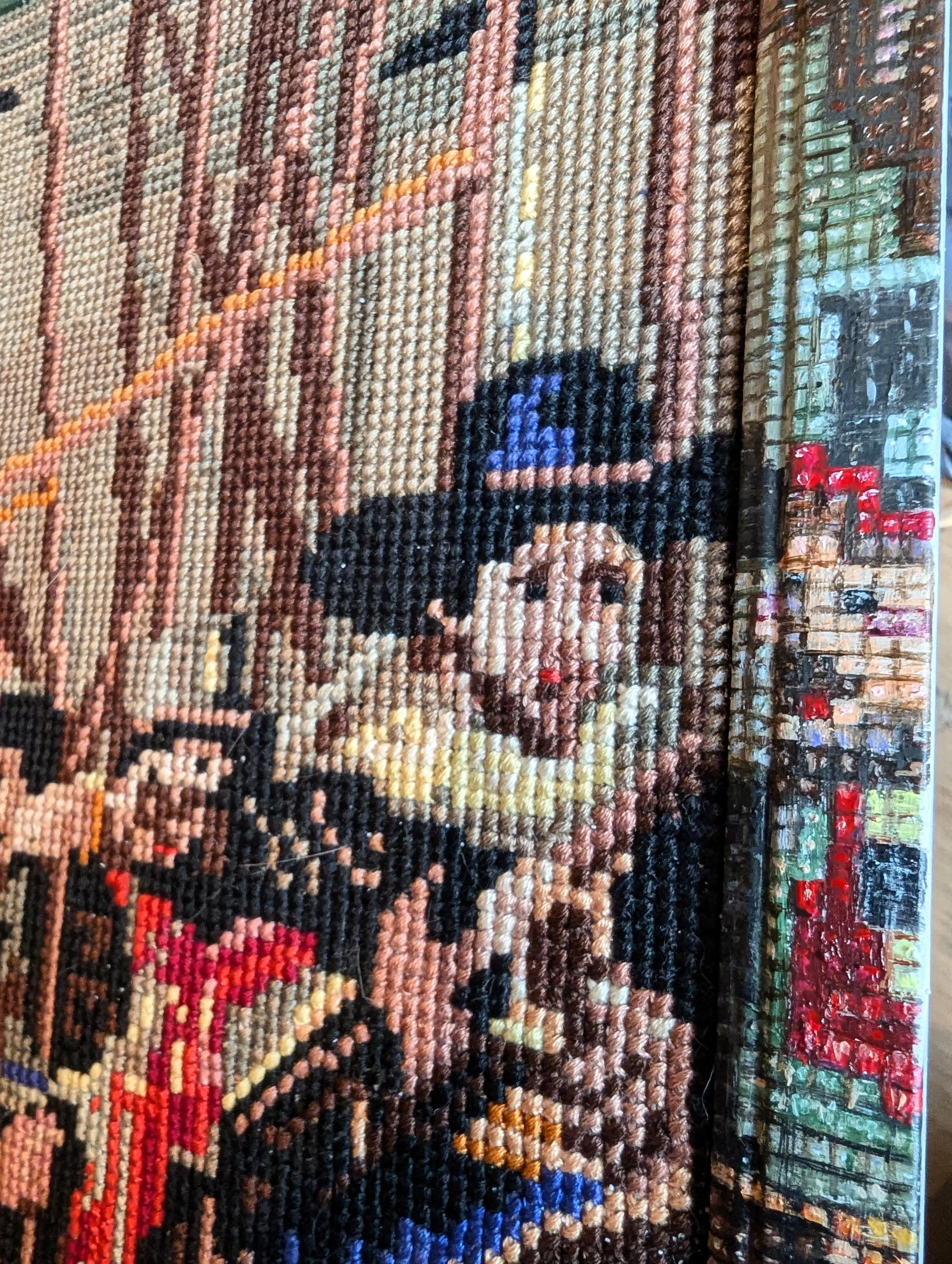
I am currently about a fifth of the way through painting/healing the 70x60cm cross-stitch, which both is and is not a lot of progress on this piece. I’m learning as I go — it’s essentially a pixel art piece and while I have made those before, I have never PAINTED one before — so hopefully I can apply those lessons to the 47x57cm and 140x95cm versions.
Stay tuned as I further develop these paintings, as well as the Night Watch Burglary Tools!
Come See 'The Storm On The Sea Of Galilee' At Unit4Art In Gouda
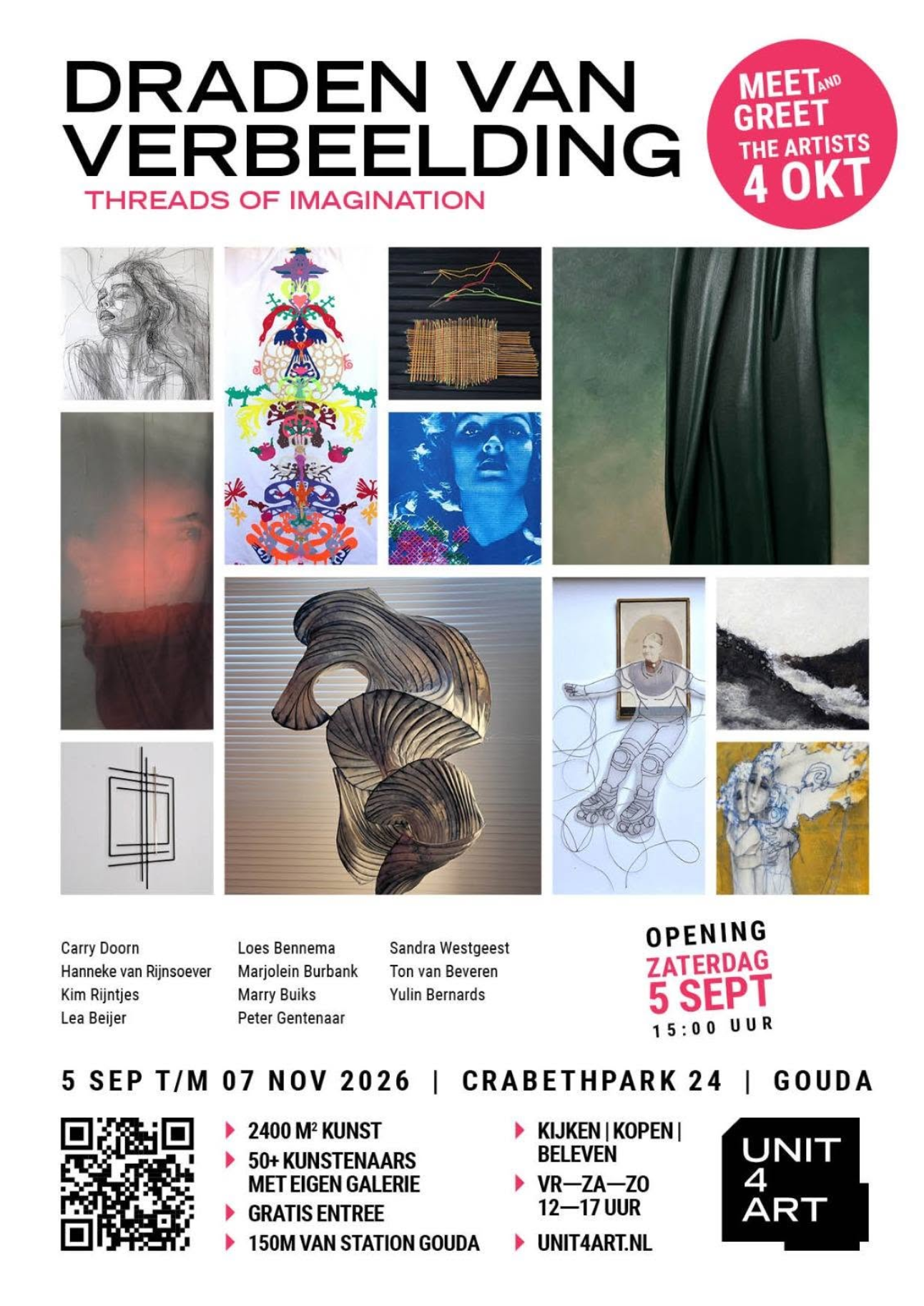
I'm excited to finally show this piece at Draden van Verbeelding -- an all-textile show at Unit4Art in Gouda. For the last year it's been hanging on my studio wall and every time I stare at it I think to myself, "I should really submit this piece to some galleries." But until now, no opportunity has felt right.
So now I'm extra excited to not only be showing it, but showing it in this context. There are some spectacular pieces in this show that are going to put my work to shame. I like being inspired by my peers and feeling challenged to grow my practice by them. :)
So if you're in South Holland between September 5th and November 8th you should stop by Unit3Art to see Draden van Verbeelding. There will be an opening at 15:00 on Saturday September 5th and a closing at 3pm on Saturday November 7th. More info can be found on Unit4Art's website.
Memory Seed Bombs - Progression
I thought I had more time…
But I always knew better.
With Alzheimer's, good days are finite. I knew that moving to Europe while my mother was still alive was functionally saying goodbye to her early. Between the distance and the expense of plane tickets and my own emotional avoidance; this move was always going to run out the clock on our time together. And it did. I do not regret that, but I have regrets about that – if that splitting of emotional hairs and word-lawyering makes sense. Anyway, this piece is about one of those regrets.
I started painting the Memory Seed Bombs when my mother was first diagnosed with Alzheimer’s. However, I never wanted her to be my “muse” for this series. That would have felt trivializing; like I was striping her of emotional agency in our shared horror story of familial loss. Years earlier we’d lost my father, my grandfather and grandmother (her parents), and my great uncle and great aunt (her uncle and aunt) to various, assorted memory disorders. We both carry those obituaries in our hearts and in our genes. Assigning her the passive role of inspirational angel would have downplayed her active grief.
She deserved better.
She deserved to have a Memory Seed Bomb painted for her, not just about her.
She deserved to receive the full experience and treatment that everyone else has received in this series – a seed bomb painted in honor of a lost relative, featuring an object/memory she associated with them, that is then planted and sprouted.
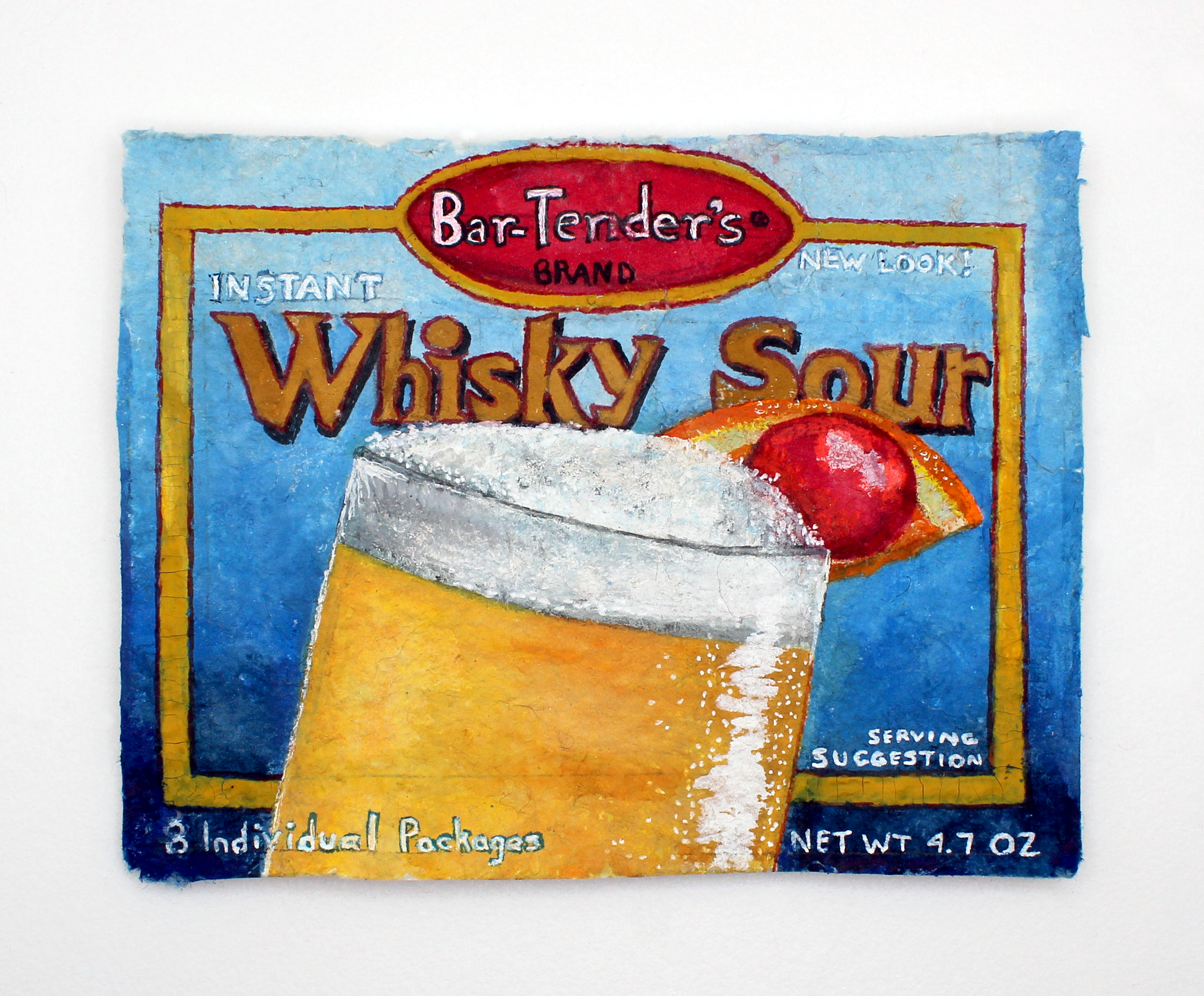
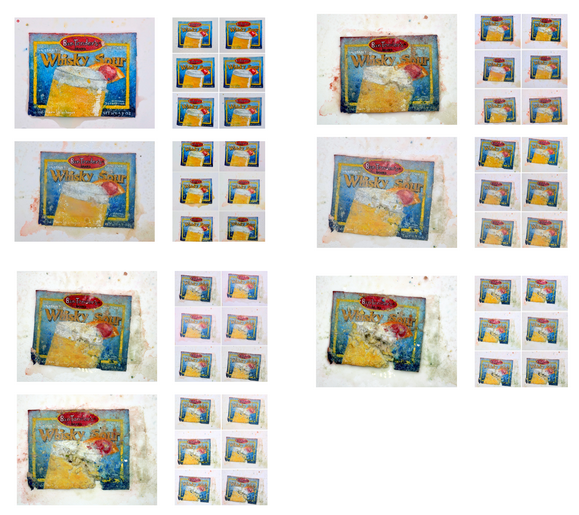
However, I was not interested in tripping into an emotional landmine with this. Offering to paint her a Memory Seed Bomb for my father was too painful; so I asked if she’d like me to immortalize a simple memory of her parents instead. She chose the whiskey sours they drank every evening after dinner. So I found an era-appropriate whiskey sour mix package and turned it into a seed bomb for her. Then life intervened.
There was the pandemic lockdown, we had to move her into memory care, I quit my job due to burn out, I moved to the Netherlands. And suddenly the visits became further and further apart. Until last year, when I went and it was mainly silence.
The moment to plant the seed bomb together has passed.
So for fifty days I watered her Memory Seed Bomb for her, sprouting the forget-me-nots inside. Going through the motions of remembrance, celebration, and grief that she no longer can. This memory may not originally be mine, but in a way, it is now.
A Micro Series Of Micro Vermeer Works
In the era of Vermeer and Rembrandt, if you wanted to become a professional painter in the Low Countries you first had to do an apprenticeship in the painter’s guild; the Guild Of Saint Luke. Apprentices would start out doing the lowest of grunt work – maintaining the studio, cleaning brushes, and mixing paints – before eventually moving on to learning the master’s style through copying exercises. Obviously, in my own studies of Dutch art I skipped that first step and went straight to the copying. I blame my impatience. Which somehow, beyond understanding, manages to coexist with my belief in the power of disciplined, repetitive exercises as a learning technique. Would I have done well as a painting apprentice in the Dutch Golden Age? Perhaps not.
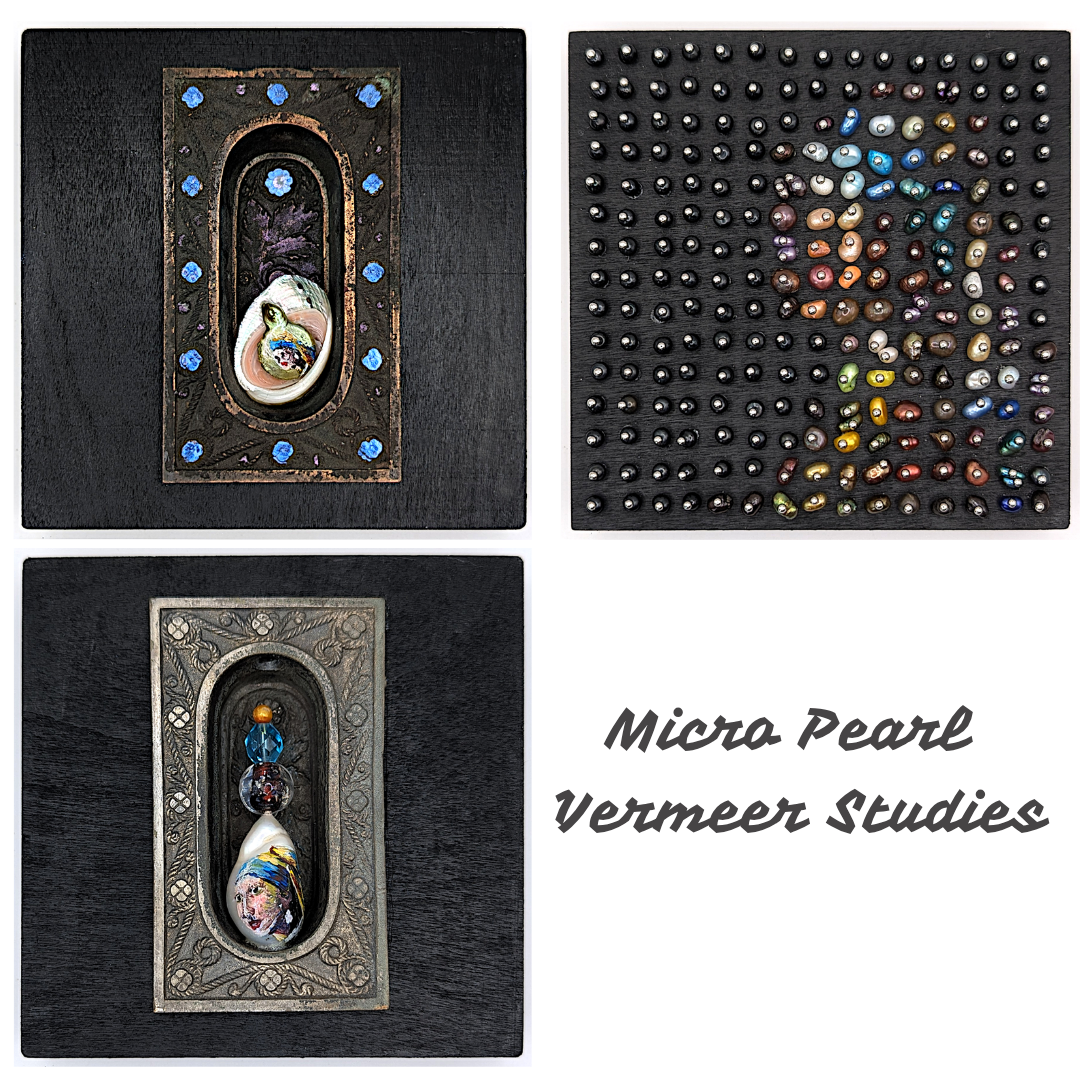
Regardless, in honor of the painter’s apprentices of yore, I wanted to do a micro-series of micro-studies of Vermeer’s Girl With A Pearl Earring. These quick (for my work) gestural sketches are an attempt to attain mastery over this particular Vermeer painting. Using pearls, pins, paint, beads, and various lock mechanisms (those vitrines are made from antique strike plates); the seven pieces conceptually and materially flow into one another in a way that I truly love. Perhaps I need more tiny art in my creative life?
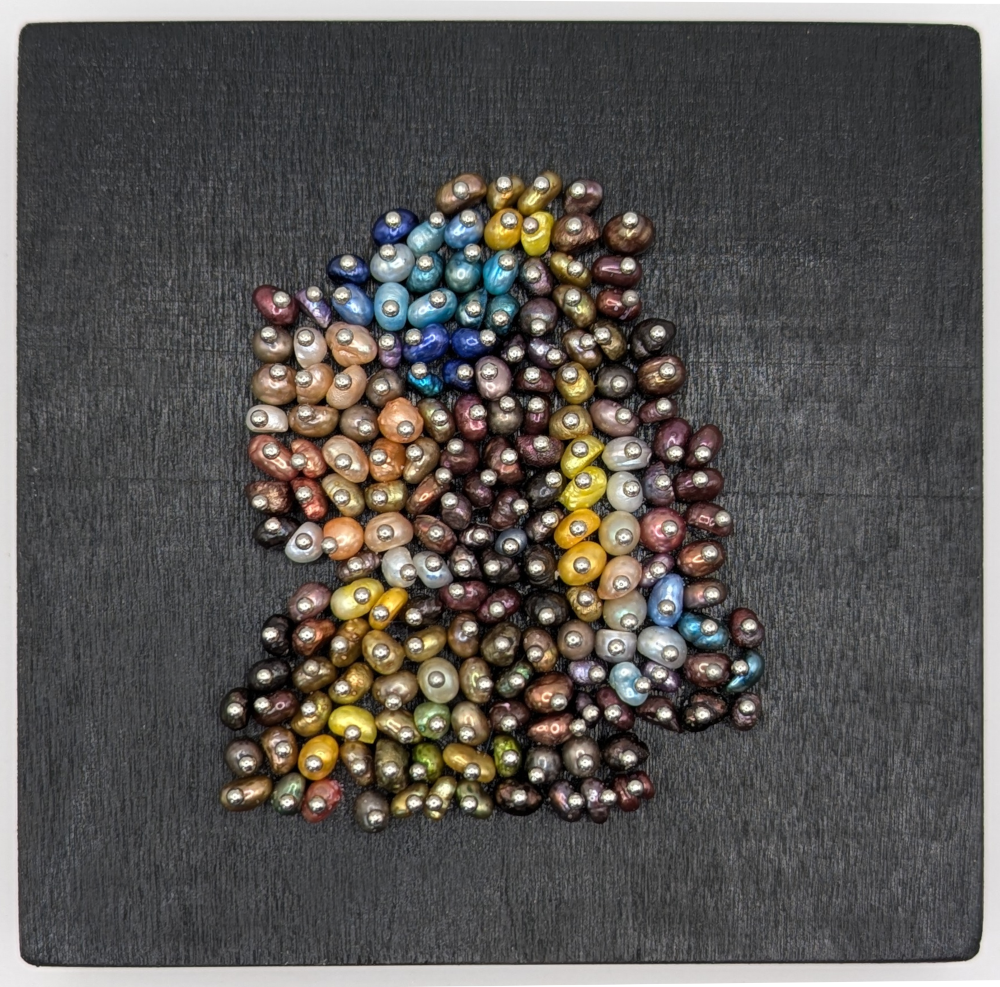
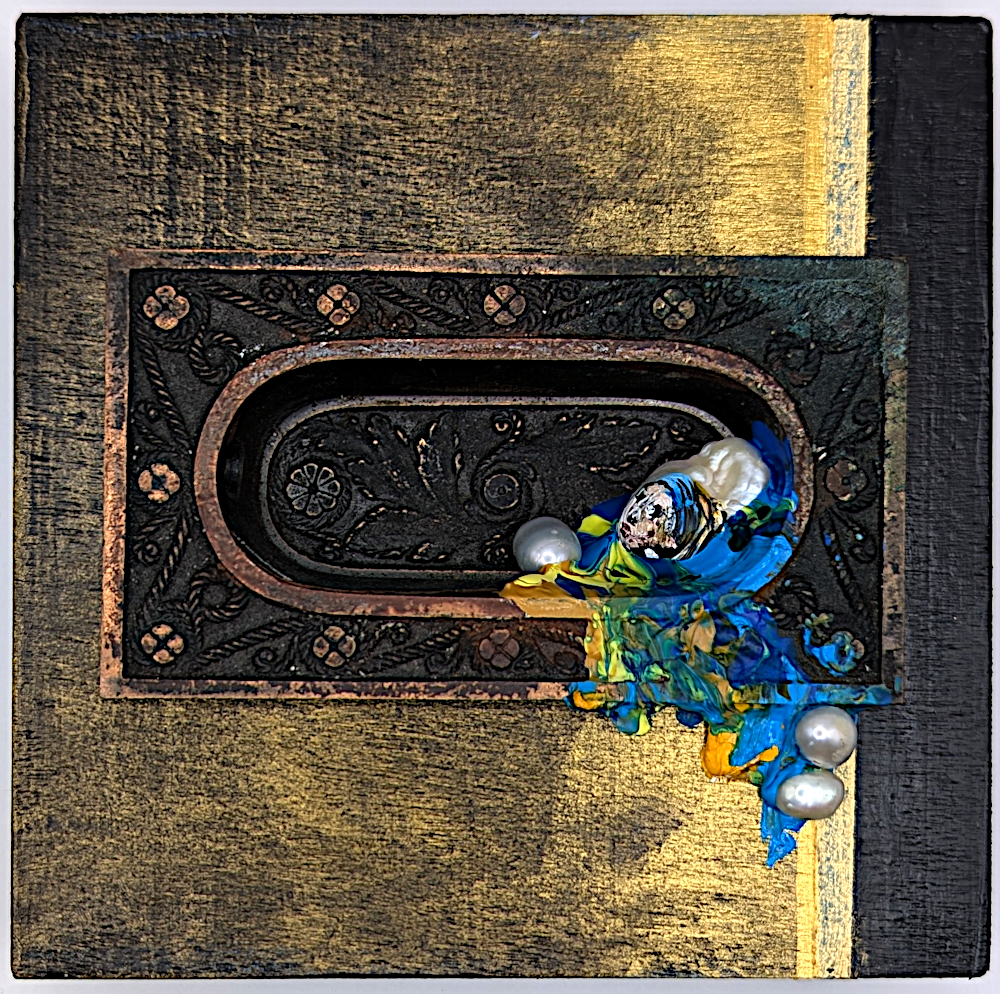
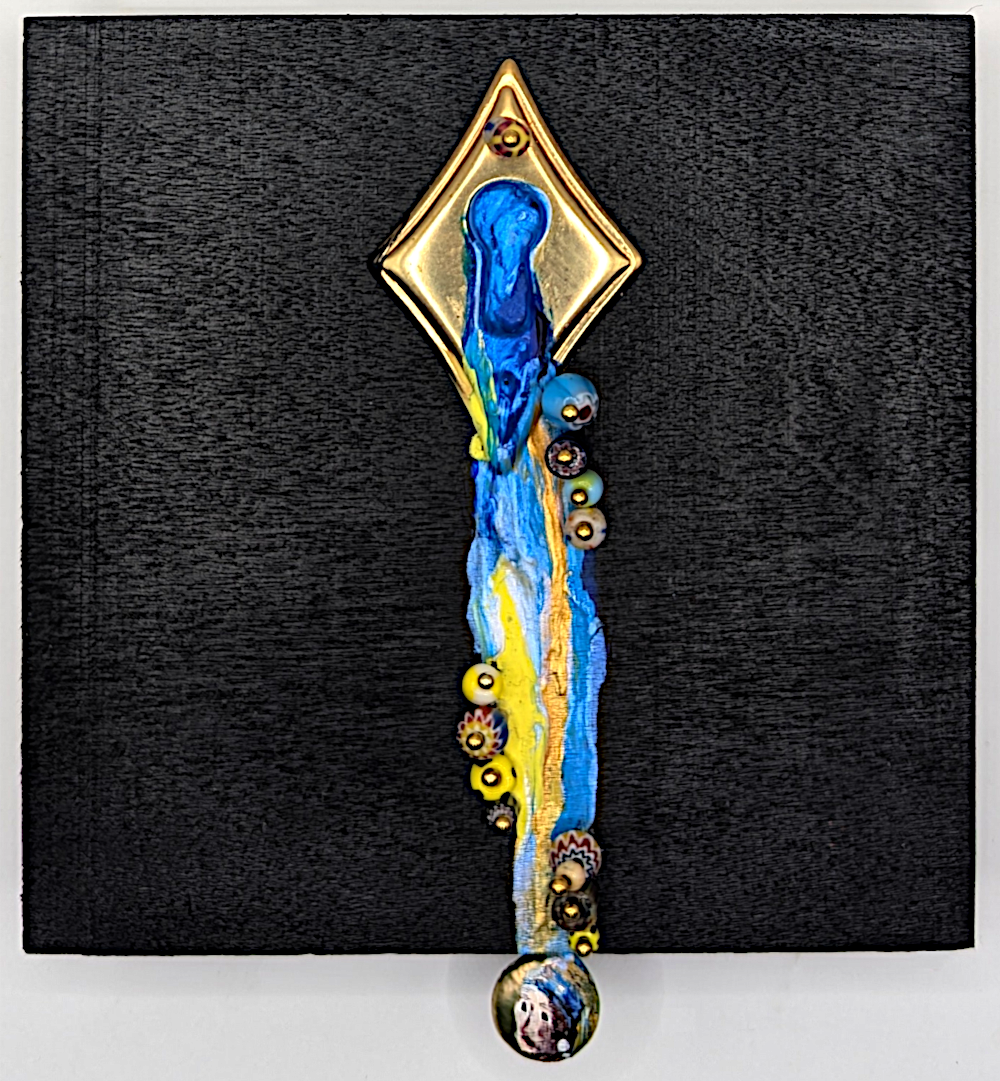
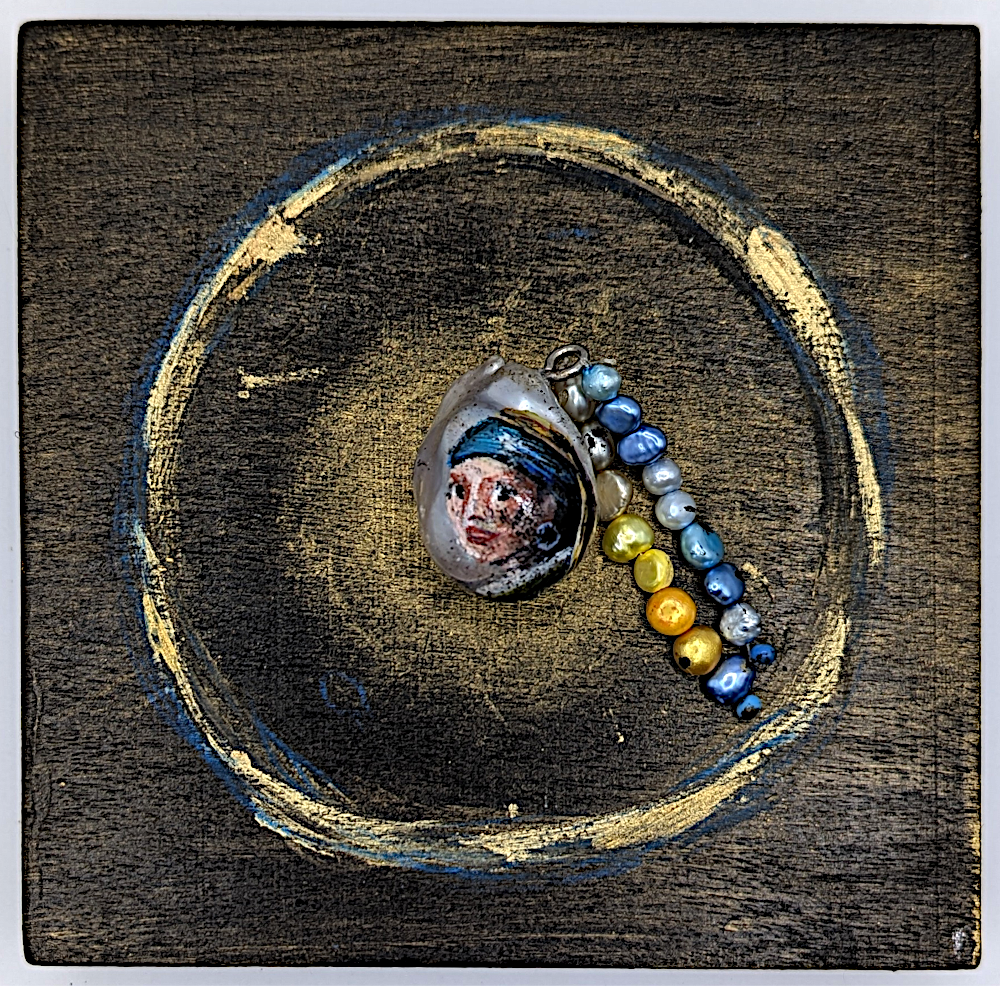
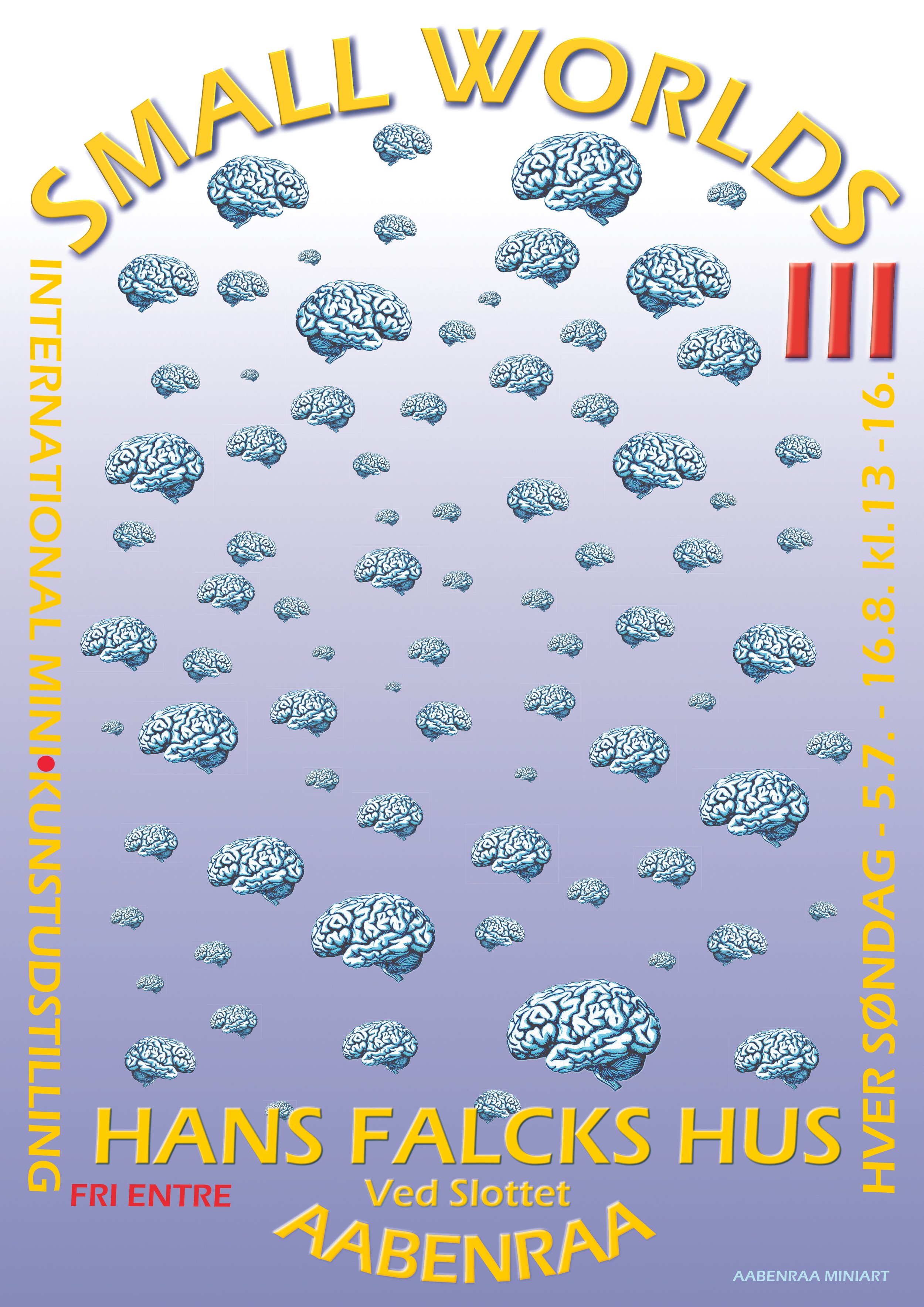
The pieces are currently in Aabenraa, Denmark for a show of tiny art pieces called Small Worlds III. I’m hoping that someone buys the whole set to keep them together; but if not, I’ll be splitting up the paintings and listing them on my site at the end of July. If one speaks to you, send me an email and we can discuss putting it aside for you once it’s come back home.
Introducting A New Series About Rembrandt and The Night Watch
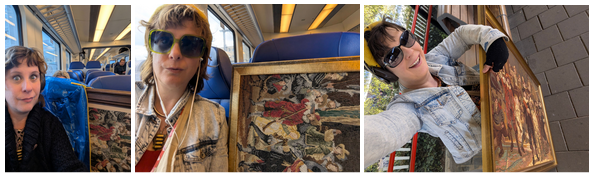
For the last couple months, I’ve been traveling around North and South Holland collecting vintage cross stitches off Markplaats (essentially, the Dutch Craigslist). Specifically, cross stitches of paintings by the old Dutch Masters. I’ve bought some super cute, aesthetic Vermeers, but mainly I’ve been buying different takes on Rembrandt’s iconic painting The Night Watch.
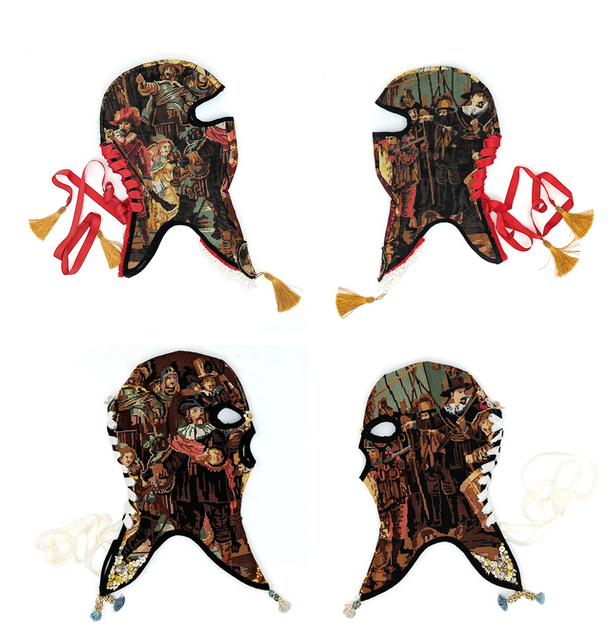
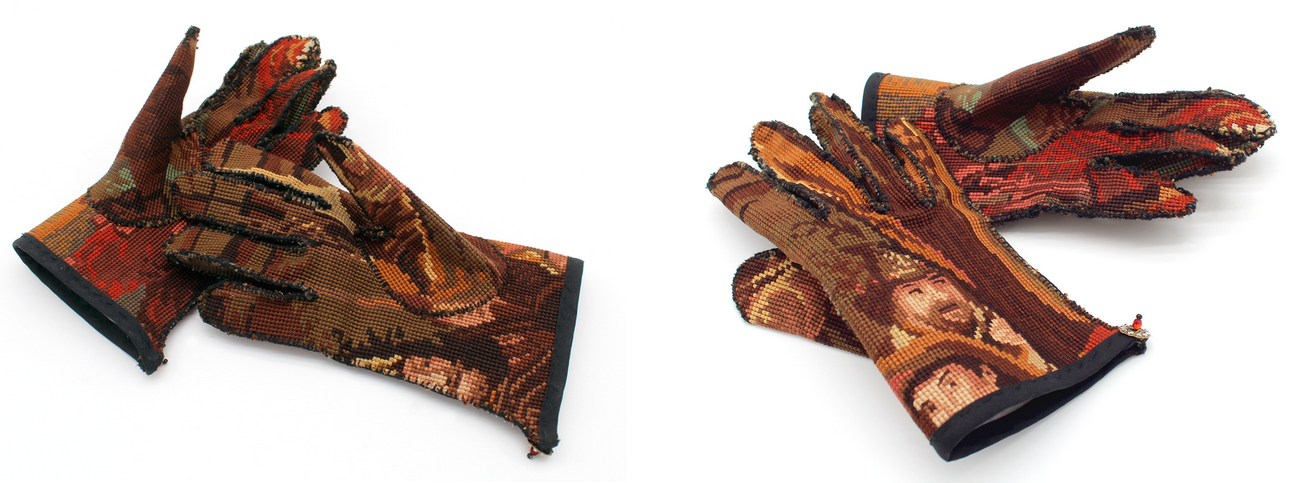
Now, I love cross stitches as folk art objects, but I also love them as a raw material. Cross stitches make wonderful elements in soft sculptures and mixed media textile pieces. Something about their almost pixel-art quality is so graphic and easy to work with. So I’ve been taking all these cross stitches, cutting them up, and sewing them into soft(ish) sculptures – specifically, into sculptures of common burglary tools.
Right now I have two balaclavas modeled after the two central figures in The Night Watch, a pair of work gloves, and a hacksaw; but there are about a dozen other elements in the works.
So why burglary tools, and why The Night Watch?
The Night Watch was a commission painted in 1642 by the Dutch master Rembrandt van Rijn. It depicts Amsterdam’s Militia Company of District II as they are about to go on duty patrolling the city. These militias, or schutterij, were voluntary civil guards made of influential city elites and were intended as supplemental military support, helping protect the city in case of attack, revolt, or fire. Now, The Night Watch was painted in the last years of the Eighty Years War, when the revolt was no longer directly impacting Amsterdam. Which is right around the point where the militias transitioned into purely social, fraternal orders of rich dudes – basically drinking clubs with fancy uniforms and weapons.
So in this painting they are pantomiming safety and security and order. There are no Spanish troops to fight, but they’re going through the symbolic motions as if there are. And me? I am pantomiming danger, violence, and chaos while wearing the guise of all those noble aims.
If you remember, earlier this year I finished a three-part series about a different Rembrandt painting – The Storm On The Sea Of Galilee – that focused on its theft and how the loss of the painting has been emotionally navigated after the fact. This new series is essentially its more nihilistic spiritual twin. Where The Storm On The Sea Of Galilee was about handling loss, this Night Watch series is more about the futility of fighting against it.
The Night Watch cannot protect you, because the Night Watch is theater. Theater with loaded muskets perhaps, but theater nonetheless. In the end, chaos will exploit that weak spot, that belief that someone is coming to save you, while robbing you of everything you care about.
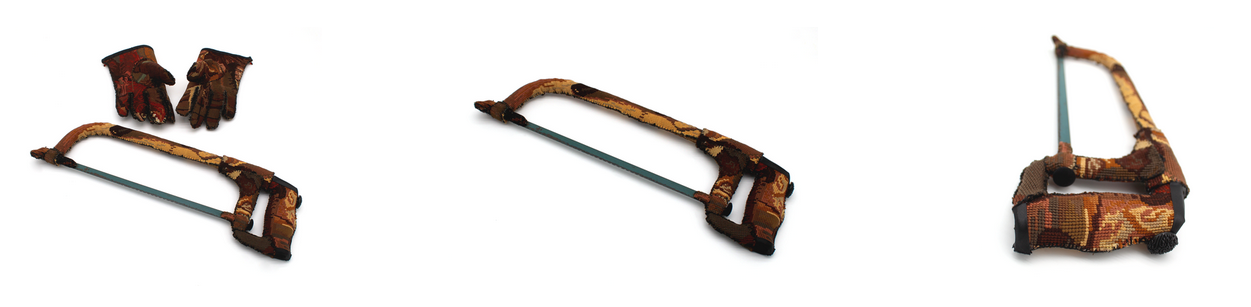
At least, that’s where the series stands right now…
This series is so new it doesn’t even have a name yet, so some aspects of the tone may mellow over time. But since I’ve been sharing elements of it on Instagram and TikTok already, I thought it was time to start sharing the context. I’ll post more updates as I build more of the burglary tools and start piecing together the larger installation.
Tell me, dear readers – what burglary tools should I make next?
Am I accidentally making art about the Five Stages of Grief?
Psychological frameworks feel safe, stable. A roadmap to the unmappable, they arm us with an understanding of our experiences. Albeit sometimes in kooky, Kool-Aid flavored and patchouli scented ways.
I have often kept these kinds of pop psychological frameworks – and their close relative, the personality test – at arms length. Greeting them with the full might of my grumpy skepticism, I’d dismiss them as the domain of self help books, HR offices, and the spiritual girlies. “Me? Well, I don’t know about you, but my unique personal experiences can’t be understood through such a generic, reductionist format.” A sentiment exhibiting just a wee bit of egotism and unhealed trauma from that Four Temperaments quiz in seventh grade Health class. *shudder*
So to say I’m an unlikely candidate to make art about the Five Stages Of Grief would be somewhat accurate. It is simply not the way I have approached loss in either my personal life or in my work. However, the more I turn my Dutch Masters series over in my head – not the pearl Vermeers or the Rembrandt tube paintings, but the broad overarching story of studying Dutch art history as a cultural integration tool – the more I can see its structure guiding the work.
What are the Five Stages Of Grief
The Five Stages of Grief, or the Kübler-Ross model, is a framework developed by psychiatrist Elisabeth Kübler-Ross to understand the emotional journey we undergo following loss. The five original stages were denial, anger, bargaining, depression, and acceptance; although later versions would expand the roadmap to include shock and processing. However, the original five remain foundational to how we popularly understand the process of grief. Even if they are neither scientifically proven, linear, nor a universal process.
Immigration As Grief
So what am I grieving?
First, some context. A therapist once described my interior emotional life as academic. I process things slowly, which means I’m constantly looking in the rearview mirror to understand my emotions; the moment, and the feeling having long passed me by. When you can only understand yourself in hindsight, your relationship to yourself becomes a bit detached, impersonal. Still unprocessed thoughts and feelings exist outside of language for you. Unnamed, unknown, untamed.
Now, there are parts of my immigration journey to the Netherlands that still live in this feral, wordless place. That are still just smears of ash and ochre on a cave wall. It has been three years since I left the US and I’m still too in the moment to apply the full might of self-reflection to these experiences. Without the benefit of time and distance I cannot name, cannot know, and cannot tame them.
***
Let me state, flat out, that immigration to Europe is a fucking privilege. Not only is it expensive, but it is gatekept by so many requirements — both soft and hard — that can only be unlocked through massive class and body privilege. I will always be a realist about the pros and cons of leaving the US, this was very much written from the place of analyzing and feeling one of those cons.
***
The best I can do is say that immigration has felt like a little death. Not THAT one you perverts. But leaving the US is a transition that is huge and transformative and unknowable. It is a small taste, an amuse bouche, of that huge and transformative and unknowable transition that awaits us all. And it has changed me so much that very few of you truly know me anymore. I am a ghost in our old shared life but I cannot even haunt it properly; having been tossed up on distant shore, the spiritual and traumatic attachments severed but not cauterized.
How the Five Stages of Grief Map to My Art
So if I am carrying around all this grief for the person I was, for the country I was born in, for the life I had in the Bay Area, how does this map to the art I am making? And why am I specifically seeing the Five Stages Of Grief in it?
The Vermeer and Rembrandt pieces are part of a larger series – The Guild Of Saint Luke – that is about my immigration journey and my attempts at cultural integration. The idea being, that by studying and researching the Dutch Masters ala an apprenticeship in a painters guild, I could gain insight into my new home. So if this series is about immigration, and immigration carries some grief for me, then the groundwork for the Five Stages Of Grief have been set.
Looking at the Vermeer and Rembrandt pieces, how do those pieces map to the first two stages of grief?
Denial
The Vermeer pieces, to me, have an undeniable edge of sadness to them. But sadness is not a stage of grief, for it imbues all of grief. No, it is the way they are sad that feels like the first stage of grief – the stage of denial. While there is strength and joy in female solitude, that was not my relationship to it when I started depicting Vermeer’s singular female sitters. All those self-contained, solitary women remind me of how early in my move, I would hide in self-imposed isolation every time I started becoming overwhelmed. Which, due to brain wiring, was often. Of hiding behind garden fences and front window curtains because everything beyond their demarcation was fraught with anxiety and the Unknown.
This refusal to engage, this disassociation-as-lifestyle, is a form of denial. Both a denial of reality and a denial of the discomfort and experiences required to grow. When we hide from the world, the world leaves us behind. Which is where/how it is so easy to get mired in this stage of grief. (is this why it took me so long to finish this body of work?)
Anger
There is not a lot of subtlety to the anger in the Rembrandt pieces. The impotent rage flailing against a senseless, violating loss is fairly surface level. The Storm On The Sea Of Galilee was stolen and likely destroyed. And for what? Nothing. A giant gapping hole in the collective culture and the Isabella Stewart Gardner Museum’s collection. We are all poorer for its loss. That is not fair and I’m angry about that. Actually, nothing is fair and I’m angry about that too. Angry, angry, angry.
And The Night Watch? That pompous pantomime of security theater? I am angry about everything that it represents. I am angry that we are offered up no better options for safety than fake it until we make it. Angry that we are expected to follow along in the charade. Angry, angry, angry.
Will there be a Bargaining?
I still have a lot of work left to do on the Rembrandt pieces, but I do know that Van Eyck and the history of oil painting will be the next stage. Will this map to Bargaining or will this emergent pattern be broken less than halfway through the series? It is still too early to tell.
Hell, even when I’m elbow deep in the series it will probably be too early to tell. The proper time and space for contemplation having yet to be achieved. But I’m interested to see how it all works out and if the Five Stages Of Grief will leave a mark on the rest of this work.
Some Of My Favorite Lawrence Gowing Quotes
Lawrence Gowing’s 1952 book Vermeer has been such a powerful inspiration on my work. Influencing both the materials I used and the paintings I chose to replicate; the Pixelated Pearl Vermeer series would literally not exist without his writings. But it’s a bit of a black hole online. While there are references to, and scans of, the book, there aren’t a lot of quote excerpts, especially around the pearl picture concept. So here is a collection of my favorite Lawrence Gowing quotes about Vermeer and his pearl pictures.
“Thus it comes about that we see Vermeer building the ideal shape of domestic and feminine life. The representation, the construing ever more closely of the aspect of the beloved as it moulds her mask of light, is also an independent, intact construction of the essential forms of female being, in their permanence.” — Lawrence Gowing, 1952, Vermeer
This is the particular theme of the pearl pictures, a gentile stillness of stature. The shape is vertical. The figure appears, tender and immaculate, out of the cleft shadow of the cumbrous furniture; it is rooted in it, rooted, as we see at last, utterly unmoving, to the floor. And beside this upright shape, this pillar, we come to know another, its antithesis that nevertheless easily and equally combines with it. It is the shape of a bell. It is noticed as the shape of the raised skirt in The Music Lesson. More essentially we remember it as the shape of rounded shoulders which is often the stooping shape of preoccupation, of a woman bent attentively over a table. It is a feminine self possession…” — Lawrence Gowing, 1952, Vermeer
“It seems as if he was of a god-like detachment, more balanced, more civilized, more accomplished, and more immune from the infection of his time than any painter before or since. Or else he was of a naivety beyond belief, all eye and nothing else, a deaf-mute painter perhaps, almost an idiot in the lack of any of the mental furniture that normally clutters the passage between eye and hand, a walking retina drilled like a machine.” — Lawrence Gowing, 1952, Vermeer
“… incident and material have evaporated and light is the sole active principle that remains within the confines of the picture. The window itself has a new significance. The inhabitants of the room turn to it as to the source of their being: its light recreates them.” — Lawrence Gowing, 1952, Vermeer
“Yet her distance remains; with gentle firmness the impartial tones convey it. Tangled defences are woven about her: she is enclosed in the impenetrable envelope of space. We have come upon female life in its whole secluded richness: engrossed in itself it is seen entire and unimpaired.” — Lawrence Gowing, 1952, Vermeer
Why I Painted Myself Into Remrandt's The Storm On The Sea Of Galilee
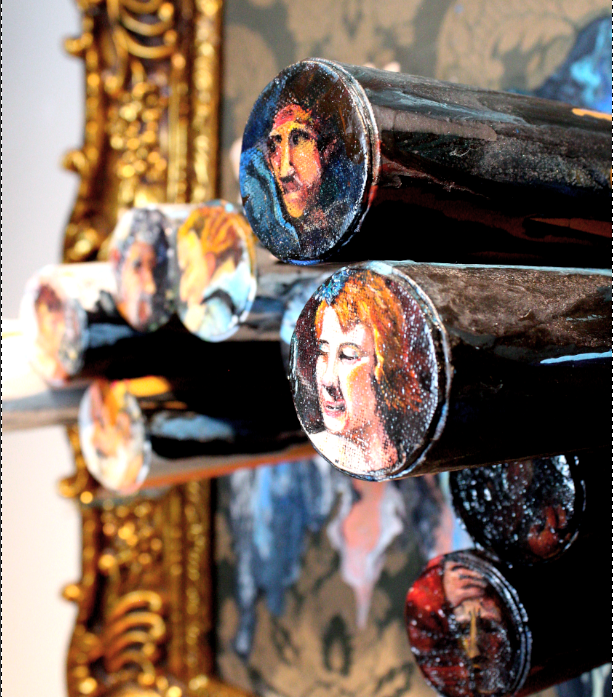
In exploration of this theory, I’ve created two mixed-media paintings where I’ve broken up the figures from The Storm On The Sea Of Galilee and painted them across a series of poster tubes. Between the two pieces and all the preliminary sketches, prototypes, and tests, I’ve probably painted each of the fourteen figures around four times. And while working on all those little portraits I was thinking a lot about that self-insert character of Rembrandt’s. About how he ropes the viewer into the painting, into the boat, and implies that we’re all stuck in this together – just us and Jesus – with just the power of his glance.
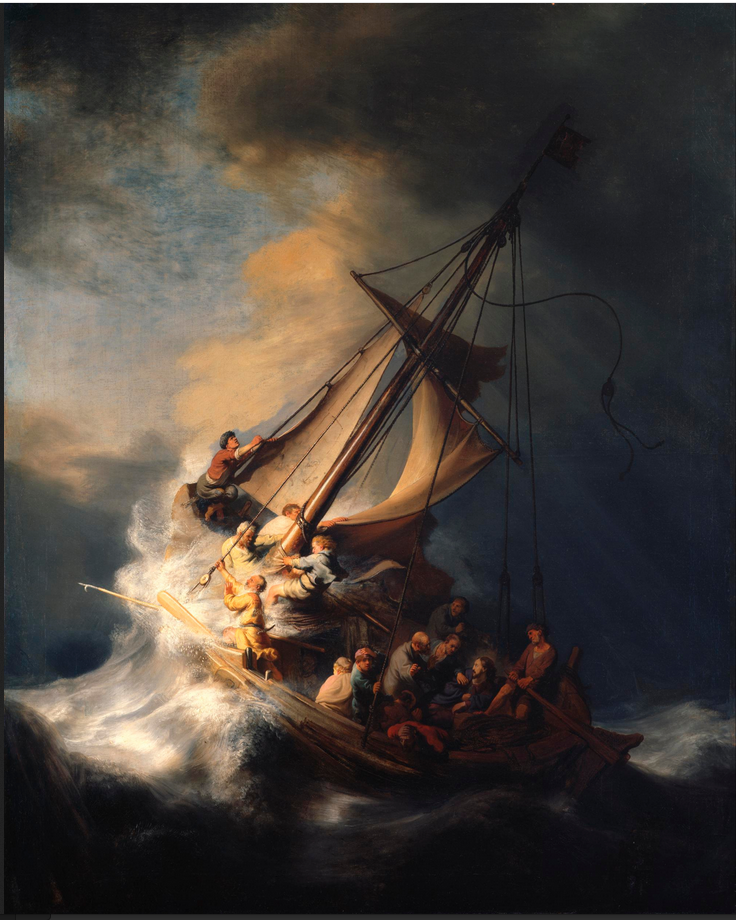
Rembrandt Painted Fourteen Figures…
Rembrandt’s painting The Storm On The Sea Of Galilee is considered a masterclass in using glances and lines of sight to convey meaning within a painting. Illustrating the biblical story of Jesus and his disciples encountering a storm at sea; it’s an allegory for salvation through Christ.
In it, some of the disciples turn their eyes to Jesus, who exudes calmness and light in the darkest part of the storm. They ask him to save them from disaster, to lead them out of the storm to the clear skies breaking on the horizon. Other disciples, their backs turned to Jesus and their eyes averted from his gaze, try to save themselves. They fight a fraught and losing battle with the boat’s sails as the storm rages on around them, unaware that salvation is right around the corner.
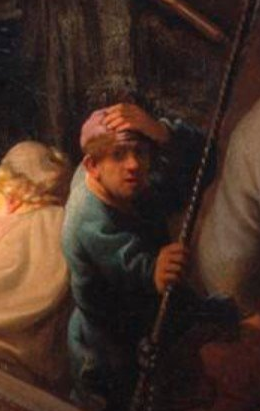
Only one figure stares at the viewer. Not a disciple, but a self-insert character of Rembrandt himself. He stands between the two groups – those motivated by fear and those motivated by faith. Rembrandt’s self portrait can be seen as a representation of the universal human struggle between those modes of thought. With his eyes he implores us, the viewer, to consider our fate on this boat of life, and how turning our life over to Jesus can help us weather the storm.
It’s a beautiful painting, but it’s not really a subtle painting.
As an atheist, Rembrandt’s religious works aren’t really my favorite Rembrandt’s. But I do love this painting, if only for the dramatic backstory of its theft from the Isabella Stewart Gardner Museum. As you know (I think?) I’ve been making a lot of art about the repercussions of that theft, specifically about the potential fate(s) of this painting and the theory that it’s been rolled up in a tube for thirty-five years.
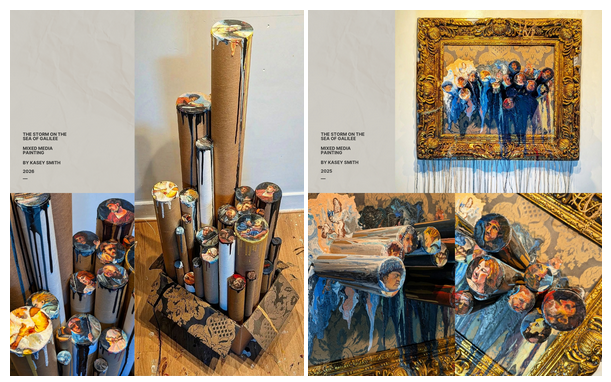
In exploration of this theory, I’ve created two mixed-media paintings where I’ve broken up the figures from The Storm On The Sea Of Galilee and painted them across a series of poster tubes. Between the two pieces and all the preliminary sketches, prototypes, and tests, I’ve probably painted each of the fourteen figures around four times. And while working on all those little portraits I was thinking a lot about that self-insert character of Rembrandt’s. About how he ropes the viewer into the painting, into the boat, and implies that we’re all stuck in this together – just us and Jesus – with just the power of his glance.
… And I Painted Fifteen Figures
Which brings me to the fact that there are FIFTEEN figures in each of my two pieces.
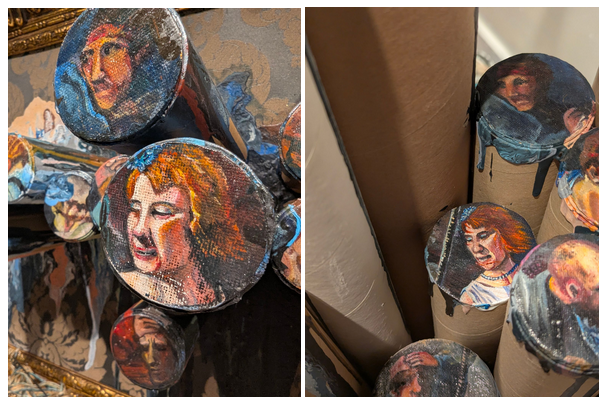
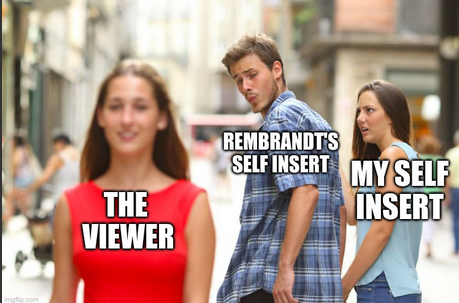
That’s because I decided to make my own self-insert character and add her into the pieces. And just like Rembrandt, I was very intentional with her gaze – where it lies and what it means. My self insert looks to Rembrandt. Looks at him, looking at the viewer. Looks at him as a stand-in for the legacy and corpus of art history.
Just as Rembrandt inserts himself into this biblical story, here I am inserting myself into the canon of art history and into the presence of one of the great Dutch masters. It’s an insertion marked by deference. I’m not THAT full of myself. I’m not claiming the viewer with my gaze – only the great master can do that. But I do look to him for creative guidance and inspiration as I continue my exploration of Dutch art history and what it means to live and create work in the Netherlands.
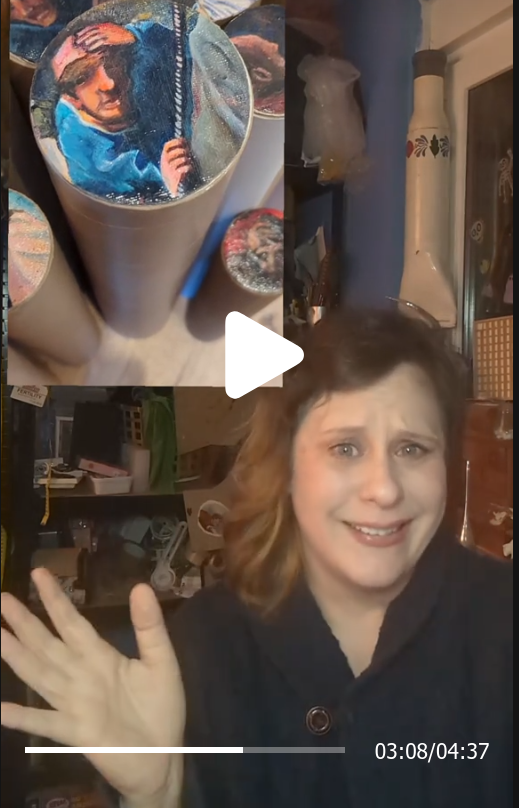
@kaseysmithdesigns Putting all those art history classes to work by doing a deep dive into why I added myself into Rembrandt's The Storm On The Sea Of Galilee. #artistsoftiktok #arthistorytiktok ♬ original sound - Kasey Smith
There Are Slugs In My Bathroom
In 2002 I took a class on Writing For Artists. It was a combination of business writing, creative writing, and book arts. Equal parts silly and serious. One of the sillier tasks was to write our art manifesto. Keep in mind, this was fifteen years before I started making art with snails. Prescience in action.
Part 1
There are slugs in my bathroom. Fat slimy slugs that leave glistening slime trails on the linoleum and burst under your toes in the dark... I don’t know where they come from or why they have chosen the bathroom of all rooms to colonize, but they are there. My toilet bowl is crisscrossed with the silver tinsel of their trails, and I, the master of the house, cannot plug up their hole because I cannot find it.
Although I still flush them down the toilet, these slugs are my new totems of willful, dedicated disregard for arbitrary boundaries of thought and action. No other animal is so invasive of my personal space, so unwarranted in the routine of my daily life. Ants and mice are tempted into trespass by the allure of breadcrumbs and spilt sugar- spiders by the shelter four walls and a roof can afford a fragile web. There is something natural about their presence in my run-down little home, while they are not supposed to be there, it is not necessarily illogical either. As I stare sleepless at the ceiling, I can hear the nighttime frolics of the mice inside my bedroom wall and I know that it is their lot in life to be there, just as it is mine to be too young and poor to avoid them.
Slugs have no reason to seek out the linoleum floors and fluorescent lights of my bathroom. Their appearance is a mistake, a fluke, an aberration, or maybe a revolution - I should not have to tiptoe in my bathroom to avoid their clammy skin and the feel of its rupture beneath my feet. It’s odd that they are in this space that both nature and human reason dictate that they do not belong. So I have built up a whole imaginary world, an embarrassingly detailed narrative to explain the adventures they have sporadically undertaken in the bathroom.
I imagine that…. the slugs have grown tired of the cold damp earth beneath the house, of the moldering leaves of the yard, and that they feel the need for change. Perhaps they were forced there as refugees, their homes having been destroyed by the ruthless invading armies of beetles from next door. Perhaps their jobs at the dirt factory were downsized due to the weak economy and now they’re searching for work on the shower mold farms. Or perhaps cold porcelain invites them because it is the last frontier to be conquered by invertebrate kind - because for so long it has been deemed uninviting - so foreign to their normal range of sensation and experience that normal life could not function within its parameters. Maybe, just maybe, to live life on the edge of the sink or the toilet bowl is to live life in the fast lane, to dream big dreams, to live and die fast and all those other clichés that inspire people (or slugs) to do rash and beautiful things with their lives.
As an artist I ask myself where is the endless porcelain fronteir, the linoleum canvas upon which the story of my passing shall be written? All great art comes from the place inside that questions prepackaged expectations and only listens to the voice of personal experience no matter how sinister or deviant its suggestions are. No matter how contrary to all “natural” modes of thought and decorum it may be, the voice of personal experience is the voice to listen to because it is most intimately one’s own. Our assignment as artists; strive to uncover the new, to colonize that space as ones own and to never stop reaching for that elusive next step, next move, next brushstroke, or next idea which was undiscovered….until you came along. Then it will be forever and undeniably yours no matter who may walk or think or paint or sculpt in your footsteps. You are the first and as far as the history books and the annuls of fame are concerned, you are the only and the greatest as well.
Part 2
Every act of bravery has its consequences. To play the part of the pioneer, the revolutionary, the genius, the artist is to risk everything on something as immaterial as a dream. I admired the slugs in my bathroom but I still flushed them down the toilet. I did not release them into the backyard, I did not raise them as pets in a jar – I killed them because they aspired to a world in which they did not belong. Neither nature nor culture takes kindly to improvisation upon their designs but is it impossible to deviate and defy them and not be annihilated under their footsteps?
When I was little my mother attempted a rose garden along our front fence. Long abandoned to the deer, the bugs and the weeds, I can still recall why she loved it and why it pained her to give up her dream of a white picket fence wreathed in heirloom roses. For the fence the roses grew on held a dirty secret- along its underside, hidden from the sun, was a colony of snails and slugs so large that in portions, the white paint of the fence could not be seen beneath the mottled brown shells that huddled against it. With stick in hand, it was my job as “mommy’s garden helper” to knock the snails and slugs off the fence and into a bucket. I would run the stick against the rails, enjoying the rhythmic rattling sound of the stick (rat-tat-rat-tat, like a gun, or a car, or a bike tire with a baseball card in it) and the hard plops that the snails made as they fell into my pail (plop, plink, plop – depending on whether they fell against the bucket’s side or their fallen comrades).
There were so many- some days, the bucket would be near overflowing – and I would have nowhere to put them all. It had never been explained to me what I should do with the snails and slugs after they had been gathered off of the fence. I had simply been told that they did not belong there, that the space they inhabited belonged to my mother and her
beautiful roses, not to such primitive and unattractive pests as these. My mother, infamous for avoiding touchy subjects, probably had not wanted to go into the logistics of garden pest extermination and had assumed that her bright young daughter would simply devise a method on her own. And I did – I threw them in the street and let the cars and bicycles take care of the rest.
Perhaps that is why there were always so many of them along that fence, huge clusters of mucous membrane and kinotine shells – like withered grapes oozing fermented juice as they rotted on the vine. I couldn’t have been throwing them more then ten or twelve feet away from their home. I assume that those who avoided being smashed by cars simply crawled their way back to the garden, living to pester my mother and her roses another day. Perhaps, in some small way, it is my fault that all those beautiful roses are gone, ripped out and replaced with hardier – and uglier – plants such as lavender and sage. But all I knew at that young age was that the snails did not belong along the fence – that they were violating some secret insect code of honor that said only weeds should be eaten, only uncultivated parts of the yard colonized.
How many times could a snail or a slug have been saved by luck from the wheels of the street traffic outside my house and returned to their home along the fence? Were there great-great-granddaddy slugs that would tell all their itty-bitty grandbabies about what life on the asphalt was like? “Grandpa, Grandpa, tell us about the great exile of 87’ when you had to crawl back to the Fence through the Asphalt Desert! Tell us the part about the great Round Rubber Beast and how he almost ate you ! Please, please, tell us just once more.”
The snails endured and prospered while the roses suffered- value judgments aside, their determination to live in that garden and not be exterminated and/or displaced by an overeager five year old was beautiful. Perseverance is a powerful quality for change; a necessity when one finds oneself in opposition to the cold and brutal so-called “truths” of reality. Vacillation is not the way of the artist- perseverance is the handmaiden to creativity and must be cradled and nurtured in order to fully realize ones potential as a creative individual. I tried to dominate the snails, alternating between stern executioner and gentle obedience trainer. In the end, the snails were neither eradicated nor domesticated as they refused to obey my commands to die or my commands to behave. True, they suffered for it. Dried out like leather on the pavement, shattered like holiday baubles – they died in what I would imagine to be horrible ways. But not all of them did. Some persevered and lived to eat the roses, procreate, and eat the roses another day. Dreams can never be allowed to become so much dead tissue on the pavement because just as the cars and bikes and pedestrians cared not for the lives ended beneath their weight, the world will not notice either. We are the keepers of our dreams, and god fear for the day when we become their mourners as well for that is the day when we are no longer artists.
Part 3
My father has a way of using humor as leverage towards action. I was depressed for most of my teens, a fact that made me too disengaged with my surroundings to contribute much to either the household chores or chatter. My dad’s response was to goad me into action by calling me a “fat stupid slug”. This usually had the opposite effect, either deepening my silence or prompting me to tears. My senior year of high school, when the depression was lessening and I was accepted to UCSC – mascot the banana slug – he proclaimed that I had found the perfect school for me because they obviously respected “fat stupid slugs” enough the make one their mascot. I would do well there he said.
Well dad, I am a slug and I am a snail. To live and create as one sees fit, irrespective of the world’s nay-sayers, one needs the vision of the bathroom slugs and the stubbornness of the fence snails and all the luck possible in order to avoid the toilet bowl /car tire deaths of this world. I am a slug and I am a snail because I refuse to relent either in my vision or my action. I will not lead a blind and sedentary lifestyle, cut off from the outlets of my creative expression. I will listen to my intuition and let it lead me astray, and I will never be lead astray from it. In the end, years after I’m worm food, part of this world will still read in silver script, “Katherine Smith was here” because I did not shy away from the great artistic unknown but rather embraced it as the proving grounds for my creative ambitions.
I finally planted the Memory Seed Bombs I painted for my own family
Memory disorders haunt my family. Mainly on my mother's side, but my father's alcohol-related dementia does make an appearance in this tally of sad inheritances. My mother, my father, my maternal grandparents -- I've struggled to articulate what losing them has meant to me. Unable to form words, I've hidden in the world of objects and images instead. Letting my hands speak where my mouth could not.
Memory disorders haunt my family. Mainly on my mother's side, but my father's alcohol-related dementia does make an appearance in this tally of sad inheritances. My mother, my father, my maternal grandparents -- I've struggled to articulate what losing them has meant to me. Unable to form words, I've hidden in the world of objects and images instead. Letting my hands speak where my mouth could not.
Which is why in 2019 I started the Memory Seed Bomb Project to memorialize other people's losses when it was too hard to confront my own. Each seed bomb represents someone's memory or association of a loved one lost to memory disorders. Painted on special seed-filled paper, they're meant to be planted to allow the flowers inside to sprout and grow.
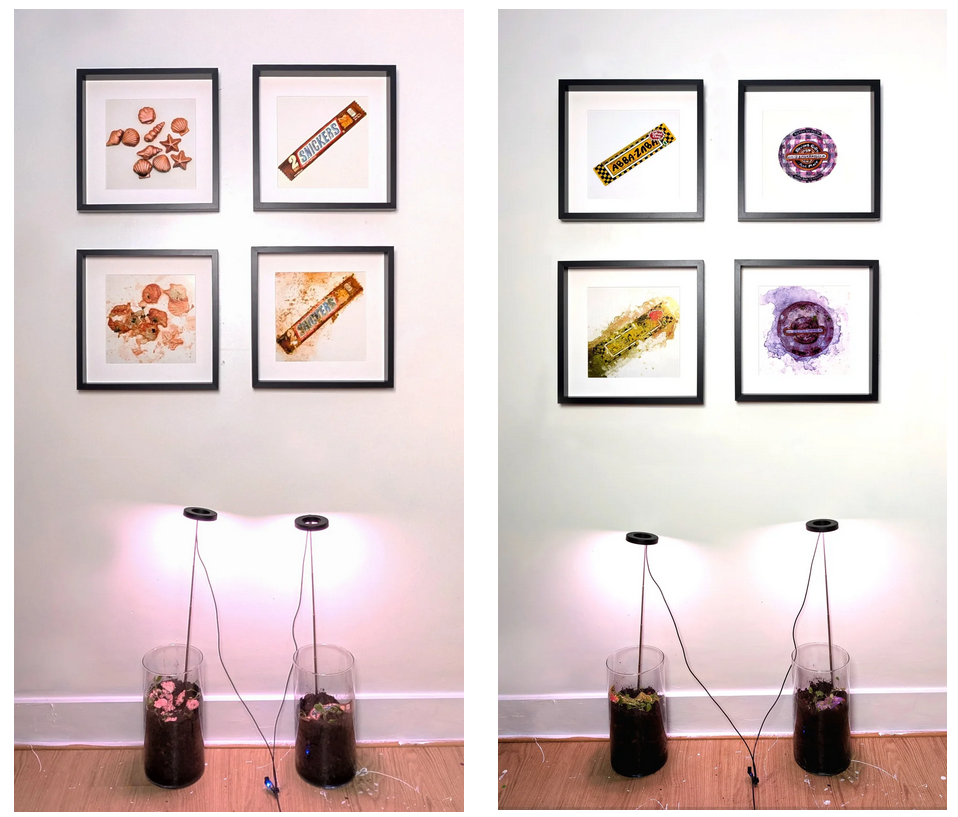
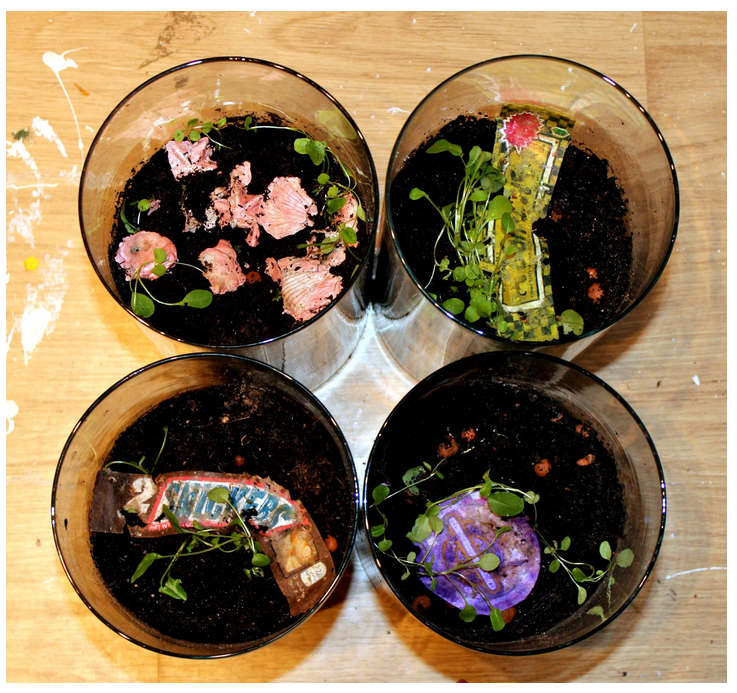
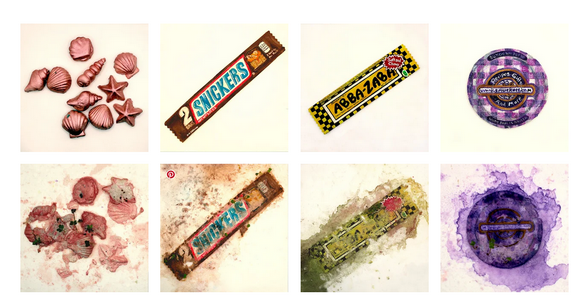
Since the inspiration for the project was my own family, I knew I'd eventually have to address that in the work. So may I present Memory Seed Bombs Lineages -- a photo installation celebrating my favorite memories of my mother, father, and maternal grandparents. Printed on archival paper, this photo installation shows the paintings both before and after they’ve sprouted, along with terrariums containing the resulting seedlings themselves. As with all the Memory Seed Bombs, these paintings were done with water color and ink on paper mache filled with forget-me-not seeds. Each was painted to-scale (although they were not printed to scale), to better recreate the memory/object they are associated with.
Decorative Seashell Soaps — These are for my grandmother, who died in the 2000’s of vascular dementia. Her house in Orinda had a gorgeously outdated powder room done up in immaculate pinks and golds. Using it always felt like trespassing. As if I wasn’t guest-enough to qualify for being there. And when I did use it, washing my hands would give me anxiety as the only soap was a dish of perfectly formed decorative seashell soaps. Was no one in my family washing their hands? Because those soaps were perfect my entire childhood. Gross.
Snickers Wrapper — I’m convinced that most elementary school teachers come up with a gimmick and stick with it their entire careers. At least most of the teachers at my mother’s school did. Since she commuted in from Napa, at one point they tried to make her The Wine Teacher, but she insisted on being The Chocolate Teacher instead. She had all kinds of knickknacks and t-shirts and coffee mugs and bumper stickers about chocolate decorating her classroom and she always, always sang the praises of Snickers.
Abba-Zaba Wrapper — My father loved being an iconoclast in a tediously eye-rolling way. Why would you relish making things like gift giving or picking movies to rent or deciding on a restaurant so hard? I don’t know, but he certainly did. So of course he couldn’t request “easy” candies for his Christmas stocking. He had to pick a random one like Abba-Zaba which was only intermittently available in our town. They’re not even that good!
Smuckers Grape Jelly Lid — My grandfather was the first person I ever lost to a memory disorder. He died in the 1980’s when I was quite young, so unfortunately most of my memories of him involve a nursing home that smelled like pee and bleach. But I will always cherish the memory of his breakfast crepes packed with grape jelly and dusty with powdered sugar. I should really learn to make them one of these days. In his honor.
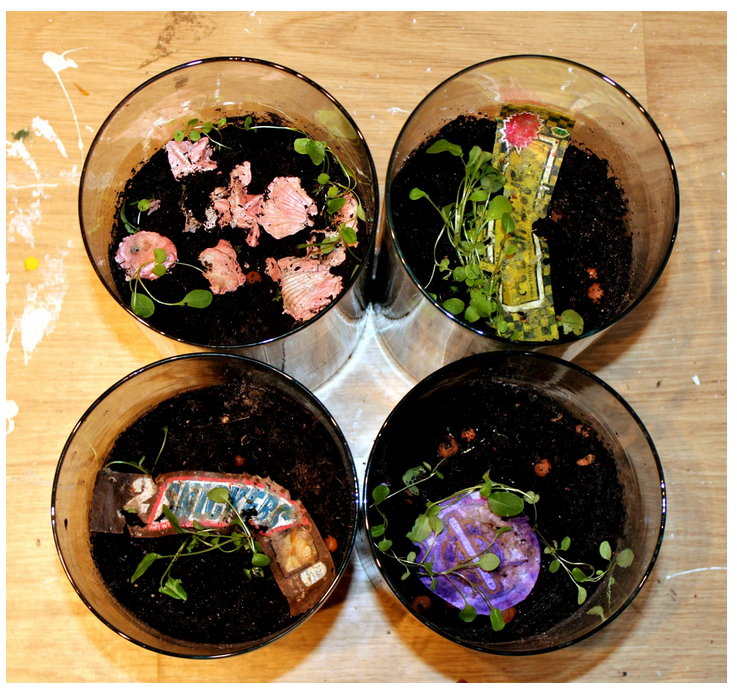
Of course, sprouts are only the beginning of the story. I am continuing to nurture these four seed bombs as they further dissolve and the forget-me-not seedlings mature. My goal is to eventually produce 100% of the seeds for the larger Memory Seed Bomb project from these four seed bombs.
From my family to yours feels like the perfect symmetry for this project.
The Storm On The Sea Of Galilee -- Parts 2 and 3
"The people that took these paintings don't have them hidden in some private art gallery, sitting back and just reveling in their beauty. These paintings are most likely up in an attic somewhere, or in a basement, not being viewed by anyone." – FBI Special Agent Geoff Kelly
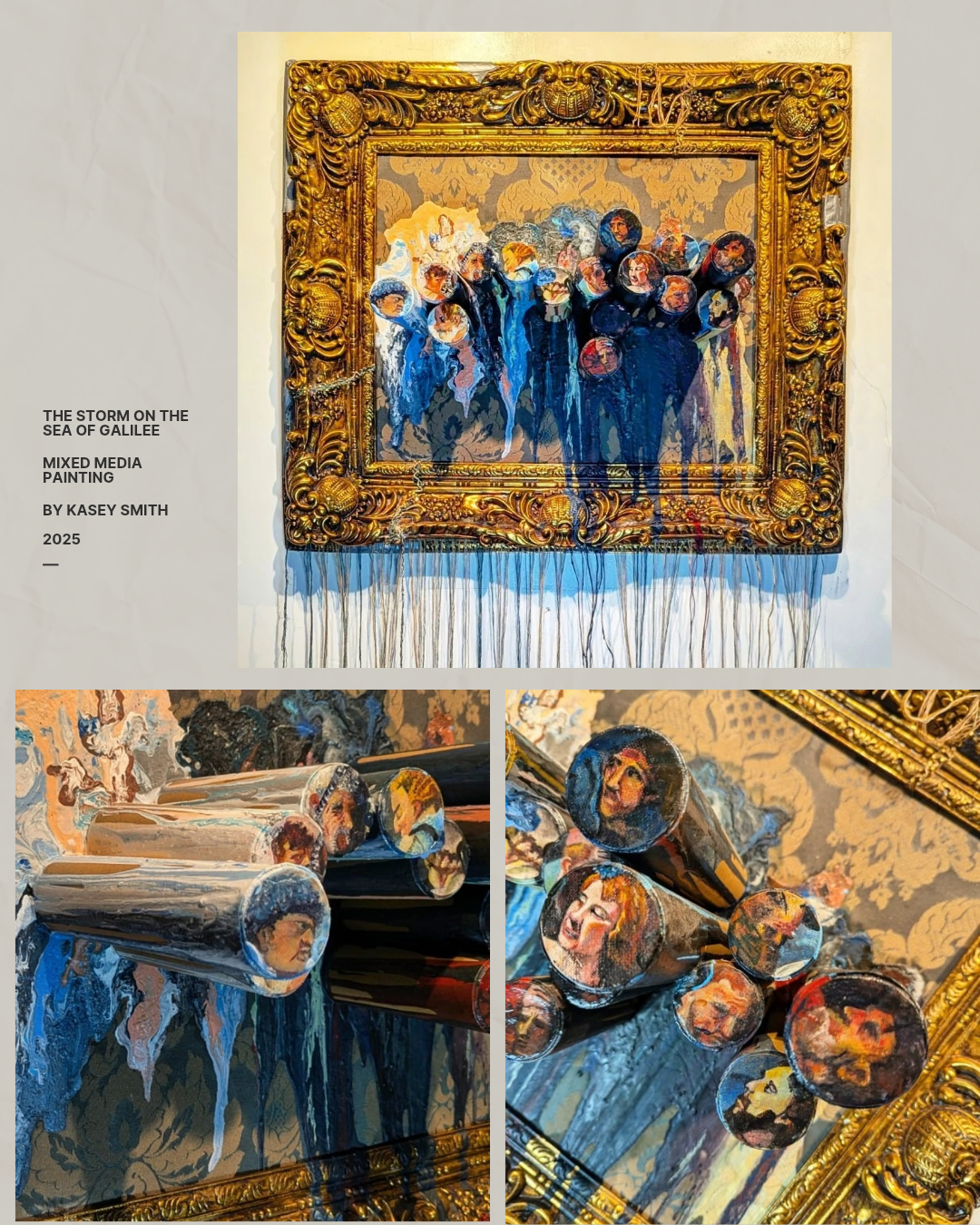
I want to introduce you to the second and third pieces in my series on Rembrant’s lost painting The Storm On The Sea Of Galilee.
The first piece in the series, which I introduced you to in 2025, was about how we navigate loss. It focused on the after effects of the 1990 theft and how the Isabella Stewart Gardner Museum responded to it in their curatorial decisions. The second and third pieces are about the inescapable grief of that loss. They focus on how this grief avoids easy resolution due to the lack of closure around the theft. Are the paintings still out there? Still findable? Still saveable? These questions remain tantalizingly unanswerable.
"The people that took these paintings don't have them hidden in some private art gallery, sitting back and just reveling in their beauty. These paintings are most likely up in an attic somewhere, or in a basement, not being viewed by anyone." – FBI Special Agent Geoff Kelly
I want to introduce you to the second and third pieces in my series on Rembrant’s lost painting The Storm On The Sea Of Galilee.
The first piece in the series, which I introduced you to in 2025, was about how we navigate loss. It focused on the after effects of the 1990 theft and how the Isabella Stewart Gardner Museum responded to it in their curatorial decisions. The second and third pieces are about the inescapable grief of that loss. They focus on how this grief avoids easy resolution due to the lack of closure around the theft. Are the paintings still out there? Still findable? Still saveable? These questions remain tantalizingly unanswerable.
These differing responses/viewpoints to loss are reflected in the materials used. In the first piece, the dominant material is string. And what does string do? It binds, it connects, it fixes, it secures. Here, string represents an attempt to heal the loss. To recreate the painting in the language of repair. In the second and third pieces, the dominant material is cardboard poster tubes. Which may be an unexpected material for Big Serious Art about Big Serious Art, but works within the context of the painting’s lore. For whereas the symbolism of string casts a wide net, the poster tubes are a laser-focused metaphor for the loss and assumed destruction of this one specific painting.
Before I contextualize this metaphor, I’m going to recommend the Netflix documentary This Is a Robbery: The World's Biggest Art Heist which goes into a variety of theories and leads about the fate of The Storm On The Sea Of Galilee. I am going to focus on only one of these theories – the theory that the painting has spent 36 years rolled up in a tube and has been destroyed due to neglect.
We know for a fact that The Storm On The Sea Of Galilee was cut from its stretcher and rolled up during the course of the initial theft. Measuring 5 feet high and 4 feet wide, it was the largest of the thirteen stolen works. Presumably far too large to be stealthily fit into the getaway vehicle.
So the question is not whether the painting was rolled up, but whether it was ever unrolled.
While we do not have a definitive answer to this question, we have had hints. In 1997, the investigative reporter Tom Mashberg claimed he’d been shown The Storm On The Sea Of Galilee by a source. They’d taken him to a warehouse where the painting was partially removed from a large poster tube and shown to him with a flashlight. He said the size and the knife damage to the edges looked correct; but he was only shown a small portion, it was a very quick viewing, the light was very low, and he was not shown any of the other missing art pieces.
If Tom Mashberg was shown the actual, real The Storm On The Sea of Galilee, at that point it had already spent seven years rolled up in a tube. He even stated that it was visibly damaged, with the paint starting to crack and flake. Unless a buyer (and an art restorer) were secured soon after this, it seems unlikely the thieves would have gone through the effort of restretching the canvas. Which means if it does still exist, it’s probably still in that tube, with nineteen additional years of damage wrought upon the paint.
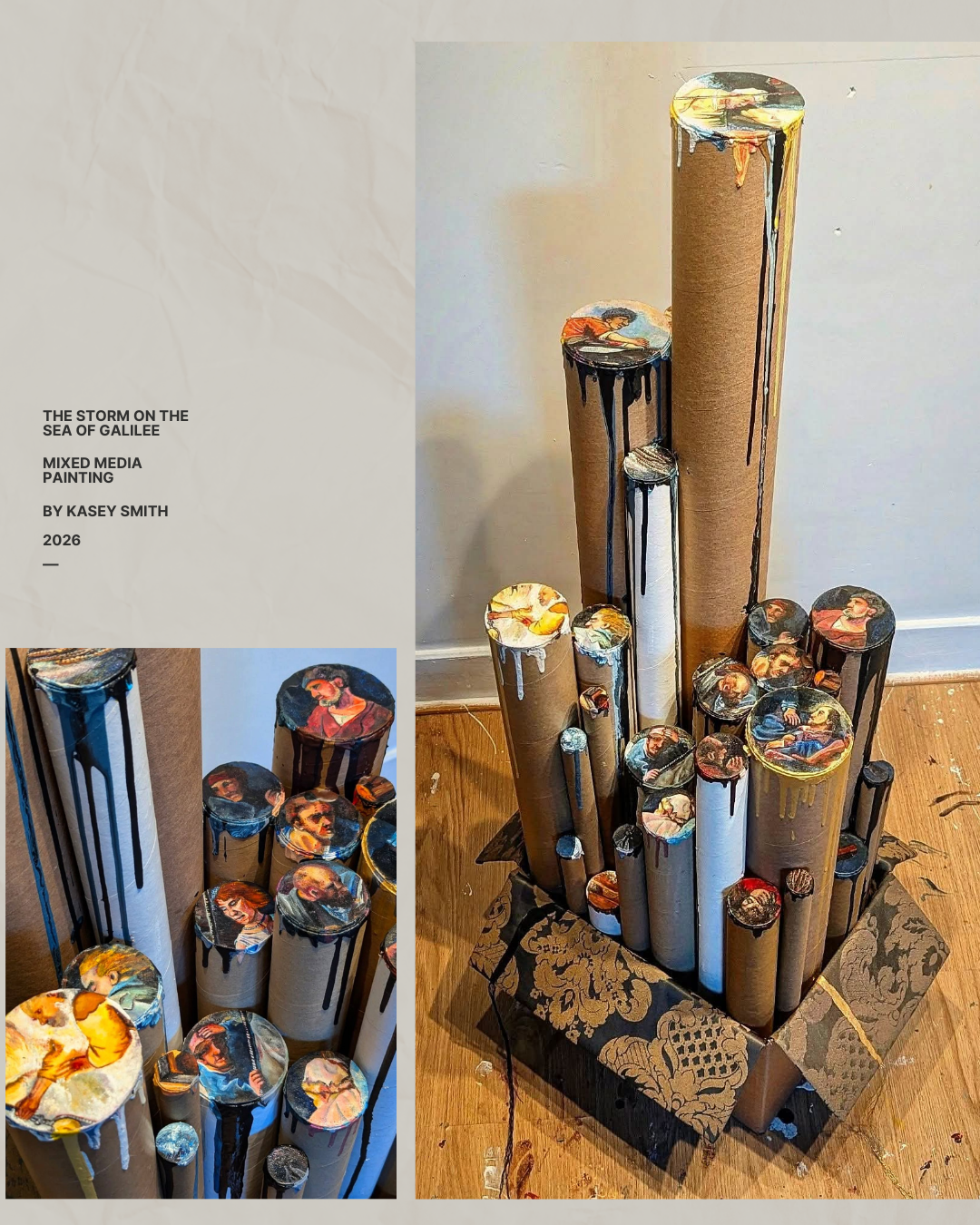
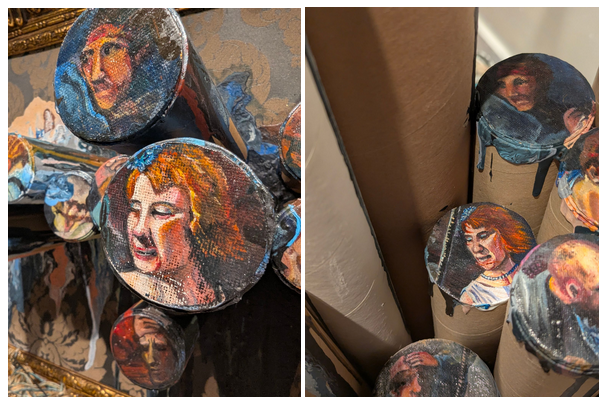
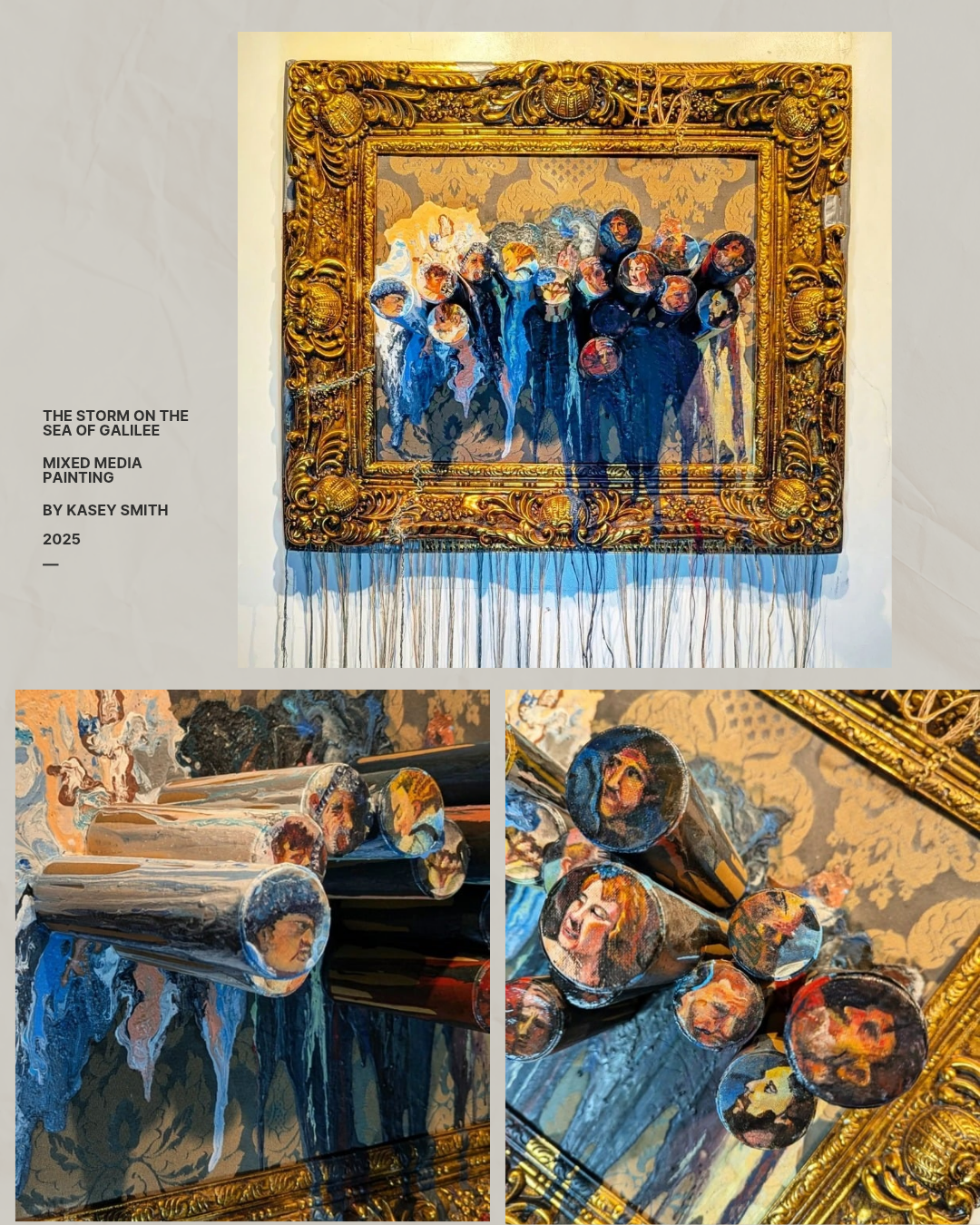
The poster tubes are thus a metaphor for the senseless destruction of The Storm On The Sea Of Galilee during the aftermath of the Isabella Stewart Gardner Museum heist. In these two pieces – a wall piece and a floor piece – the figures in The Storm On The Sea of Galilee have been broken up and painted across a collection of poster tubes. The paint drips off these paintings as if it’s dissolving – flowing down the tubes, across the damask, off the edges of the frame and box, and along the frayed strings hanging off them. The works present The Storm On The Sea Of Galilee as fragmented and disintegrating. The paint drips, the damask unravels, the frame cracks, the box creases. String and tape and nails struggle to keep things whole but are defeated. This is something whose integrity has been broken, something in the process of becoming undone.
Much like a four hundred year old oil painting that has spent thirty-six years in a poster tube.
When faced with the vicious stupidity and senseless loss of The Storm On The Sea Of Galilee, sometimes all we can do is just sit with our grief. This was the mindless, pointless destruction of something beautiful. One of the greatest paintings in Dutch art history rotting away in storage because someone cared enough to steal it, but not enough to protect it afterwards. The cultural loss is incalculable, in part because the act itself is so inconceivable. We want there to be a why, but neither the universe nor the FBI has been able to provide one. Seemingly stolen for nothing and destroyed for nothing, we are left with this final nothingness to contend with – the nothingness of an unknowable answer to the painting's fate.
@kaseysmithdesigns Why I used poster tubes to recreate Rembrandt's The Storm On The Sea Of Galilee. #artistsoftiktok #rembrandt #isabellastewartgardnermuseum ♬ original sound - Kasey Smith
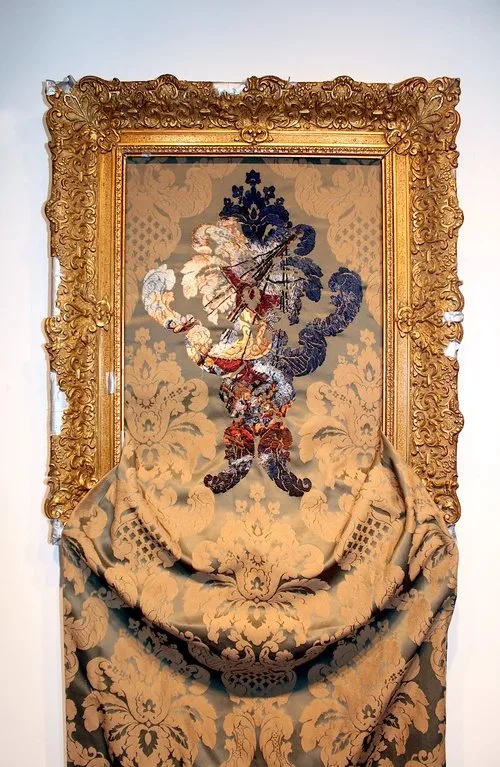
The Storm On The Sea Of Galilee -- Part I
Let me begin by saying — I never planned to make art about The Storm On The Sea of Galilee and the Isabella Stewart Gardner Museum heist. Once I finished all fourteen Pixelated Pearl Vermeers I was supposed to start a new series on Van Eyck and the history of paint making. But after recreating Vermeer’s painting The Concert, I fell in love with the drama and intrigue around its theft. Which of course led me to fall in love with the Rembrandt paintings taken that day. Or, more specifically, with the frame left behind by The Storm On The Sea of Galilee.
When art is stolen or destroyed, how can curation decisions mediate our relationship to that loss?
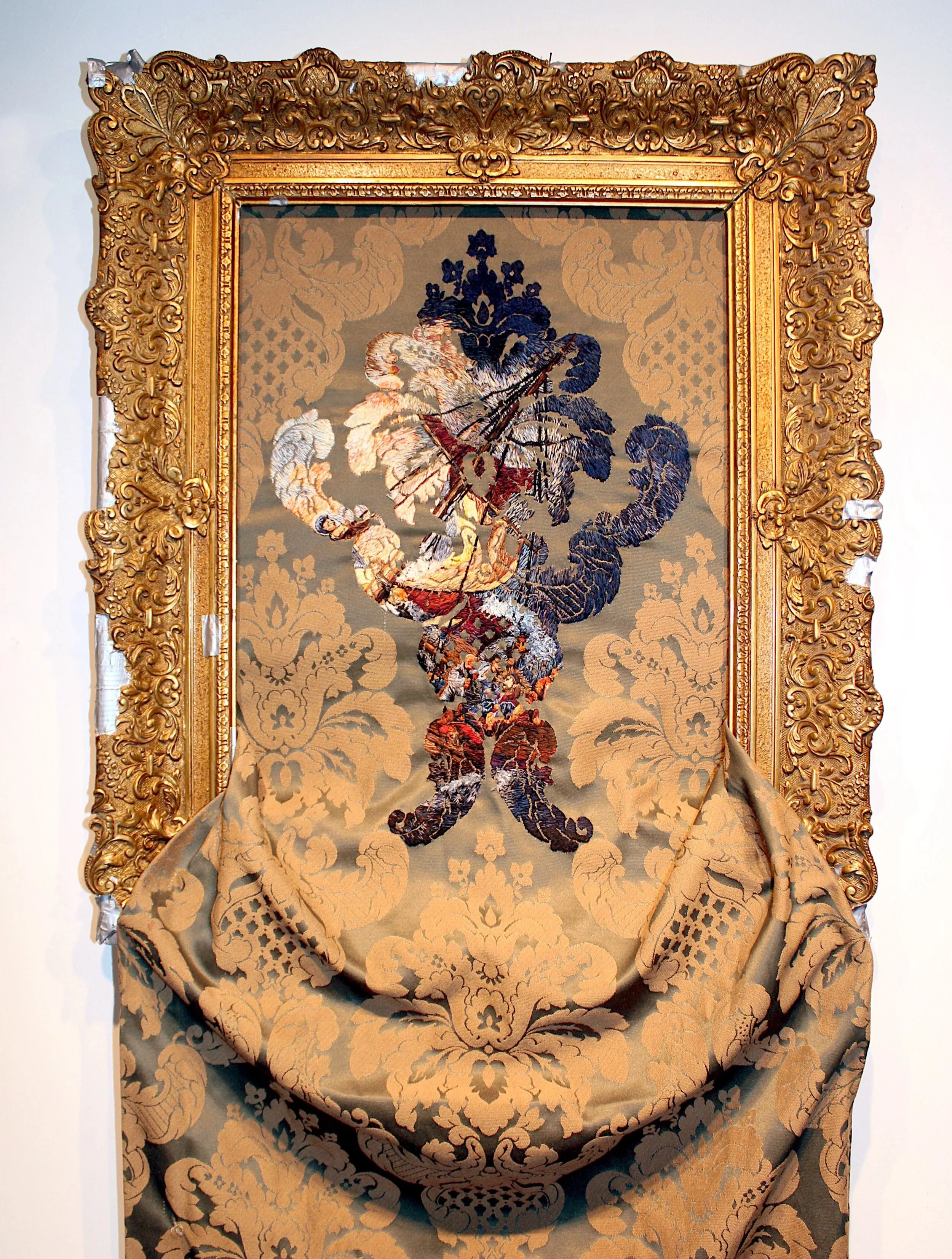
The Storm On The Sea of Galilee
Antique frame, vintage damask, thread, and duct tape
50cm x 150cm
2025
When Isabella Stewart Gardner established her museum in 1903, she did so with an enviable clarity of vision. She was so sure of her collection and approach to curation that her will required it be kept intact after her death — meaning nothing could be sold away, rotated out, added into, or rearranged within the original building. This portion of the museum now functions much like a momento mori, helping to enshrine her legacy as if it were funerary marble. Such monumentality is somewhat uncommon within art museums, with most striking a much different balance between growth and conservation. It’s almost as if the Isabella Stewart Gardner Museum has transitioned from being a living, breathing collection of objects to a singular, historic Object. The building, its decor, its collection, and its history now operating as a single, undifferentiated entity.
Which is not to say that it’s a bad or inferior museum. Simply that the terms of its creation imbue it with a historicity that exists outside the contemporary moment. But what happens when the contemporary moment intervenes? As it did during the infamous Isabella Stewart Gardner Museum heist in 1990?
But I'm getting ahead of myself...
Let me begin by saying — I never planned to make art about The Storm On The Sea of Galilee and the Isabella Stewart Gardner Museum heist. Once I finished all fourteen Pixelated Pearl Vermeers I was supposed to start a new series on Van Eyck and the history of paint making. But after recreating Vermeer’s painting The Concert, I fell in love with the drama and intrigue around its theft. Which of course led me to fall in love with the Rembrandt paintings taken that day. Or, more specifically, with the frame left behind by The Storm On The Sea of Galilee.
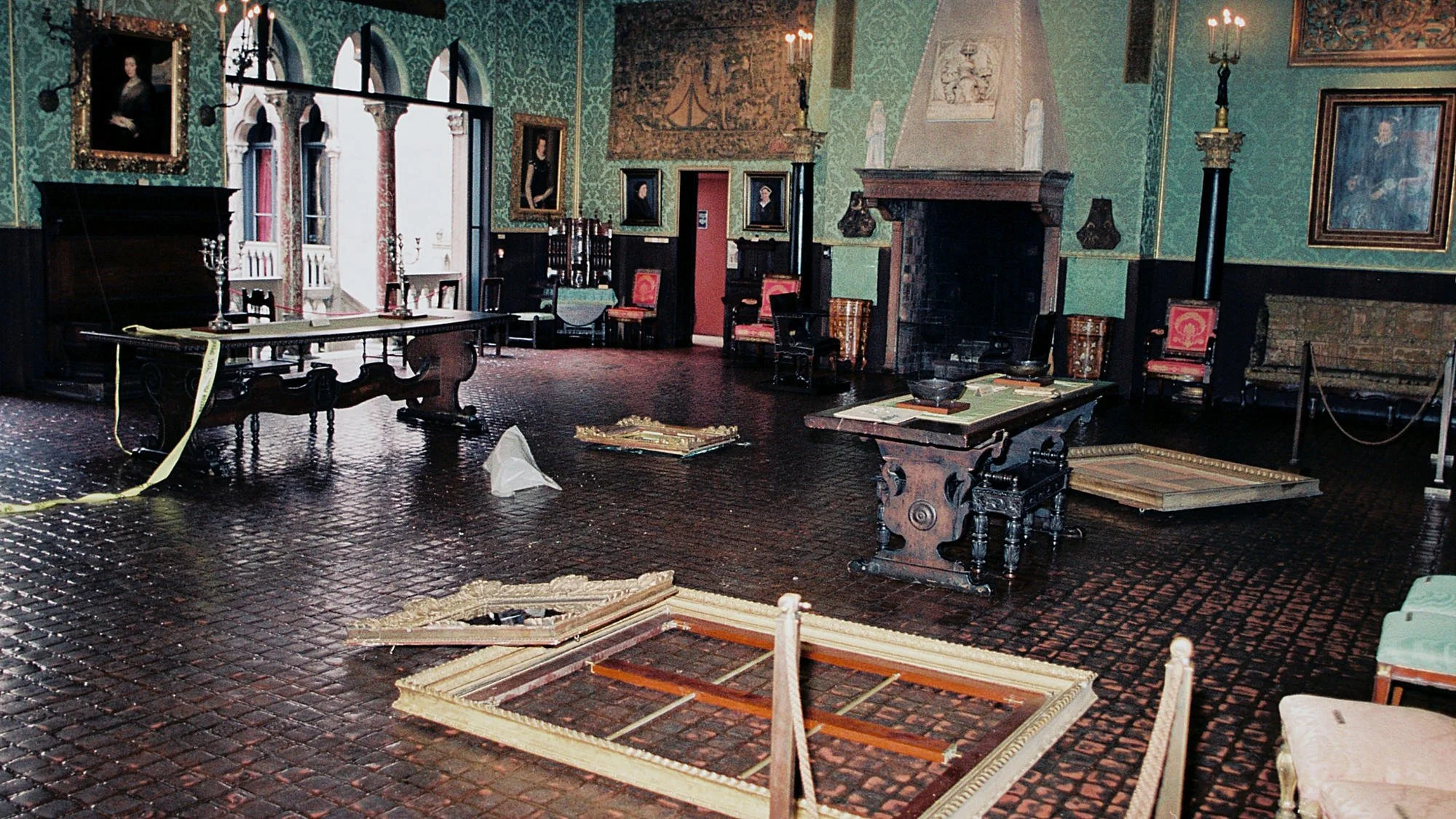
For while thirteen art pieces were stolen that day, the frames of the five largest paintings were not. Left scattered across the floor of the museum’s Dutch Room, they were removed to reduce bulk during the getaway. After the cops had left, statements been made, photographs been taken, and fingerprints dusted for, back up onto the walls the frames went, in order to fulfill the institution's promise to Isabella that nothing about her museum would change. Even though, with that theft, everything unfortunately did.
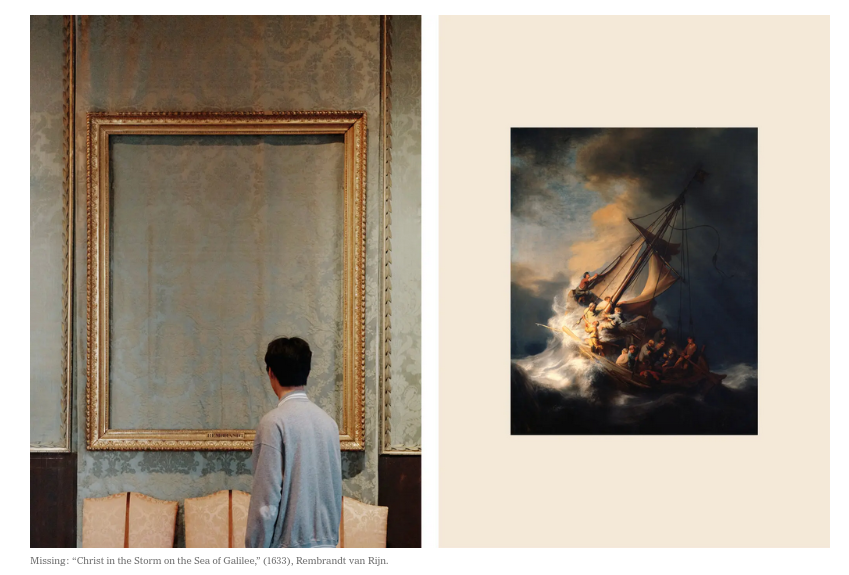
Frames delineate. They form a visual boundary that helps us differentiate between things that should be read as Art and things which should be read as Not Art. In the Dutch Room, instead of Rembrandts and Vermeers, these five empty frames now highlight the green damask curtains hanging behind them. Elevated to the visual foreground, the damask feels awkward on the receiving end of our attention. Framed in this way we notice very fold, every errant wrinkle, every fault or defect in the weave. Decor is ambiance not Art and curtains were never meant to be considered in such detail. But curated in this way, the damask represents lack — as in the lack of the painting that should fill this frame instead — yes cannot fade into lack itself, it’s pattern lending far too much visual volume for it to feign Nothingness.
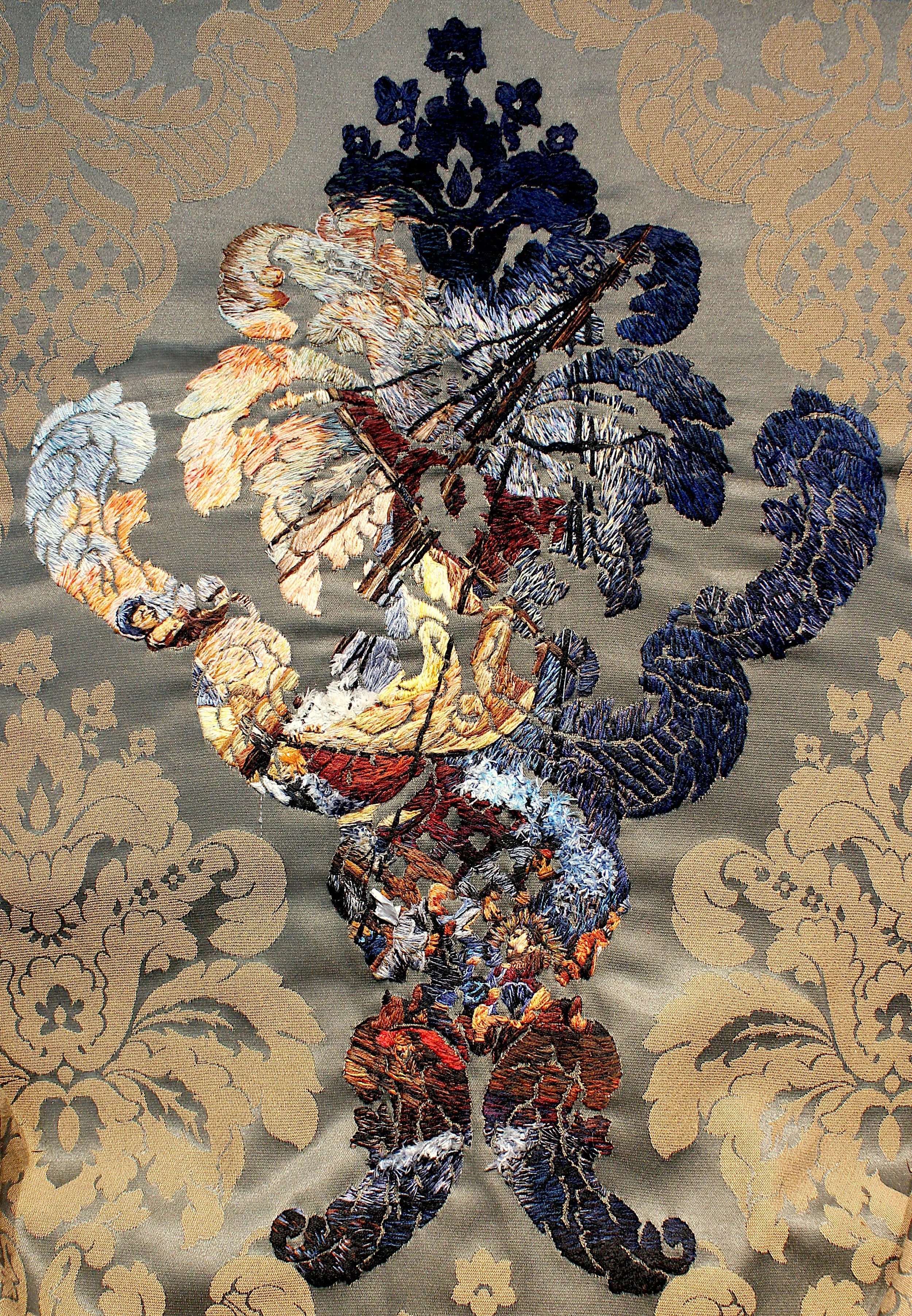
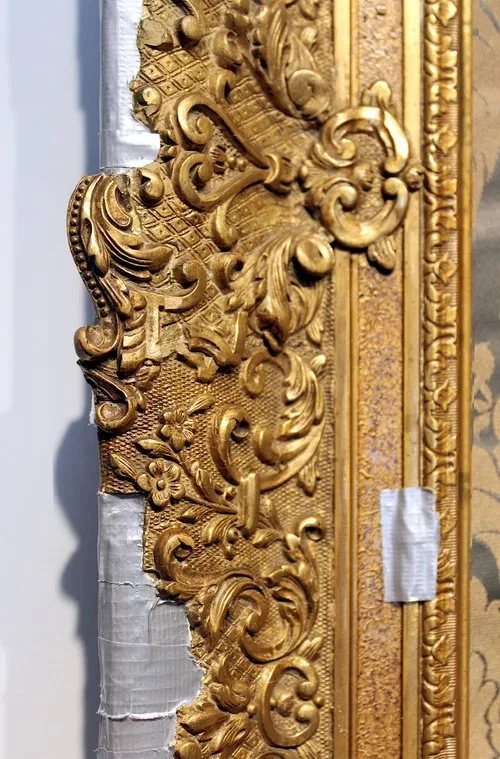
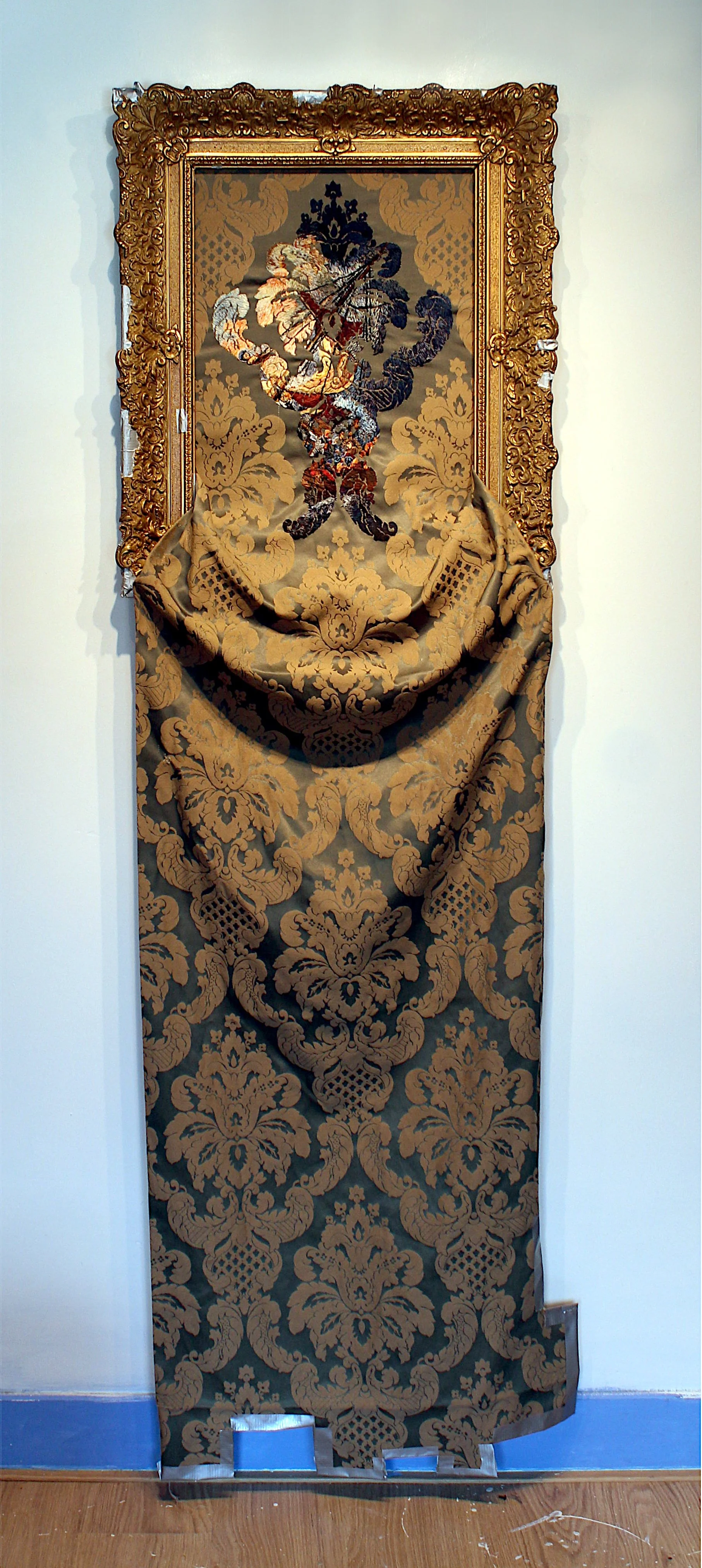
It fascinates me that this patch of green thread was never even meant to be seen. And certainly not on these terms! So in my piece of the same name, I have recreated The Storm On The Sea Of Galilee within the form of a similar green damask pattern; embroidering an image that merges the original painting with how its frame has been curated in absentia.
For without the painting to anchor the eye, the frame requires us to consider the damask as Art in its place. Which means each thread of the damask is seen and analyzed as if it were a brush stroke on canvas. Here, by translating Rembrandt’s actual brush strokes into thread, I am elevating the damask to fully actualized Art in its own right. As the frame highlights and contextualizes the damask, here the damask highlights and contextualizes the painting that once obscured it; defining it as both an object with meaning and something which can delineate meaning itself.
This is a powerful transmogrification of ambiance into Art that acknowledges the role of curation in how Art is understood. Does this replace the original? No, nothing short of a full return and restoration of the stolen works can achieve that. But as with much of my work, this piece forms a vessel of remembrance to deposit our feelings about the original painting and its theft into. Much as the empty frames on the walls of the Isabella Stewart Gardner Museum do.
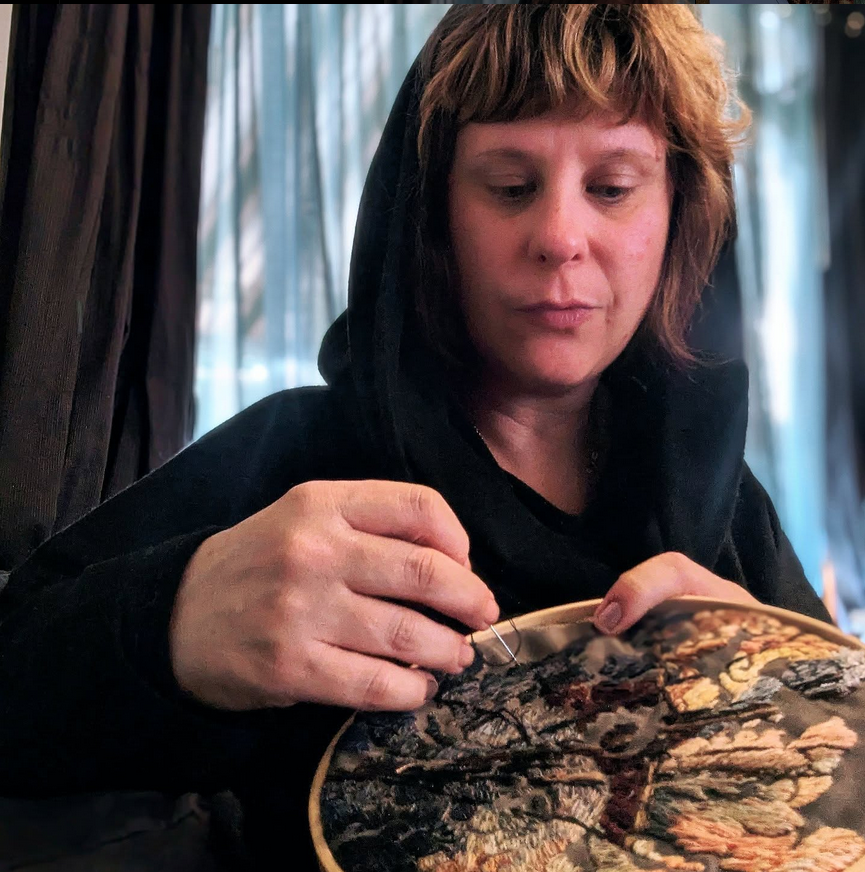
This is the first piece in a new textile art series about stolen Rembrandt paintings. Where the Pixelated Pearl Vermeers were about immigration and isolation, these works are about immigration and loss. The next two pieces, also about the Storm On The Sea of Galilee, explore the fate of the painting and the destructive nature of loss. I'll expand more on that in a follow up post.

Keep Your Art Close
There’s an easter egg hidden in my rendition of The Concert. A secret homage to an artist who shaped me as a teenager. To a small moment in a big museum with profound knock-on effects to my art.
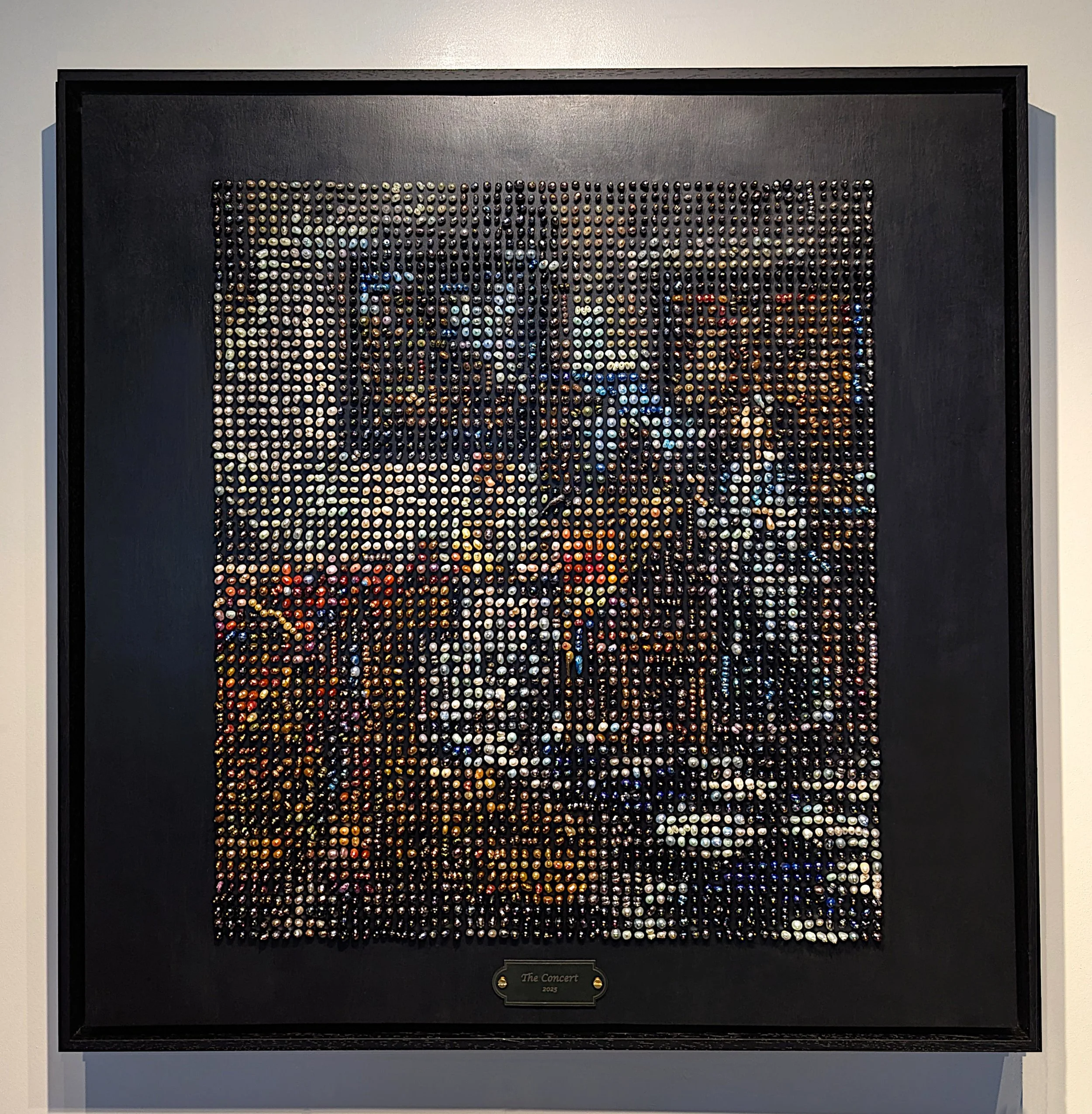
There’s an easter egg hidden in my rendition of The Concert. A secret homage to an artist who shaped me as a teenager. To a small moment in a big museum with profound knock-on effects to my art.
But first. A bit of a family backstory…
My great uncle was somewhat of a hoarder. He’d inherited the family home back in Illinois and nominated himself to be the keeper of family memories, family heirlooms, and family detritus. Everything was there – the photos and letters and birth announcements and knick knacks from 3+ generations of the family. But there was also a lot of junk that didn’t need to be cluttering up every corner of the home. Piles of cardboard boxes and catalogues and 50 year old coupons and So. Many. Stamps. (he’d worked for the post office).
When he and his wife needed to enter memory care, the women in the family took it upon themselves to sort, clean, and throw out this memory palace of debris. I went with them on their second trip, when the house had already been sold, and we were sorting through the last of its contents in a cavernous storage unit in the suburbs of Chicago. It was a grueling trip, and we had only one day for sightseeing, which we spent in the Art Institute of Chicago.

I have a lot of fond memories of that day at the museum, but the one that really stands out is standing in front of Chuck Close’s Big Self-Portrait, 1967–1968 with my mother and debating whether it was a painting or a photo. I think I was around 14 or 15 at the time. I’d been to the (old) De Young and the Legion of Honor, but SFMOMA had *just* reopened and we hadn’t gone yet. So this might have been my first experience of an art piece from the post-WWII era. Either way, I was fascinated.
To this day, I love Close’s hyperrealism portraits. The big, exacting canvases that exude that magical optical aesthetic which he staked his initial career/reputation on. But the ones that truly move me are the ones from the 90’s when he was recovering from his spinal artery collapse and relearning how to paint from his wheelchair. Specifically the ones where he was working with pixel grids, color theory, and layered organic shapes.

Are you seeing where I’m going with this… ;)
From Day One of this Vermeer series, I’ve been thinking about Chuck Close and his use of grids. Specifically the ones from this era. About the geometries and anti-geometries at work within them and the parallels with the freshwater pearls I use. But The Concert is the only one where I purposely tried playing with a “Closeian” approach to layering by pinning contrasting and complimentary pearls onto one another.
There’s A LOT going on in The Concert – the folds of the oriental rug, the viol on the floor, the paintings on the wall and on the harpsichord, the three figures, the pegboard of the lute – and I knew that capturing them was important to the “success” of the work. But how to achieve that within a medium-scaled piece? Especially within the formulaic limitations of pixel art AND the color limitations of the dyed freshwater pearl market?
By using layering and color theory I was able to highlight small areas of the piece that I wanted the eye to linger on, or draw sightlines that I wanted it to travel across. I was also able to give the impression of subtle patterning in areas that required depth, and shift the temperature and tone of color areas that needed a little extra umph.

Thus the layered pearl technique is densely clustered around the most colorful and most detailed areas of the painting. The highlights on the folds of the rug, the shoulder belt on the seated lutist, the pleats on the singer’s dress, the tree within the landscape painting, etc. Many of them are also placed on diagonals, working with Vermeer’s original composition to enforce how the eye moves around and into the painting. The effect is an economical approach to detail, working in a level of subtly that far exceeds the size of the pixel grid I was working within.
So I have to ask -- If I made a small version of Girl With A Pearl Earring using this layering technique would you buy one?
The Pearl and the Pixel
Despite being addicted to my smartphone, I am, at my core, an analogue creature. I have no allegiance to this digital dopamine dispenser. It’s just a means towards an end, towards a preferred neurotransmitter. Perhaps this lack of fealty to my various glowing screens is part of why I, personally, have never felt the pull of digital art. Oh, I get the appeal. I’m just too busy playing in the dirt for it to capture my attention for long.
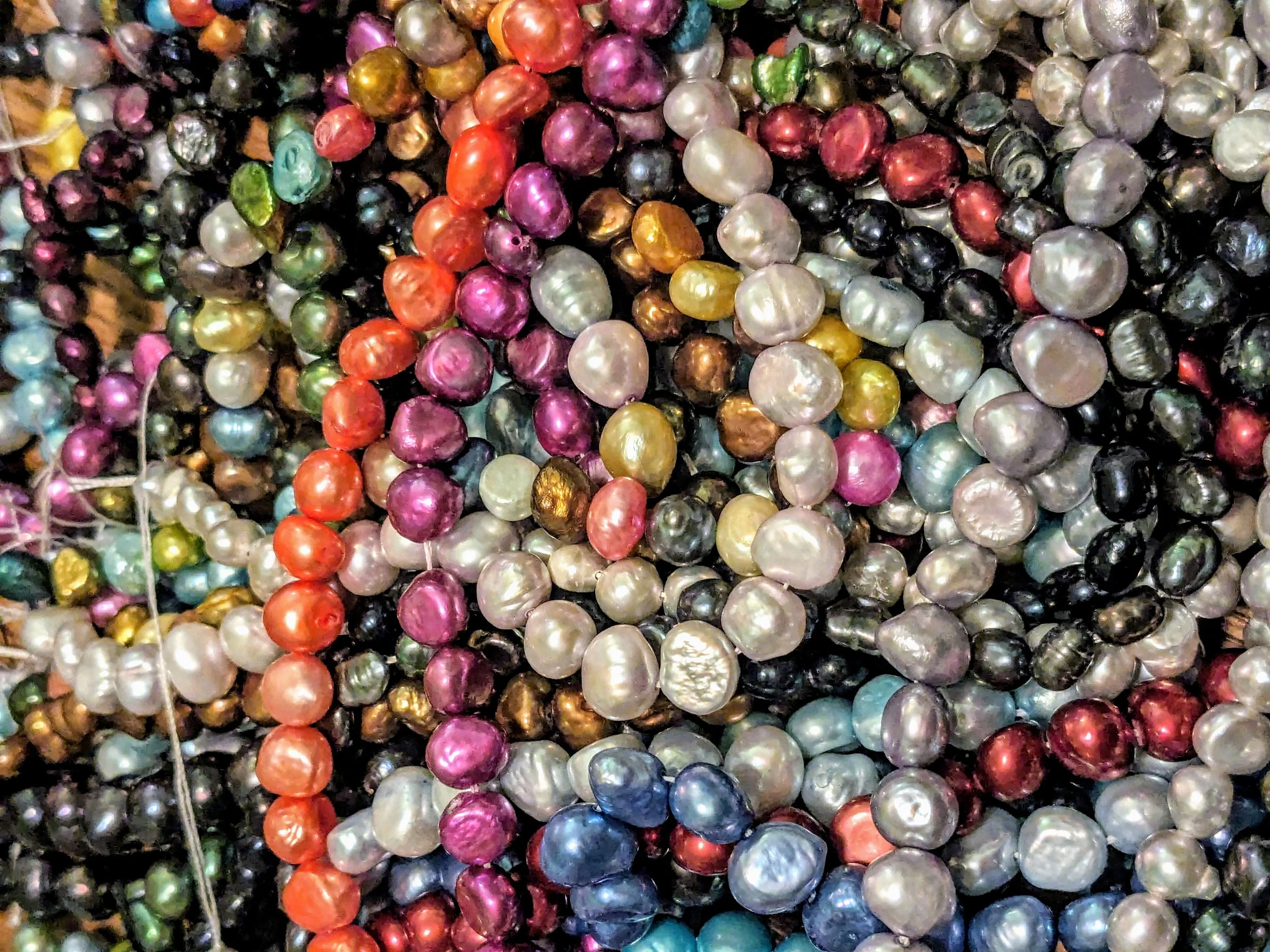
Despite being addicted to my smartphone, I am, at my core, an analogue creature. I have no allegiance to this digital dopamine dispenser. It’s just a means towards an end, towards a preferred neurotransmitter. Perhaps this lack of fealty to my various glowing screens is part of why I, personally, have never felt the pull of digital art. Oh, I get the appeal. I’m just too busy playing in the dirt for it to capture my attention for long.
But the deeper I go into the works of Vermeer, the more I have been thinking about technologies and toolings. And of course, in my contrarian and luddite way, their opposites. Why? Because Vermeer is one of the earliest artists associated with assistive drawing technologies.
Did he or didn’t he
Their whispers bouncing
softly, inappropriately
off the Do Not Touch sign
on the museum walls.
Did he or didn’t he
they inked with keyboards and quills
into journals unread, collecting dust
in the academic halls.
Ever since Vermeer’s work was rediscovered in the 19th century, the question of whether he did or did not use a camera obscura has been a point of much academic contention. A clever little device – where light passes through an aperture in a darkened box or room, projecting an image (upside down) onto the inside – the camera obscura is considered a forerunner of the camera and the optical aesthetic we associate with photography today.
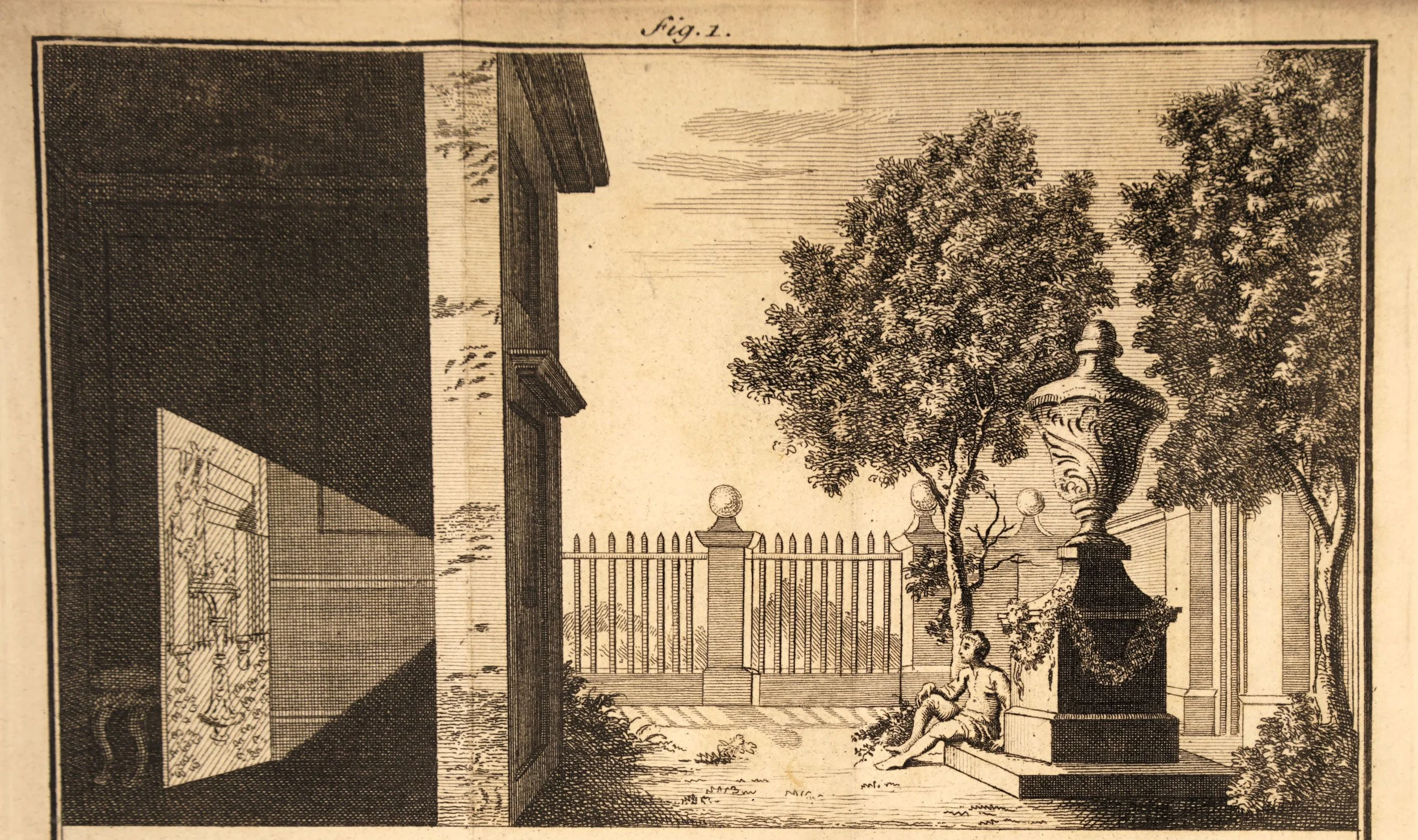
Some people see this optical aesthetic in Vermeer’s work – in the planes of focus, the pointillé highlights, the relative detail in how objects and figures are rendered, and the precise reflections and even more precise lines of his perspective. Painted over two hundred years before the invention of photography, it’s assumed this optical influence could only have come from the camera obscura.
But did he actually use one? And if so, did he use it for direct tracing or simply for aesthetic inspiration? They were certainly in circulation in the Netherlands in his time, albeit largely as a scientific curiosity. And while it’s been said that several of his contemporaries were introduced to it, there is scant proof that they were actually in use in the arts. Hell, Vermeer’s paintings are riddled with tiny pricks – evidence that he was using pins and strings to map his perspective. A crude method that would not have been necessary had he been using an optical device to outline his figures.
In the end, I do not really have an opinion on whether he did or did not use a camera obscura. I don’t find the question nearly as fascinating as what the techno-reverence behind it says about our larger relationship to art. This is the energy I have tried to bring to the Pixelated Pearl Vermeers.

These are purposefully pixel art pieces. Not pointillism pieces – but pixel art pieces with all the digital connotations that word implies. To make them I find photos of the originals on the web and feed them into GIMP, using the software to pixelate them. These pixel art renditions are then printed out and used as the guide for choosing, placing, and pinning the pearls.
1 pixel = 1 pearl.
A laborious, expensive, and aggressively physical method of reinterpreting the computer’s output. Like Vermeer and the camera obscura, yes, I could do this whole process by hand. The computer is not necessary in this equation, but I like the creative parallels to Vermeer’s mythos and the way it brings a symmetry to the long and twisted digital paths his pieces have walked.
For the camera obscura introduced 17th century artists to a new aesthetic. To a new visual language of light and lines and focus that they then translated onto canvas. A three-dimensional subject rendered flat by the lens and then reinterpreted a second, equally flat time by brush and paint. My process continues that chain of dimensional custody, but inverts it at the last step. Tripping through a cascade of 2D renditions, only to thrust the subject back into the 3D world at the very end.
Subject – Camera Obscura – Painting — Photograph – Digital Image – Pixelated Image – Printed Image – Subject
Pearls annihilate the digital object by returning its volume, its substance. Bookending all those bytes and brushstrokes in the firm embrace of the real. Unabashedly corporeal, they thumb their nose at the digital world by using it to undermine itself.
Also, they’re just really fucking pretty.
Mona Lisa of the North
The source of Vermeer’s artistic mastery lies in the interplay of The Girl’s features with one another and with us the viewer. In the way our eyes travel across her face, looping her features deep into our brain like a particularly catchy radio jingle. Her penetrating gaze, her sly smile, her lack of eyebrows, her puzzling backstory, her talented but un-prolific creator, her modern day over-commercialization…
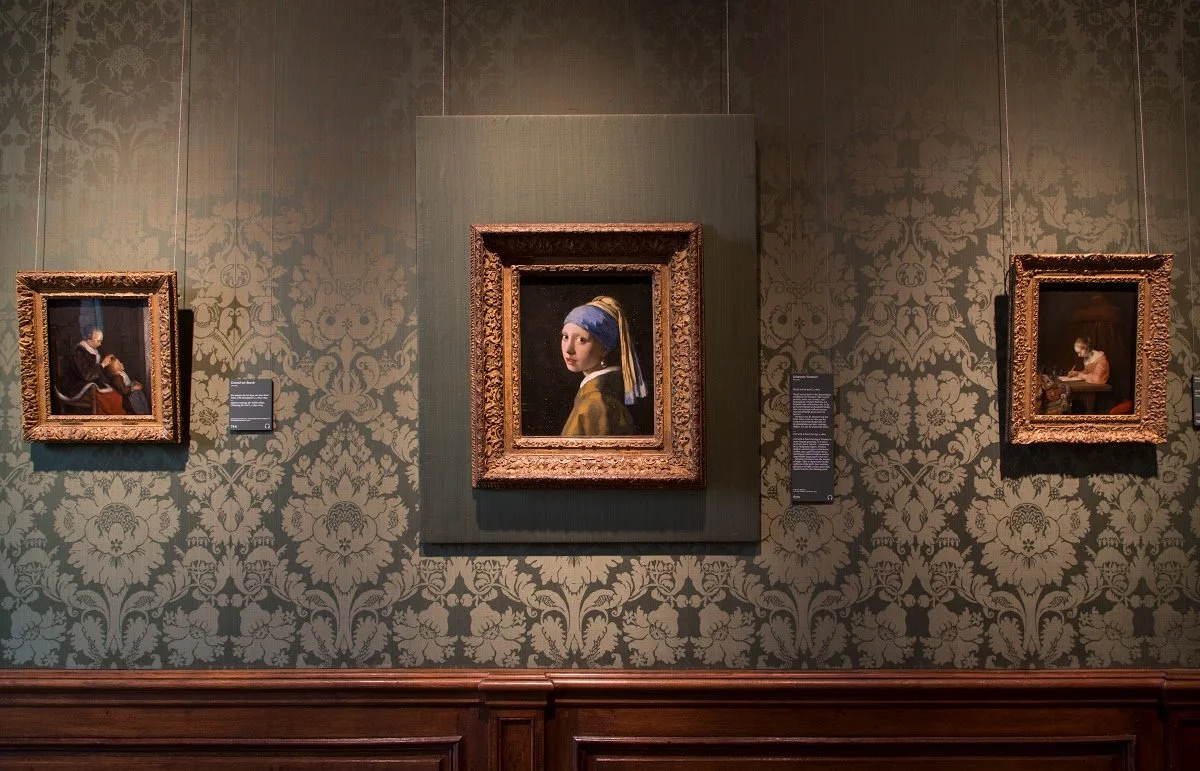
Girl with a Pearl Earring has many nicknames but none more telling than “the Mona Lisa of the North.” Part backhanded artistic compliment and part acknowledgement of the power of a mysterious smile, this nickname nonetheless positions Vermeer’s painting as one of the most important art pieces never louted for the Louvre.
Painted in Delft in 1665, Vermeer’s Girl with a Pearl Earring is a masterpiece of the Dutch Golden Age. While by no means my favorite Vermeer, she is definitely The Vermeer that his legacy hangs upon. A gorgeous portrait of a nameless girl wearing a turkish turban and an ostentatious pearl earring, it’s one of four surviving “tronies” painted by Vermeer.
Now tronies are a bit like obscenity - hard to define but you’ll know them when you see them. Neither portraits nor caricatures, they’re more akin to a character study. For tronies focus on physical qualities and expressions over the identity of specific, identifiable sitters. Coming after an era where most art was a political endeavour commissioned by churches and kings, this was quite the novel artistic development.
“The main goal of the artists who created tronies was to achieve a lifelike representation of the figures and to show off their illusionistic abilities through the free use of color, strong light contrasts, or a peculiar color scheme.Tronies embodied abstract notions such as transience, youth, and old age, but could also function as positive or negative examples of human qualities, such as wisdom, strength, piety, folly, or impulsiveness.” - Wikipedia
A distinctly “Low Country” tradition, by Rembrandt’s time in the early 1600’s a lucrative tronie market had developed and every Tom, Dick, and Jan was creating them. And while Rembrandt painted quite a few himself, his name is not pinned to the genre in quite the same way as Vermeer’s. Which is slightly ironic, for, as I mentioned, Vermeer painted only four of them.

But what a four they are! Hell, throw out the other three and Girl with a Pearl Earring is still a show-stopping, reputation-earning, tour de force amongst the genre. Painted in striking chiaroscuro with liberal use of ultra-expensive ultramarine pigments, Girl with a Pearl Earring absolutely captivates the viewer. I’ve heard you can watch people at the Mauritshuis lose their composure in front of her. Moved to cultural and aesthetic rapture as they make eye contact across the safety glass. Without the Louvre’s crowd control trappings (not to mention the crowds that have justified them), it’s still possible to sneak an intimate moment with her. Something untrue of the Mona Lisa for several decades now.
There’s a quote attributed to Girl With A Pearl Earring author Tracy Chevalier that I find apt when discussing the Mona Lisa comparisons.
“The image works because it is unresolved… You can’t ever answer the question of what she’s thinking or how she’s feeling. If it were resolved, then you’d move onto the next painting. But it isn’t, so you turn back to it again and again, trying to unlock that mystery. That’s what all masterpieces do: we long to understand them, but we never will.”
A mystery is continually in motion. In both the Mona Lisa and The Girl there’s a delicate triangulation between the eyes and the smile (and the earring) that moves our vision across the canvas. Back and forth, back and forth, our sight jumps between the features without resolution. Is the power of this art in her eyes? In her lips? In the slight dimpling of her checks? We fail to find a singular repository for the True Artistry Of The Work® because it resides in the gyrations of our eyesight, not in any surgically atomized facial feature.

The source of Vermeer’s artistic mastery lies in the interplay of The Girl’s features with one another and with us the viewer. In the way our eyes travel across her face, looping her features deep into our brain like a particularly catchy radio jingle. Her penetrating gaze, her sly smile, her lack of eyebrows, her puzzling backstory, her talented but un-prolific creator, her modern day over-commercialization…
Fine. The comparisons to the Mona Lisa might run more than skin deep. Or should I say, the comparisons to The Girl with a Pearl Earring of the South run more than skin deep. :P
Some photos from The Holy Art Amsterdam Show
I was honored to have my piece Pixelated Pearl Vermeer — Lady Seated At A Virginal featured in last week’s The Holy Art Amsterdam show. Openings always make me nervous and while I forgot my business cards, I did not forget to take pictures!



The Pearl Pictures -- An Extended Cinematic Universe
One of the 20th century’s leading Vermeer experts was the English artist and writer Lawrence Gowing. Knowledgeable on both Vermeer’s historical and artistic context, one of Gowing’s most noteworthy contributions to The Discourse was defining the concept of the “pearl pictures” within Vermeer’s work.
“This is the particular theme of the pearl pictures, a gentle stillness of stature. The shape is vertical. The figure appears, tender and immaculate, out of the cleft shadow of the cumbrous furniture; it is rooted in it, rooted, as we see at last, utterly unmoving, to the floor. And besides this upright shape, this pillar, we come to know another, its antithesis that nevertheless easily and equally combines with it. It is the shape of a bell... More essentially we remember it as the shape of rounded shoulders which is often the stooping shape of preoccupation, of a woman bent attentively over a table. It has a feminine quality of self-possession..." - Lawrence Gowing Vermeer, Oakland CA: University of California Press
One of the 20th century’s leading Vermeer experts was the English artist and writer Lawrence Gowing. Knowledgeable on both Vermeer’s historical and artistic context, one of Gowing’s most noteworthy contributions to The Discourse was defining the concept of the “pearl pictures” within Vermeer’s work.
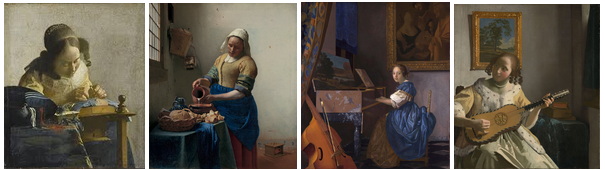
Named for their luminous approach to light, the “pearl pictures” are a group of Vermeer’s mid-career paintings noted for their similar subject matter and composition. They each feature a single woman at a table, facing a window in the left-hand corner of a room, engaging in a discreet activity, while either wearing or handling pearls.
Goring would initially identify four quintessential pearl pictures - Woman Reading a Letter, Woman with a Pearl Necklace, Woman Holding a Balance, and Woman with a Lute. Other scholars often group Woman Reading a Letter at an Open Window and Woman with a Water Pitcher into the pearl pictures, although their inclusion is not universally agreed upon.


Now, when I say that I’m a Vermeer fangirl, what I really mean is that I’m a pearl picture fangirl. Like Gowing, I am captivated by this series and its extended cinematic universe. All those bell-shaped women, like bowed tulips, gracing the canvas with their quiet introspection and soft self composure. Through repetition, you can watch as Vermeer hones his craft across the series. Whittling his visual language down to a precise, pointed simplicity.
“Even by Vermeer's standards, the scenes of these works are organized with exceptional economy utilizing a table with a single woman, a meager still life, a few carefully chosen props, a map or painting on the background wall and one or two chairs”
This is the apex of Vermeer’s art. The pearl pictures feel like individual celluloid frames clipped from a film reel. They are the pregnant pause preceding the action. A woman lost in her internal world, depicted in the half-second before the viewer’s entrance upon the scene. In them one can anticipate the interruption, the broken concentration to come. How the angles of her body and face, startled out of their self reflection, will snap back like a rubber band. Shifting their orientation under the requirements of a woman being perceived.
The way Vermeer captures this moment before the re/action feels intimate, familiar and also ripe for a feminist reading. And so the pearl pieces have become the centerpiece of my Vermeer studies.
In the art studio, bent over my work table by the window, I toil alone with my pearls and my pictures. A paper bell, a silk tulip, I pantomime the actions of Vermeer’s solitary female figures, perfecting them through my own repetitions. I feel a deep kinship with them. Yes, much of it is rooted in our shared gender. But there is an important divergence – I identify with the subjects of the pearl pictures because being an immigrant is a terribly lonely business and I see myself in their solitude and self containment.
In a way, my Vermeer studies are a pregnant pause of sorts. They represent the moment between being an American artist and an American-Dutch artist. The lonely, solipsistic work of figuring out who I am and what I want to create in this new place. I am the half-second before the re/action. Waiting for what comes next in this journey of making art in the Netherlands.

Tot ziens!
🎨🎨🎨
Of Sphinxes and Pearls - An Exploration of the Works of Johannes Vermeer
Johannes Vermeer, that famous painter of Dutch interiors and Dutch interior life, is one of the most elusive sphinxes of the art world. So much so that he is often known as “the Sphinx of Delft” due to the mysteries shrouding his life and practice. There are no notebooks, no journals, no sketches, no resumes or work histories, no early or in-progress works, and few contemporaneous accounts. His story is but conjectures wrapped in myths wrapped in legends, as all that’s survived are 36 paintings and the scantest of biographical details.
“A legend grows around a grain of truth, like a pearl.”– Peter S. Beagle
A painter without an origin story is but a sphinx without a riddle. In the realm of myth, the sphinx’s riddle is the source of her power, the vehicle she uses to send tongue tied travelers to their deaths. If she loses or lacks a riddle, her ferocity is reduced to the level of a declawed housecat mewling for more milk. Therefore, to call someone a riddle-less sphinx is to point at their hollowness without fear. To call out their toothlessness with a full throated and pearly white grin.
“You cannot kill me in any way that matters.”
“You cannot make art in any way that matters.”
Johannes Vermeer, that famous painter of Dutch interiors and Dutch interior life, is one of the most elusive sphinxes of the art world. So much so that he is often known as “the Sphinx of Delft” due to the mysteries shrouding his life and practice. There are no notebooks, no journals, no sketches, no resumes or work histories, no early or in-progress works, and few contemporaneous accounts. His story is but conjectures wrapped in myths wrapped in legends, as all that’s survived are 36 paintings and the scantest of biographical details.
The sphinx sits and paints
Tall as the crooked church leans
Against delft blue skies
Which makes it difficult to infer concrete biographical meaning in his work. Who and why and how Vermeer painted; all this information has been lost to the sands of time. In fact, for two centuries his work also languished in obscurity– attributed to other, more famous artists – only to be plucked from anonymity by Théophile Thoré-Bürger’s scholarly excavations. So without a biographical lens onto Vermeer’s work, how can we answer their riddles and come to understand his origin stories? Through his historical context.
The cut and cloth of a dress, the architecture and decor of a room; we can still interpret Vermeer and his work through the trappings of his era – specifically that of the merchant class during the Dutch Golden Age. And for me, one historical/cultural detail especially catches my eye– the presence of pearls in Vermeer’s work. Of his 36 paintings,18 feature pearls. They adorn ears and necklines and updos. They pour out of boxes and lay scattered on tables. Preposterously large and threaded in great quantity, they speak to an opulence emblematic of Vermeer’s specific era.

Rare and exotic, pearls were brought from Asia via the same trading routes and colonial holdings as the infamous Dutch spice trade. This evolution in capitalism and economics – aided by Dutch independence in 1648 – helped propel the merchant class to prominence in Dutch society. The very same class that Vermeer (nominally) and his collectors belonged to. And capitalism, ever abhorring a vacuum, would require new and expensive class markers to match this new era. Hence pearls became somewhat synonymous with this moment in Dutch empire, going “viral” among an upper class hungry for luxury goods.
Vermeer, by using pearls so consistently in his work, is positioning his figures in this same time period and economic space. For adorning his figures in gold and gemstones would have been too aristocratic and old fashioned. Just a few years out from the 80 Years War, this would have stuck out like a Hapsburg chin in the new Dutch society. And on the flipside, leaving his figures unadorned would have rendered them indistinguishable from the maids who served them. Too earthy and humble to enjoy the class-based leisure that his figures often exude.

So Vermeer's pearls function quite effectively as symbols of a certain class of wealth during the Dutch Golden Age. Was this about capitalizing on the class vanitas of his audience to sell work? About making social commentary in a rapidly changing country? About telling his or his family's biographical stories? The sphinx's lips remain sealed.
Why I Can't Get Vermeer Out Of My Mind...
There is no painter more Dutch than Vermeer. The other greats? Most casual viewers think Rembrandt was Italian (I did for embarrassingly long). And Van Gogh is far too French-adjacent (despite all those early peasant paintings). And beyond that? There’s Mondrian and Bosch and a sea of long-dead Jan and Frans and Hans named painters. But the national imagination and artistic reputation rests in outsized part upon Vermeer and his slim thirty-six surviving works.
A painter of middle class domestic spaces and the women who inhabited them, he is of course most famous for his “tronie” style portrait Girl with a Pearl Earring. Her face stares out at you from a hundred Amsterdam souvenir shops. Right next to the windmill magnets and the clog keychains. Like the scent of weed, she drifts throughout the cityscape. Inescapable. Elusive.
One of the most famous faces in art, there’s a reason she’s referred to as the “Mona Lisa of the North.” But more on that particular story another day…

But The Girl is a bit of an anomaly in Vermeer’s oeuvre, despite her immense contribution to it. Vermeer infamously played with the gaze but was rarely so direct with it. While some of his figures do look at the viewer – interrupted in mid-act, mid-sentence, mid-thought, mid-flirtation – the direct, perceiving gaze of The Girl is a bit of a rarity in Vermeer’s work. More frequently, he positions us, the viewer, in the role of voyeur; watching women in their personal moments of self reflection and interaction. We see them drinking, conversing, reading, writing, playing music, but generally we are not included in these acts. As silent and passive witnesses to their quietude, our presence is bought with the art patron’s coin. A currency outside the usual economies of the private family space.

This familiar and familial painting style – colloquially known as genre painting – represented a huge departure from the suffering Christs, self-aggrandizing patron portraits, and quaint landscapes of other European masters. A staple of the Dutch Golden Era, genre paintings were created all over the Low Countries, but few examples are as captivating as the intimate simplicity of Vermeer’s women.
The art historian Lawrence Gowing would even go so far as to christen a subset of Vermeer’s genre paintings “the pearl pictures” for their similar compositions and enigmatic, individual beauty. He would hold these paintings - each depicting a single woman at a large table facing towards a left-hand window while engaging in some discreet activity – as the pinnacle of the artform.
“The lady of the pearl pictures inherits a rich accumulation of meaning. Sometimes it seems that half the imagery of the genre tradition hangs about her, invisible.” - Lawrence Gowring, Vermeer, Oakland CA: University of California Press, 1997
Within this strict compositional guideline we see a visual language distilled to its purest qualities, to the interplay of light and color and melancholy detachment. “Yet she is usually alone, waited on only by the light. Daylight, the window itself, is indeed a presence in the room.”

As an immigrant to the Netherlands, studying Vermeer is part of how I’m artistically acclimating to my new country. Learning the stories and brushstrokes that make up Dutch art history. But my love for Vermeer runs deeper than mere historical relevance. I am also drawn to the solitude and sense of quiet containment in his subject matter – and how this reflects my own experience of being female and restarting life in a new country.
There are days where I’ll be working in my studio or tending to my house and I’ll catch a glimpse of a familiar posture or gesture or expression – familiar because I’ve seen them depicted in the dozen Dutch art history books cluttering my coffee table. The resemblance is uncanny because the emotional component is uncanny. I love the Netherlands, but the nest I’ve carved out for myself here is lined with a deep solitariness. Which is different from solitude, mind you. There is none of the emptiness, the unhappiness. Just quiet. The quiet of an art studio and a garden. Of tea kettles and chicken coops and sun-drenched naps. Of owning too many cats and not having enough local friends.
Vermeer’s is an art of everyday intimacies, single film cells clipped from the reel of time, left scattered across the floor, as relatable now as they were in the 1650’s. I'm excited to share my artistic and intellectual journey through his work. To share what that work has meant to me on my immigration journey.